January 2018 Archives

This section describes screw parts feeding errors, the second commonest cause for troubles in automating screw fastening.

(1)Screw parts feeding errors and causes for the troubles

・Approximately 50% of troubles in automating screw fastening is accounted for by screw fastening failures from the previous discussion and screw parts feeding errors in the current section.
・Factors such as various screw shapes (screw diameter, length, special type of screw, with or without washer, etc.) being used, or the processing cycle being rather short are also causes for errors.
・A variety of screw parts are listed below.
・Besides the variety of screws, burrs formed in the outer region due to a difference in the processing method, and variations in screw quality per production lot are sometimes convincing causes for the trouble.

[Fig. 1] Variety of screw parts

・Fig. 2 shows a typical distribution data representing factors for screw parts feeding errors.Factors causing the problems, based on the data in the figure, can roughly be classified into three categories: (1) feeding mechanism (parts feeder, feeding pipe/chute), (2) screw clamp mechanism, (3) screw parts quality

[Fig. 2] Data for distribution of factors for screw parts feeding errors

(2)Screw parts and difficulty in feeding

・From such a wide variety of screw parts (Fig. 1), you could easily imagine it is hard to keep stable feeding of screw parts.
・Differences in screw appearance fluctuate "center of gravity" or "friction characteristics" which greatly affect the feeding orientation. Lower cost screws may sometimes have problems like burrs, magnetization, etc.
・Screws with washers may become foreign substances due to "entanglement" or disengagement of the washer, which makes countermeasures more complex.
・In the case of Fig. 3-a), the screw orientation during transport and the screw fastening direction after the transport are matched, which requires no inversion of screw orientation. But, this increases a risk that "jamming" may occur in the bending section of the feeding pipe, since the center of gravity is backward against the transport direction.
・In the case of Fig. 3-b), the orientation needs to be reversed before the screw fastening process, although the stability of orientation is good during the transport.

[Fig. 3] Example of screw orientation and difficulty in feeding

・Since entry of foreign substances is involved both in the first and the third commonest causes for feeding errors shown in Fig. 2, the countermeasures for avoiding such entry is extremely effective. Following are some examples:
a) Inspection for entry of foreign substances at receiving inspection (automatic selection, etc.)
b) Double selection design during automation process

(3)Importance in design of feeding system

・Automation of screw fastening requires both high productivity and reliability at the same time.
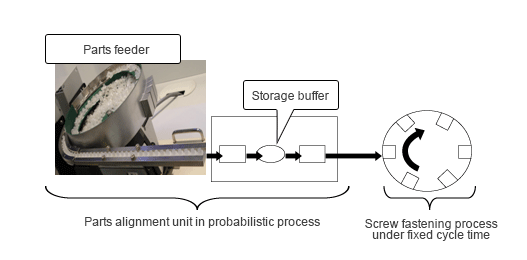
・An automation process consists of a screw alignment feeding unit, and a screw fastening unit. In the former unit, alignment of parts is based on a probabilistic process since it involves the parts feeder.The screw fastening unit, on the other hand, involves a process at a fixed cycle.
・It is desirable to have a storage buffer for storing screws for alignment in order to connect these two units with different process cycles.
image

From the previous discussion of trouble analysis regarding the automation of screw fastening, we learned the following countermeasures are required on the screw fastening automation equipment side:
(1) fastening failures
(2) screw parts feeding errors
(3) screw positioning errors, etc.
This section describes fastening failures.

(1)Evaluation of screw fastening quality

・Evaluation methods for screw fastening are summarized for reference in considering countermeasures for fastening failures in automating screw fastening (Fig. 1).

・Quality of screw parts, mostly evaluated in the context of elaborate fabrication, indirectly affects the quality of fastening section.

[Fig. 1] Quality of screw fastening and evaluation

(2)Trouble countermeasure for screw fastening failures

・Fig. 2 shows causes for screw fastening failures in the order of the rate of occurrence (%). This graph suggests that factors for failures (indicated by arrows) need some countermeasures on the screw fastening automation equipment side, excluding machining of pilot hole, or quality of screw appearance.

・The top factor on the equipment side, bit sliding, is a serious defect which is caused by combined simple factors such as when the screw position relative to the screw hole is shifted, or the shape of cross recess of the screw head and the bit shape are inappropriate.

・Therefore, empirical pursuit for the optimal shape in the first place, and durability such as countermeasure for friction reduction are essential for bits.

・Also the handling section of screw needs to have a clamp mechanism ensuring reliable holding property.

[Fig. 2] Causes for troubles while automating screw fastening

#323 Know-how on automation: Automating screw fastening

| No Comments | No TrackBacks

While technique for fastening two parts using screws requires control over rotary motion of screws for fastening and fastening torque for fastening reliability, this technique has become an important automation technology in terms of environmental concerns and so on.

(1)Components of automating screw fastening

・ Automating screw fastening consists of two components: hardware which includes fastening devices and parts feed mechanisms, and software which controls and manages fastening conditions such as fastening torques etc. (Fig. 1).

[Fig. 1] Components of automating screw fastening

(2)Analysis of troubles while automating screw fastening

・ Fig. 2 shows typical troubles encountered while automating screw fastening.

[Fig. 2] Causes for troubles while automating screw fastening

・ Factors for these troubles suggest necessity for solving issues in automation equipment such as (1) fastening failures, (2) screw parts feeding errors, (3) positioning failures, etc.

(1)Detailed description of factors for bias error

This section tries to deepen understanding on factors and solutions for "bias errors" taking the actual measurement equipment as an example.

・Here, fluctuating factors for "bias errors" due to temperature drift are roughly divided into two groups: a) stabilizing temperature of measurement equipment, and b) thermal deformation in the mechanical components for automation devices.
a)Temperature drift in measurement equipment
b)Thermal deformation of automation devices

・This section describes a) Temperature drift in measurement equipment.

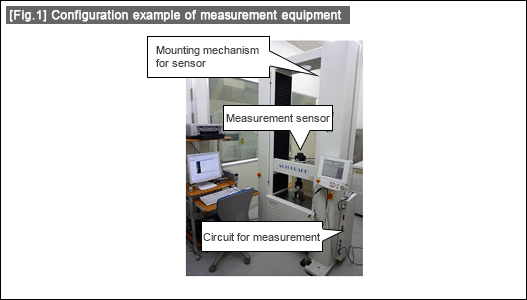
・Measurement equipment for positioning consists of three main components: "measurement sensor", "circuit for measurement", and "mounting mechanism for measurement sensor". Accuracy variation on measurement time varies by component. Universal test machine in Fig.1 consists of "measurement sensor" (load sensor), "circuit for measurement" (measuring unit for load sensor), and "mounting mechanism for measurement sensor" (gate type mechanism).

Configuration example of measurement equipment

・Although a "measurement sensor" itself is designed to be insensitive (cover protection, material selection, etc.) to fluctuations in the environment, the sensors using composite structural members, such as laser beam, piezoelectric element, etc. are likely to be affected by temperature drifts.

・In the "circuit for measurement", temperature drifts in many electronic components on the circuit board cannot be avoided because the temperature in the circuit boards, etc. inside rises to a certain degree after the power on. Handling, thus, is necessary in such a way that measurement should start after the temperature rises to certain degree. The period until the temperature reaches the required level is called "warm-up time". "Warm-up time" required for measurement equipment is generally about 10 minutes.

・"Mounting mechanism for measurement sensor" is affected by temperature changes in the mechanical components. In the testing facility where accurate measurement is required, even the universal test machine in Fig.1 is also placed under the constant room temperature.

・Fig.2 shows the relationship between temperature drift in "circuit for measurement" and the "warm-up time" as the countermeasure. The straight line in figure 2 represents the ideal measurement data. The data that has the property of curved line at the start shows the case where temperature drifts. Effects of temperature drift can be avoided by starting the measurement at the point when the "warm-up time" of this curved line is past.

[Fig. 2] Illustration of temperature drift and warm-up time as the countermeasure

月別 Archives

Pages

Powered by Movable Type 6.0.3

About this Archive

This page is an archive of entries from January 2018 listed from newest to oldest.

December 2017 is the previous archive.

February 2018 is the next archive.

Find recent content on the main index or look in the archives to find all content.