January 2012 Archives

The automation machinery designers will design assembly datum features into parts where accuracies are needed for assembly. For this, abilities to design the assembly datum features that are: (1) easy to machine, (2) easy to assemble, (3) low in manufacturing costs will be needed.

Explanations on assembly datum features that are easy to machine

a) Obtaining datum accuracies
  • Choose accurate machine tools in order to accurately machine the parts with assembly datum features.

Utilize the inherent positioning accuracy characteristics of accurate machine tools to obtain high accuracies of the parts with assembly datum features.

-Explanation
Machine tools use precision guides for accurate motion and precision measurement instruments for accurate positional detection to move the cutting tools in desired manner to obtain the targeted shapes accurately. For this reason, the machines that produce highly precise parts are called "Mother machines"

-Examples
Hole position accuracy: ±0.5mm > Drill press
Hole position accuracy: ±0.01mm > CNC Milling machine
Hole position accuracy: ±0.005mm > Jig boring machine
Datum plane accuracy: ±0.01mm > CNC Milling machine
Datum plane accuracy: ±0.005mm > Precision flat grinder

b) Easy machine assembly datum designs
  • Utilize the inherent accuracy of the machine tools for parts accuracy.
  • Use the external profile (or datum reference holes) features as the datum surfaces, and measure from these surfaces to machine the assembly datum features. (2 red lines show in Fig. are the datum lines)
  • Therefore, an easy to machine design is where all the datum locations can be machined at once while the part is mounted on a machining fixture.
  • If a fixtured part must be unfixtured and reset (ex. reversing), resetting error will result.

Highly accurate and cost effective part designs are where the parts' all datum features can be machined at once with one time fixturing.
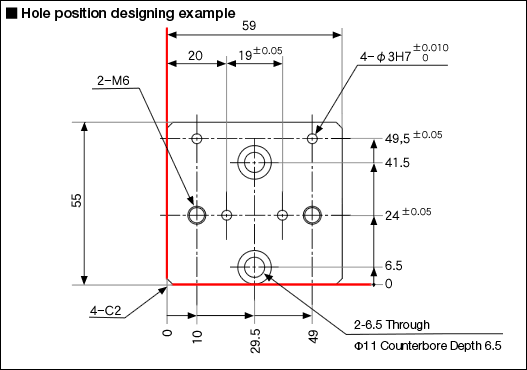

Hole position designing example

Holes are machined by the following three methods.

a) A drill with spiral cutting blades and a tip with a sharp center., b) A drill tool with carbide chips mounted at the tip., c) Electro-discharge machining.

For the best cost economy it offers, a) is the most general hole machining method.

Some notes on the points are introduced below to consider for the shape designs when drill machining.

Examples to be noted when drill machining.
  • For drilling, the metal is cut by a rotating bit with push forces and rotational speeds.
  • When drilling, the tip of the drill (Name: chisel edge) is rotating at zero speed since the center of the point has no radius.
  • The function of this chisel edge is to dig into the metal to be cut and create a priming point.
  • When the drill is pushed against the metal to be cut, the chisel edge can cut into the metal perpendicularly.
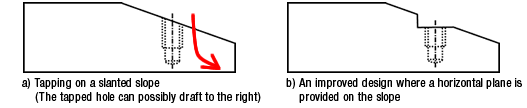
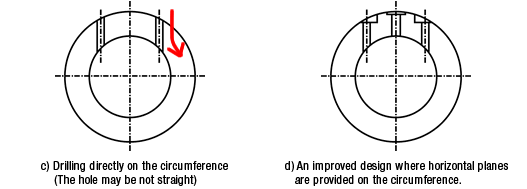
  • However when the drill is not perpendicular, the chisel edge does not bite the metal correctly and the hole machining will not be straight.
  • Therefore, the drilling surface should be designed to be perpendicular to the drill axis.
[Example-1] Machining a tapped hole on a slope

a) Tapping on a slanted slope (The tapped hole can possibly draft to the right), b) An improved design where a horizontal plane is provided on the slope

[Example-2] A case of hole machining on a circumference of a circle

c) Drilling directly on the circumference (The hole may be not straight), d) An improved design where horizontal planes are provided on the circumference.

When designing for compactness, tightening bolt holes with partially missing counterbore sections can often be seen, with the following problems.

Problem of missing counterbore sections

  • Partially remaining material may cause injuries to fingers, etc.
  • May cause malfunctions of sliding mechanisms due to the notched portion falling off.

Countermeasures

(1) At the time of designing, evaluate the external dimensions and the hole locations to avoid the "notches" (See [Fig.2], [Fig.3])

[Fig.1] Example of

(2) Machine off the sections that become narrow during the manufacturing process (See [Fig.4])

[Fig.4] Design example of machining off the thin sections during manufacturing

月別 Archives

Pages

Powered by Movable Type 6.0.3

About this Archive

This page is an archive of entries from January 2012 listed from newest to oldest.

December 2011 is the previous archive.

February 2012 is the next archive.

Find recent content on the main index or look in the archives to find all content.