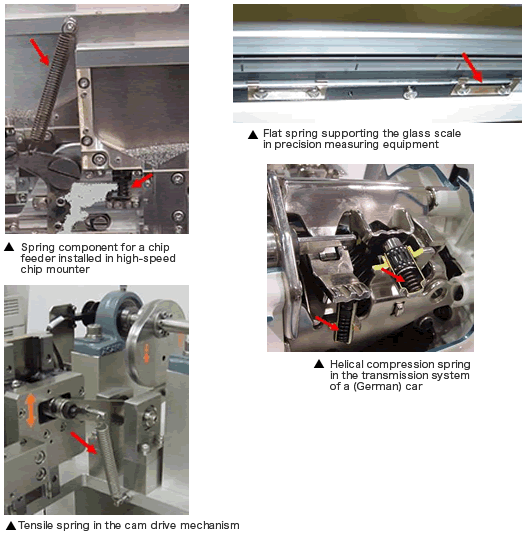
A "spring" is used for various structures. Each spring has its purpose, but it plays more of a supporting role than a lead. In spite of this image, springs are one of the most important LCA components in ongoing technological advancements because they are closely related to making the product more compact and lightweight, improving products' reliability, high-speed performance, and operability.
(1)Origin of the word "spring"
| - | A "spring" in Japanese is called "ba-né", which is said to be derived from [1] the word "haneru" (meaning, "to jump") or from [2] how chain armor repels ("hane-kaesu") a sword. There are many theories, but the exact origin is unknown. | |
| - | The word "spring" in English has other meanings, including the season, a place where water or oil wells up from an underground source, the ability to spring back strongly, a sudden jump, and more. It seems that all of them are related to the functions of the elastic device "spring". |
(2)Functions of springs
The following characteristics of springs are utilized for mechanical components.
| 1. | Elastic energy will be stored in a spring based on the deflection caused by the spring force. | |
| 2. | The elastic energy accumulated in Step 1 will be released outwardly as the external force diminishes. | |
| 3. | When a spindle hanging from the spring is oscillated, the spindle continues to oscillate in accordance with the spring constant. |
The following table summarizes the uses of springs according to operating conditions.
|
![[Fig.1] Initial shape of thread groove,[Fig.2] Wear state of thread groove after use,[Fig.3] Initial shape of nut groove,[Fig.4] Wear state of nut groove after use,[Photo 1] Worn-out part of nut](http://www.misumi-techcentral.com/tt/en/lca/345.gif "[Fig.1] Initial shape of thread groove,[Fig.2] Wear state of thread groove after use,[Fig.3] Initial shape of nut groove,[Fig.4] Wear state of nut groove after use,[Photo 1] Worn-out part of nut")
![[Fig.1] Dynamic drag torque measurement](/tt/en/lca/340_1.gif "[Fig.1] Dynamic drag torque measurement")
![[Fig.2] Initial value of dynamic drag torque](/tt/en/lca/340_2.gif "[Fig.2] Initial value of dynamic drag torque")
![[Fig.3] Dynamic drag torque (after usage)](/tt/en/lca/340_3.gif "[Fig.3] Dynamic drag torque (after usage)")

