December 2013 Archives

There is "Screw fastening technology" as one of representative assembly element technology, along with the "Swaging technology". Fundamental technologies required for automating screw fastening process are explained below.


(1) Configuration of screw fastening automation

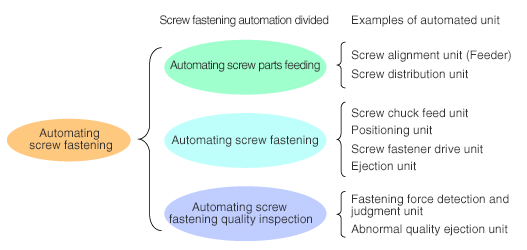
In order to automate screw fastening, system configurations including the processes before and after the screw fastening process will need to be clarified. The automation configurations of screw fastening processes can be classified as follows.

(2) Troubles related to screw fastening automation

Major problems regarding screw fastening automation are organized into above three functions as below. Therefore, the measures below are needed to be incorporated in the automating process.


1) Troubles related to screw parts feeding

(1)Jamming of automated screw parts feeder
(2)Screw parts chucking errors (miss-chucking, dropping)
(3)Defective screw parts (Accuracy defects, burrs, type mixture, magnetization)


2)Troubles related to automated screw fastening

(1)Abnormal fastening force (Insufficient or excessive fastening force)
(2)Abnormal stoppage due to defective parts feeding
(3)Malfunction of positioning unit


3)Troubles related to screw fastening quality inspection

(1)Loosening
(2)Over-tightening
(3)Appearance defects (Scratches, bending, tilting, etc.)


60% of the troubles are caused by screw parts feeding errors and automated fastening process errors.

Swaging has high productivity combined with excellent fastening reliability. However, it is important to optimize the process conditions for mass production due to the difficulties in re-working. Representative control factors that affect swaging quality is explained below.

(1) Swaging Quality

Below representative items can be listed related to swaging quality.

a)Swaging strength (Slip torque)
b)Appearance (Cracking, Bow deformation, Axial deformation)

Explanation

a) Swaging strength Evaluated with the slip torque which is the deformation torque force generated by the pins (rivets) inserted in holes and deformed. Naturally, this is largely affected by the material of both parts.
b) AppearanceThis is a quality management item required to avoid negative influences on assembly productivity, and to indirectly determine the swaging quality by the appearance of the swaged parts.


(2) Control factors for swaging quality

Swaging quality control factors are classified as 4M (Material, Machine, Methods, Man) and explained.

1) Control factors related to Materials
(1)Materials to be swaged (Relationship of 2 material types.. Differences in tensile strengths, modulus of elasticity, etc.)
(2)Swaging section shapes and accuracies of 2 parts (Material thickness, Swaging overlap, crush dimension, Axis swaging shape, Burrs, etc.)
(3)Pretreatment conditions on swaging materials (Heat treatment.. hardness, surface treatment.. friction coefficient, surface layer strength, hardness, etc.)

2) Control factors related to equipment (Machine)
(1)Drive characteristics of swaging device (Operation stability, workpiece locating accuracy, play, etc.)
(2)Swaging punch shape (Punch angle, tip shape, etc..... Transferring of deformation stress and its stability)

3) Control factors related to Materials
(1)Pressure application method (Constant dimension pressuring, Constant load pressuring) and pressuring force
(2)Pressuring condition (Heat applied or not, pressuring speed, etc.)

4) Control factors related to operator (Man)
(1)Stability of pressuring work (pressuring force, Retention time)
(2)Equipment maintenance


月別 Archives

Pages

Powered by Movable Type 6.0.3

About this Archive

This page is an archive of entries from December 2013 listed from newest to oldest.

November 2013 is the previous archive.

January 2014 is the next archive.

Find recent content on the main index or look in the archives to find all content.