June 2015 Archives

The automation device needs to have a cover installed for the purposes stated below.In this case, it is necessary to adjust the gap between the driven object and the cover by fitting actual parts.This section introduces examples of cover structures that allow for easy height adjustment.

Example of covers for an automation device

(1)Protection covers to shield the motion area for safety
(2)Covers to prevent contamination or tampering
(3)Covers to hide the automated processing unit
(4)Covers to stabilize the environment for inspection work by blocking light, etc.
(5)Covers to avoid problems caused by unintended operation as part of preventive maintenance

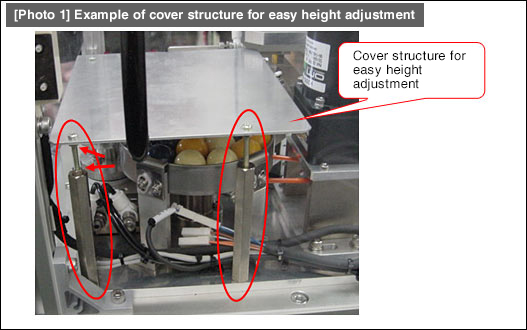
  • The cover in the photo serves the purpose of (3) listed above. This cover hides the color of the balls to be selected next by the Bingo Machine.
  • The reason for providing an opening is to make the color balls visible so that the operator can visually check the color balls to see if the machine stirs the balls as intended and selects them in a random manner during automated operation.
  • This cover structure has been adopted so that the operator can adjust the opening appropriately.
  • We adopted both-end tapped hexagonal posts (standard parts of MISUMI) to support the cover. The female tapped screw on one side allows for cover height adjustment.
  • Use nuts to securely fasten two hexagonal posts and the cover fixed by flat head screws. This prevents them from loosening by vibration.
Figure

You can win this Bingo Machine by stacking balls of the same color in a linear arrangement.For that reason, you need a sensing mechanism that can automatically detect the color of stacked balls.This section introduces how to identify color balls at low cost.

  • A color sensor is used for identifying colors.
  • To identify colors, the color sensor uses LED light sources in three colors (red, blue, green) for its projection elements. It distinguishes colors based on the light reflection rate of each color by emitting these three colors to a target object.
  • To be able to identify subtle color differences, you need relatively expensive sensor/amplifier systems.
  • A color sensor distinguishes colors by the following criteria: "Base color match: ON" or "Base color match: OFF." In order to distinguish yellow, black, and white balls, you need three sets of expensive color sensor/amplifier systems.
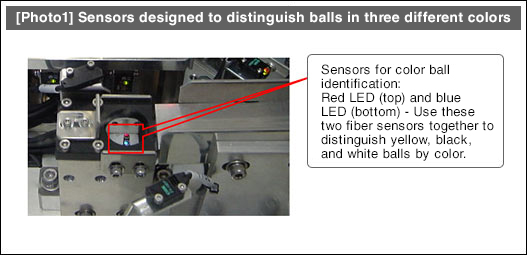
  • The Bingo Machine adeptly utilizes fiber sensors emitting homogeneous light so that the balls in three different colors can be identified at low cost.
  • In [Photo 1], two fiber sensors are installed for color ball identification.As you can see, the color of the optical fiber cables is different for the two fiber sensors.
  • We chose a fiber sensor that uses red LED as the light source (wavelength of 680 nm) along with another fiber sensor that uses blue LED as the light source (wavelength of 470 nm).When you use these LEDs of two different wavelengths to distinguish three different color balls, choose the appropriate sensitivity setting in order to produce light reflection that can distinguish yellow, black, and white color balls.In this way, all you need is two sets of economical sensor/amplifier systems.
  • As you see in this example, you can adopt economical sensor/amplifier systems if you understand and take advantage of the sensing principle to create the sensing function required for an automation device.

Figure

月別 Archives

Pages

Powered by Movable Type 6.0.3

About this Archive

This page is an archive of entries from June 2015 listed from newest to oldest.

May 2015 is the previous archive.

July 2015 is the next archive.

Find recent content on the main index or look in the archives to find all content.