October 2011 Archives

#092 Motion Mechanism Design - 9 : Positioning Pusher Materials

| No Comments | No TrackBacks

Positioning pushers are needed with transfer conveyors in order to align and position work-pieces. Especially when the following process utilizes any automation, they are required.

  1. Out-feeding of work-pieces by Pick & Place units.
  2. Automated work-piece inspection with image processing systems.
  3. Processes requiring accurate work-piece positions such as automated soldering stations and resin dispensers.
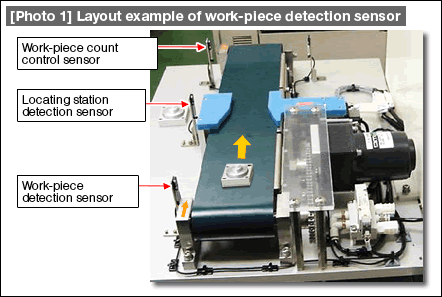
Photo 1: Layout example of work-piece detection sensor

(1) Focus points of positioning pusher material selections

The mechanism example uses an air cylinder (Pico-Table MPPT16-20-RS) to push and align the position of work-pieces on the conveyor.

  1. Lightweight ---- In order to lighten the load on the actuator
  2. Not to inflict scratches or dents on work-pieces.
  3. Wear resistant properties

(2) Positioning pusher material selections and characteristics

The materials used for the mechanism can be largely classified into the following.

  • Metals ---- Ferrous metals, Aluminum, Copper
  • Non-metal ---- Plastics, Ceramics

From the selection focus points of (1) above, the plastics are chosen as a candidate, especially with the criteria (1) - 3 engineered plastics are suitable.

When using plastics as parts of mechanisms, the mechanical strengths (tensile and compressive strengths, hardness, toughness) are lower than that of the general ferrous materials used, and the plastic wall thickness must be designed larger.

#091 Motion Mechanism Design - 8 : Detection of Moving Workpiece

| No Comments | No TrackBacks

This section explain the method of detecting workpieces moving on a work transfer conveyor (Photo 1) as a typical application of non-contact type photoelectric sensors.

[Photo 1] Typical configuration of moving workpiece detection sensor system

(1) Detection of moving workpieces

The following three different methods of workpiece detection are available: (1) contact detection, (2) non-contact detection, and (3) close contact detection. Non-contact type sensors are selected here for moving workpiece detection for the following features:

  1. No possible damage to the workpiece
  2. Capable of detecting workpieces during machine operation

It should be noted, however, that the detection light may behave unpredictably depending on the shapes of the mechanical parts around the sensors and may cause detection errors, leading to a reduced operating ratio of the machine.

- Precautions for use of non-contact type photoelectric sensors
  • The light emitters/receivers of the sensors must be kept free of foreign matter, such as debris, dust, water droplets, working fluid droplets, and chips. Install sensors facing in the direction with the least likelihood of adhesion of foreign matter. For example, avoid installing sensors facing upward (so that debris will not fall on them).
  • Carefully select the sensor mounting locations to prevent interference between neighboring sensors.
  • Shield sensors from incident light emitted from the surrounding structures (external incident light and reflected sensor light).
  • Avoid mixing opaque and transparent workpieces. Failure to comply may result in inaccurate detection due to changes in surface light reflectance. (This is particularly important with reflection-type sensors.)
  • Select fast response sensors for detection of fast moving workpieces.

Photo 1 shows a work transfer conveyor (second from the right bottom row in "Typical Applications of Standard Components: 1" on the center-page spread of the catalog) with three photoelectric sensors (beam sensors: PEX13B) performing the following functions:

  • Detects workpieces when feeding onto the conveyor belt (see Photo 1 above).
  • Controls the positioning station in the middle of the conveyor to adjust the orientation of the workpieces.
  • Detects the presence or absence of a workpiece at the end of the conveyor and limits the number of workpieces on the conveyor to the specified value.

#090 Motion Mechanism Design - 7 : Shaft-boss Fastening Methods

| No Comments | No TrackBacks

There are various shaft fastening methods available, including ones used to couple two shafts or to fasten a shaft to a boss for power or torque transmission. This section provides a brief comparative summary of shaft-boss fastening methods for power or torque transmission.

(1) Shaft-boss fastening methods

A mechanical element fastened to a shaft is called a boss. Typical shaft and boss fastening methods are shown below:

-Fastening with keys (See Fig. 1.)

[Fig. 1] Fastening with keys

-Fastening with setscrews (See Fig. 2.)

[Fig. 2] Fastening with setscrews

-Coupling with pins (See Fig. 3.)

[Fig. 3] Fastening with pins

-Frictional locking (See Sections 92 and 93.)
-Weld-fastening

(2) Comparison of fastening methods

Shaft-boss fastening method Principle and features Torque transmission capacity
Fastening with keys
<Types>
Flat key
Saddle key
Sunk key
Round key
  • Keys (that may be shaped rectangular, round, conical, etc.) inserted into keyways in the shaft and boss to fasten them.
  • JIS and DIN standardized
  • Available in various shapes and highly reliable.
Flat key: Moderate
Saddle key: Low
Sunk key: High
Round key: Low
Fastening with setscrews
  • Setscrews inserted through a boss to fasten the shaft.
  • Poor compatibility with overload torque.
Low
Used to secure a small (low-power) motor output shaft to a coupling.
Fastening with pins
  • Pins inserted into thru holes in the shaft and boss to couple them together.
  • Suitable for coupling linkage mechanisms.
Low
Frictional locking
  • Clamping screws apply radial force to the shaft and boss to frictionally fasten them.
  • User-friendly, allowing removal and reattachment and easy shaft alignment.
Low to high
Torque transmission capacity variable depending on frictional force available from Mecha-lock selected.
Weld-fastening
  • Shaft and boss welded and firmly fastened together.
  • Inconvenient because disassembly impossible after welding.
  • Accuracy variations unavoidable due to weld strain, etc.
Moderate to high

In addition to the tapered sleeved type introduced in Section 141, there are also single and double conical frictional locking devices Mecha-locks available (see p. 993 and p. 995 of the FACE FA Standard Components Catalog).
This section describes the structures and features of the single and double conical Mecha-locks.

(1) Structure and features of single conical Mecha-lock (MLM, MLMP, and MLHS)

Pushing the pressing flange integrated with the tapered inner ring into the tapered hole of the outer ring by tightly screwing the multiple numbers of locking screws into the threaded holes of the outer ring produces friction between the inner ring and the outer ring. (See Photo 1 and Fig. 1.) The radial component of this frictional force locks the motor shaft and the sprocket. The single conical Mecha-lock fits into narrow spaces but can produce a relatively large radial locking force. The single conical Mecha-lock is used for locking various rotating power transmission elements, including sprockets, gears, and pulleys.

[Fig. 1] Single conical Mecha-lock

(2) Construction and features of double conical Mecha-lock (MLA and MLAP)

Tightly fastening the multiple sets of the two opposing tapered side rings by setscrews produces friction between the tapered rings and the outer/inner rings, and the radial component of this frictional force locks the shaft and the hub (for example, sprocket). (See Photo 2 and Fig. 2.) The double conical design enables applications that require large torque transmission. This type of Mecha-lock is widely used for clamping flywheels, pulleys, etc.

[Fig. 2] Double conical Mecha-lock [Photo 2]

月別 Archives

Pages

Powered by Movable Type 6.0.3

About this Archive

This page is an archive of entries from October 2011 listed from newest to oldest.

September 2011 is the previous archive.

November 2011 is the next archive.

Find recent content on the main index or look in the archives to find all content.