February 2016 Archives

In recent years, using aluminum materials in place of steel or iron is becoming more common. The specific weight of aluminum is only 35% of steel (7.9). Therefore, 65% weight reduction is possible.

=Weight reduction by adopting aluminum alloys=

·While being more lightweight compared to steel, aluminum alloys are susceptible to deformation since the Young's modulus is approximately one third of the steel's. Thus, they are not the good choice of structural members requiring accuracy and strength.

·Because aluminum alloys are suited to continuously manufacturing products in complex shape by extrusion, they are chosen as the base materials of aluminum frames for covers and sashes. In this case, adopt the cross-section shape with the greater secondary factor for the frames to make the structural member lightweight and strong (see [Fig.1]).

·Aluminum is also adopted as structural frames of a worktable for prototype production line or jigs for small-lot production such as for trial or research purposes (see [Fig.2]).

·Aluminum alloys must go through welding process if you use them as large-sized structural members. Friction Stir Welding Method (patented in the U.K.) is a frontier technology of welding work. This method is adopted for manufacturing bullet train cars and high-speed vessels (see [Fig.3]).

·In the production facility of an automation device, aluminum materials are used for precision surface plates assembled to lightweight and high-precision tables. In this case, apply hard anodic oxide coating to improve abrasion resistance on the surface and increase the surface hardness before use.

[Fig.1] Cross-section shape of an aluminum frame[Fig.2] Structural example of an aluminum frame

[Fig.3] Welding structure example of aluminum alloys produced by the Friction Stir Welding Method

Reducing the weight of structural materials can speed up the processing equipment and transports since the acceleration increases for the same amount of energy.

(1)Weight reduction of structural materials

·Iron casting is adopted for columns in the body structure of machine tools. On the other hand, the structural material substitution is becoming popular for reducing the weight of a movable body.

·Structural materials used for machine tools need to have morphological stability, which means that the initial accuracy will not be degraded for a long period of over 10 years. Therefore, certain characteristics are required, such as the homogeneous stability of the material itself and nonexistence of residual stress inside. The required characteristics are summarized here.

Required characteristics of structural materials
(1)Free from deformation over time
(2)Minimum thermal deformation
(3)Superior vibration damping
(2)Superior vibration damping

·Currently, the following materials are mainly adopted as structural members:

Structural materialSpecific weightSpecific rigidity
(×106m)
Linear expansion coefficient
(×10-6/K)
Logarithmic decrement
(×10-3)
Cast iron7.91.412 (×)1~3
Granite2.91.58.36
Resin concrete5.21.3 (×)1220 (◎)
Ceramics3.97 (◎)70.6 (×)
Invar8.91.70.6 (◎)-

·Each material has its own characteristics.

·Granite has the least specific weight. However, the Young's modulus is so small that it is susceptible to deformation. Adopt an appropriate material as the structural member to avoid deformation.

·Ceramics are the lightweight and strong materials. However, they are extremely difficult to work with. In addition, they are not meant for large-sized products. The exterior panel of a space shuttle is an example of using ceramics in tiles (see [Fig.1]).

·Resin concrete has superior vibration damping but with less structural strength. In Europe, this material has long been adopted in the main units of machine tools.

[Fig.1] Space shuttle

A typical example of material substitution is replacing metal-based materials with plastics. There are many cases where metal parts have been replaced with engineering plastics to reduce weight.

(1)What are Engineering Plastics?

·Engineering plastics are a group of plastic materials that have excellent resistance properties against heat, dust, chemical, weather and flames. Because they can maintain dimensional stability and mechanical properties even at a high temperature, they can be used in structural members. Engineering plastics may be referred to as EPs.

·The most common types of engineering plastics include PC (polycarbonates) and ABS resin (acrylonitrile butadiene styrene copolymer).

(2)Examples of substitution with engineering plastics

·For FA automation parts, engineering plastics have been adopted for retainer parts used to change the direction of ball screw bearings in the circulation zone.

[Fig.1] Slide guide and its end cover part

[Fig.2] Ball screw end covers made of engineering plastics

[Fig.3] Toothed gears made of engineering plastics

·Engineering plastics have been adopted for device parts that are frequently exposed to chemicals during processes such as etching and cleaning.

·They are also adopted for parts requiring high accuracy in areas where the temperature changes.

·Other examples of this application include exterior parts requiring lightweight properties, such as replacement lens bodies for digital cameras or high-end models of single-lens reflex cameras.

·Some automobiles have had their glass or body parts replaced with engineering plastics in order to improve fuel efficiency by reducing the vehicle weight.

Weight-reduction techniques are of particularly necessity for fast-moving machines.

*In the aerospace industry, high-strength and high-reliability materials are extremely important, and there has been a shift towards using CFRP composite materials as a replacement for lightweight metals such as Duralumin.
*The same materials used for airplane bodies are adopted for F1 racing car bodies.
*The arm parts of electronic packing machines and conveyance robots are examples of their use in high-speed drive units.

Weight-reduction techniques by material substitution are applied to the above case examples.

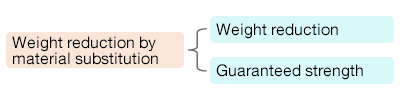
(1)Weight reduction by material substitution

To make a product lightweight by material substitution, the following technical requirements must be satisfied at the same time:

Fig.

(2)Material design to guarantee strength after material substitution
  • For material substitution from a metal to a resin, adopt a composite structure in order to reduce weight while achieving the guaranteed strength.
  • The "CFRP" in CFRP composite materials is an abbreviation of "Carbon Fiber Reinforced Plastics."
  • Carbonize the fiber and adopt it to the structural member inside the resin. The fiber continuum and adhesive strength of the resin will make the material lightweight and shatter-proof.

[Fig.] Carbon fiber and molding

Weight-reduction techniquesExamples of weight-reduction techniquesDevelopment agenda
1) Material substitutiona) Metal → Lightweight metalBonding technology
b) Metal → ResinStrength, reliability, forming technology
c) Metal/others → Composite materialSame as above
2) Shape modification of structural memberd) Lightening, hollow architectureStrength, noise
e) Shape alterationReliability in the load/stress direction

月別 Archives

Pages

Powered by Movable Type 6.0.3

About this Archive

This page is an archive of entries from February 2016 listed from newest to oldest.

January 2016 is the previous archive.

March 2016 is the next archive.

Find recent content on the main index or look in the archives to find all content.