July 2011 Archives

#081 LCA for Transfer - Classification of Transfer Functions

| No Comments | No TrackBacks

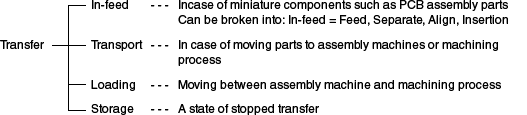
There are following four types of Transfers that effect locations of objects as: In-feed, Transport, Loading, and Storage. Each is explained in relation to LCA. (Storage is omitted)

(1) Classification of transfer functions

A flow of material to assembled products is simplified as the following.

A flow of material to assembled products is simplified as the following.

Function Classification Related Mechanism Notes
Transfer Conveyor types:
Belt type, Chain type, Roller type
Cart types:
Railed transfer carts, Unmanned transfer carts, Manually operated carts
General transfer mechanism
Aim for flexibility and high cost vs. performance ratio by modular concepts.
Transport Intermittent transport types:
Rotary type, Linear type, Free-flow type
Work performed on conveyor, etc.
Continuous transport type:
Synchronous linear type, etc.
Work cycle time is synchronized to the intermittent drive time.
Loading Handling robot
Auto-loader
P&P (Pick and place) unit, etc.
Know-how required on material handling and work-piece holding devices.

#080 LCA for Transfer - Standard Component Selection Practices

| No Comments | No TrackBacks

The previous LCA discussion (Vol.83) on non-circular gears and link mechanisms as an example, selecting of standardized component specification selection is explained.

The selection of standard components vary depending on the environments where the LCA are applied. The table below shows the examples for general manufacturing applications.

(1) Selection criteria based on LCA usage environments

Industry Classification LCA Usage Environment Standard LCA Component
Selection Criteria
Semiconductor Mfg.
Electronics Mfg.
High Prec. Bearing Mfg.
Pharmaceutical Mfg. etc.
Cleanroom Non-rusting material, surface treated, does not generate wear particles, non-grease and maintenance free, high performance
Food Mfg.
Printing Ind.
Semi-cleanroom In accordance with above.
General Mfg. Air conditioned general room Good cost vs, performance

(2) Explanation on standard component selections by LCA functionality

The figure below is an example of motion control LCA. The table below explains the standard component selection.

[Fig.1] Example of an LCA mechanism with non-circular gears and a link using MISUMI FA Mechanical Standard Components

Functions Location

Standard LCA
Component
Selection Criteria

Standard Component Selection Specification
(From: MISUMI FA Mechanical - Standard Components)

Transmission of force and torque. Link
Link connections
Strength against moment force.
Prevent wear and seizure of pivot pins and bearings.
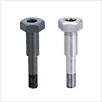
1. Link: LNFB
Material: S45C
Surf. Treatment: Black oxide
2. Pivot pin: HCDG
Material: S45C, 40HR or more
3. Oil-less bushing: LFZB
(For Heavy load / Low speed)
Force vector change Slider
fulcrum pin
Strength
(Stress considered)
4. Fulcrum pin: CMSG
(Larger dia. selected for strength)
Rotation Link connections Durability
(Wear, Seizure)
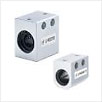
5. Linear bushing: LHSS
(Requires selection by given load)
Motion guide Shaft Rigidity, Durability
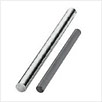
6. Solid shaft: SFJ
Material: SUJ2
Surf. treatment: Induction hardening
(58HRC or more)
Guide supports Shaft support Cost vs.
performance
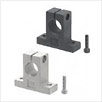
7. Shaft support: SHA

(3) Other constraints

1. Overall size determined based on special constraints.
2. Not to overlook safety aspects such as cover and etc.

#079 LCA for Transfers

| No Comments | No TrackBacks

There are "material flow" and "information flow" when considering the "Flows" regarding Production. The following section explains the "Material Flow: Transfer" and associated LCA.

(1) What is Transfer?

Materials, parts, and semi-finished products being moved with locational changes applied is the state of "Transfer". Dedicated units are called Material Handling machines. For one-person assembly cell unit production schemes, manual moving of materials corresponds to this and supportive LCA is also required.

(2) What is Transfer?

Importance of the LCA in Transfer are listed below.

1. Necessary for almost all production lines.

No single production line completes everything from start to finish in one process.

2. One transfer mechanism needed for every product variety.

Subjects to be transferred will vary in shape, weight, and properties (solids, powder, fluids)

3. Significant effects on the entire layout.

The entire line layout is almost determined by how the transfer mechanisms are arranged.
On the other hand, inappropriate transfer scheme will cause the following issues.
* Losses in investments * Losses in space * Losses in flexibility * Increase in failure rate

(3) Things that designers should consider.

In factory automation schemes, machining operations tend to be handled by machining centers where multiple machining processes are performed with one process station in order to save transfer equipment layout space as well as reducing transfer time.
However, giving the multi-process capabilities to the machines also increases complexity, propriety, and cost, so system optimization by applying transfer units based on LCA concepts.
The transfer LCA for cellular manufacturing schemes need to be designed with human engineering viewpoints.

Matter to be considered by the designers for both cases.

Added value of Transfer = Ease of operation for the next process = Feeding of work with ease to handle posture

(2) Stepping Motors and Ball Screw Drive

-Ball screws provide good transmission efficiency and utilization of motor efficiency since [1] they directly convert motor's rotary motion into linear motion, and [2] the screw pitch works as a deceleration mechanism.

-[Fig.4] is a drive mechanism with ball bushings and a ball screw drive on the Y-axis, typically used where reduced cycle times and increased positioning accuracy are needed.

[Fig.4] Ball Screw Driven Linear Bushing Mechanism

Supplementary Explanation

a) Stepping Motor Characteristics
-Stepping motors generate high torques in low speed (starting/decelerating) ranges, thus suitable for multiple position incremental moves over short distances.

b) Required Motor Accuracy to Achieve Targeted Positioning Accuracy
-When a 10mm lead (10mm/rev.) ball screw is selected for required accuracy of ±0.01mm, the following equation can be used to obtain the required motor accuracy (resolution).


(3) Air Cylinder Drive

-[Fig.5] is an air cylinder driven guide bearing of a clamp mechanism, and [Photo 2] is a magnetically coupled air cylinder mechanism. They both use linear bushings (arrow leader).

-Since the air cylinders cannot be velocity controlled during acceleration and deceleration, shock absorbers are used to reduce the shocks when stopping ([Photo 2]).

[Fig.5] Air Cylinder Driven Clamp Mechanism, [Photo 2] Air Cylinder Driven Unit

(4) Vertical Guide Example

-For vertical guiding applications, use of flanged linear bushings can achieve compact and simple mechanism without dedicated retaining mechanisms provided. ( require a vertical base plate for guide rails)

[Photo 3] Cover Open/Close Mechanism Example, [Photo 4] Table Height Fine Adjustment Mechanism

-Flanged linear bushings are also used for elevator mechanisms for transfer conveyors ([Fig.6]) and locating mechanisms ([Fig.7]), similar to the mechanism in [Photo 4].

[Photo 6] Application Example for Conveyor Elevator, [Fig.7] Application Example for Locating Mechanism

月別 Archives

Pages

Powered by Movable Type 6.0.3

About this Archive

This page is an archive of entries from July 2011 listed from newest to oldest.

June 2011 is the previous archive.

August 2011 is the next archive.

Find recent content on the main index or look in the archives to find all content.