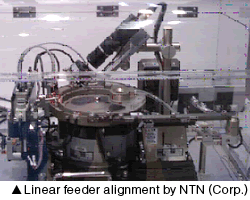
Surface mount components such as capacitors and insertion parts for assembly need to be top/bottom and for/aft orientation aligned. The orientation alignment will be based on the unique characteristics of the subject components (shape differences, identification markings, and etc.).
Explanation on For/Aft orientation alignment
(1) When there are differences in front end and rear end shapes
The directional alignment is often performed utilizing the for/aft shape differences of the parts.
a) Movement of a part not requiring directional changes
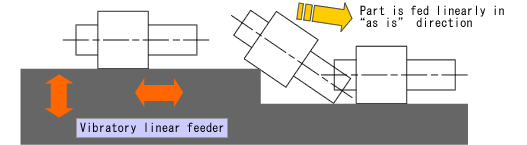
b) Movement of a part requiring directional changes
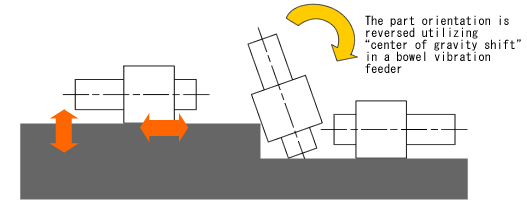
(2) Parts feeding and aligning
| - | Small parts such as shown in the above example are randomly put in a funnel shaped vessel called "Hopper". |
| - | This Hopper is vibrated finely to perform parts orientation change operation on the "Alignment feeder". |
| - | There are following three vibratory methods for the Hopper. The vibratory hopper is also called Parts Feeder.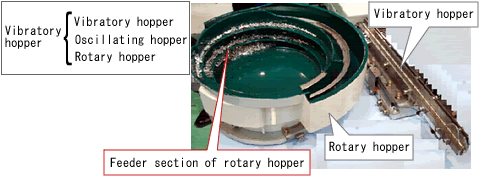 |
| - | A vibrator unit is mounted below the hopper to make up the parts feeder. |
| - | The round hopper is sometimes called a Bowl. |


![[Fig.1] Capacitor size component, [Fig.2] Transition graph of capacitor projection area and volume](http://www.misumi-techcentral.com/tt/en/lca/images/150_01.gif "[Fig.1] Capacitor size component, [Fig.2] Transition graph of capacitor projection area and volume")