February 2012 Archives

#106 Screws - 4 : Common Sense in Bolt Fastening Strength Assurance

| No Comments | No TrackBacks

If used improperly, even the high strength classified bolts cannot guarantee the strength (tensile strength and etc.). In this vol., some basics (common sense level) of fastening using bolts will be explained.

(1) Combination of bolts and nuts

  • The fastening strength guarantee values are for usages of bolts and nuts of the same strength classifications used in a normal manner.
  • The term "used in a normal manner" means that all the threads of a standard thickness nut are fully engaged with the threads of a bolt ([Fig.1]).
  • [Fig.2] shows examples of abnormal usages. The threads of the nuts are not utilized fully.
  • [Fig.3] shows examples of excessively long incomplete threads and improper application of shoulder bolts. The subject to be fastened is not properly fastened with bolts and nuts.

[Fig.1] Properly fastened bolt and nut

[Fig.2] Improperly fastened bolts and nuts

(2) For a bolt and threads

  • When bolting a part to a threaded part, the threads must be properly designed depending on the material strength of the threaded part.
Example
  1. For low strength materials (i.e. aluminum), thread length must be made long in order to ensure ample thread strength.
  2. If the thread length cannot be made sufficiently long, use threaded inserts (MISUMI: HLTS, etc.) for thread reinforcing.

[Fig.3] Examples of thread strength assuring

Of the machine parts produced, many tapped holes are provided on base plates and covers. If the tapped hole layout is not properly designed, troubles such as locating errors and excessive machining time may often result. Therefore, it can be said that the fastener layout design is indicative of the designer's technical levels, and is a design parameter to be reckoned with.

Example 1: Screw hole and tapped hole design on round objects

  • As long as there is no concern of causing drawing to be misread, one pitch set of the holes are drawn with actual features and the rest are indicated with a pitch circle and center lines ([Fig. 1]).
  • The hole quantity and dimensions are indicated with a leader line, starting with the qty. followed by a hyphen and dimensions ([Fig. 1]).

Screw hole design basics for round objects

- Equally divided angle
- Concentrically located

layout design

[Fig. 1] Example of hole/tapped hole dimension indications for round objects

Example 2: Screw hole design for rectangular cover

  • If locations of the intersections can be made clear by dimension indications, the centerlines intersecting the pitch line can be omitted. In this case, the number of the repeats must be clearly shown in the dimension indication ([Fig. 2]).
  • a) The end hole is located where the lines of 2 sides intersect. In this case, locating of all the holes can be done all at once making it simple and low cost.
  • b) The end hole is located on the arc along the cover outer shape, making it necessary to separately locate the hole and more costly.

Screw hole design basics for rectangular object

- On straight lines
- Equally spaced

layout design

[Fig. 2] Example of dimension indications

#104 Screws - 2 : Many Dangers with Senseless Double Nut Usages

| No Comments | No TrackBacks

One of the more reliable means to prevent screws from loosening is to use "Double nut" method. There are some fundamental points that must be understood regarding this method. [Fig.1] and [Fig.2] are the fundamental rules with double nutting. If these rules are not observed, seemingly reliable implementation will not yield effective results.

Fundamentals of loosening prevention double nut method

  1. Effective when the screws may come loose due to rotational force caused by vibrations
  2. Not effective for loosening caused by material elongation due to material properties.
  3. Proper procedure is required for double nut tightning. (See [Fig.1])
  4. The strength of double nut method depends on the strength of the nuts used (principle). Thickness of the two nuts used must be carefully considered.

[Fig. 1] Tightening procedure of double nut arrangement

[Fig.2] Double nut thickness principle

"Screws" are the most widely used and imperative components for machine system manufacturing. They are classified by shapes, sizes and strength (class) according to the standards of JIS, ISO and etc. However, in many LCA design scenarios, the selection of the screws is relied upon the engineers' guessing based on experiences, as well as what's available on the shelf for assembly work sites. The tech. seminar will explain the tips and pointers as well as principles of "Screws".

[Fig.1] A view of a

(1) Design troubles in LCA designs

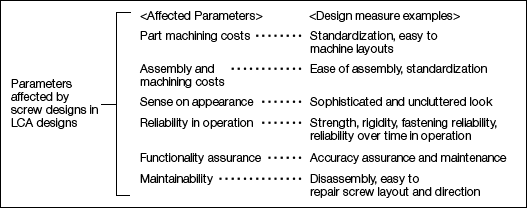
The LCA automation systems and fixtures are mostly fastened by the use of screws (incl. nuts and bolts). Therefore, designing with screws affect the following items.

Parameters affected by screw designs in LCA designs

Therefore, screw designing cannot be overlooked for the LCA designs that are lean and functional.

(2) Screw troubles during designing and post implementation

Screw troubles during designing and after the implementation can be classified as two of the following.

(a) Troubles arising LCA assembly and fastening ---- When there are LCA design errors
-Example
  1. Correct bolts to fit the counterbore holes and thread depths are not in stock
  2. Screw position is not aligned with mating threads.
  3. Damaged threads during assembly.
  4. Part is deformed from tightening force.
(b) Troubles arising when time has past after fastening ---- Errors in strength evaluation during designing.
-Example
  1. Screws coming loose causing the parts to be misaligned causing equipment damages.
  2. Destruction of bolts
    Both a) and b) are caused by the designer's ineptitude during designing.

月別 Archives

Pages

Powered by Movable Type 6.0.3

About this Archive

This page is an archive of entries from February 2012 listed from newest to oldest.

January 2012 is the previous archive.

March 2012 is the next archive.

Find recent content on the main index or look in the archives to find all content.