February 2018 Archives

#329 Know-how on automation: Pressurized heating technology

| No Comments | No TrackBacks

Of production technologies, a processing method where heat treatment is conducted while a constant level of pressure is being applied is widely used for processes of adhesive/bonding and transcription (deformation).This section describes pressurized heating technology and automation.

(1)Description of pressurized heating technology

Pressurized heating (hot pressing) technology is used for the following machining processes:
1)Adhesive of the machined workpiece and machining fixture for precision machining (cutting, grinder polishing, etc.) (Fig. 1 a)
2)Adhesive of two glass substrates with a gap of some µm (LCD devices, etc.)
3)Mount bonding of COG (Chip On Glass), etc.
4)Transcription process of fine pattern (micro/nano imprint, etc.) (Fig. 1 b)

[Fig. 1] Example of pressurized heating method

Pressurized heating technology is being expected to meet the following requirements for precision and productivity:
a)Applying homogeneous and high precision pressure onto the area of the object workpiece
b)Control program capable of ensuring homogeneous and high precision distribution of temperature, and accurate temperature rise, steady temperature, and temperature fall
c)Pressurized heating method with high productivity (at a constant cycle)

(2)Instrumentation of pressurized heating

・This section describes hot pressing technology mentioned above in 2).
・For the pressurized heating process, it is commonly practiced that instrumentation of the process is carried out by dividing it into two processes: pressurizing and heating.
・Pressurizing process is of two types of process design: (1) process of final pressurizing only, and (2) process of preliminary pressurizing and final pressurizing. The latter is used in the case where positioning precision is required.
・Fig.2 shows an example of mechanism of pressurizing process.The basic structure is the same as that of a press machine. The pressure is applied by moving the pressurization plate in parallel with the base plate using the four guide columns.
・Even if the two opposing surfaces of the base plate and the pressurization plate are kept exactly in parallel, a deformation of the mechanism as a whole cannot be avoided due to the load of pressurization plate applied. As a countermeasure for this deformation, the pressure is often applied through the pressurization buffer material (rubber elastic body, etc.).
・Heating treatment is often adopted in tunnel furnaces, because control of temperature rise from room temperature to the level for treatment or temperature fall, and also heating treatment for a given period of time are required.A box furnace is more appropriate for processes for high-mix production.
・From the viewpoint of productivity, it is desirable to place several workpieces in the pressurization mechanism, shown in Fig.2, to conduct the pressurized heating process.

[Fig. 2] Example of pressurization mechanism

Examinations used in image processing for screw fastening automation include appearance inspection for screw parts (for foreign substances, burrs, deformations, etc.) and state inspection after fastening.More advanced technology for inspections using image processing as a means to avoid variations in manual inspections is needed in an attempt to seek for a solution with zero defects (with no failures).

(1)Necessity of inspection with image processing

Since human visual inspection has the following limitations, inspections using image processing are needed all the more.

  1. Examinations are apt to be affected by the inspector's intuitive judgment, which are hard to be free from subjective interpretations.
  2. Standards of judgment may vary depending on the fatigue of the inspector.
  3. Long hours of visual inspections may be a limiting factor in the labor environment.
  4. Proficiency, which varies among inspectors, may produce difference in inspection productivity. This may affect the labor cost a great deal.
(2)Difficulty in automation of image inspection and various techniques

・Appearance inspection covers a wide range from simple detection of foreign substances to qualitative and intuitive judgment as to contamination, etc. Appropriate image detection sensors and inspecting and identifying algorithms/programs are required based on specific items for testing.

・For these reasons, automation of appearance inspection is often shunned from the viewpoint of Return On Investment.

・For plain recognitions of presence of parts, rough profiles of the shapes, or orientation/direction among a variety of image inspections, a simple and low cost inspection system can be implemented by defining the object under inspection.

・Image sensors include a (1) simple photoelectric sensor, (2) liner image sensor (Fig. 1), (3) matrix image sensor, (4) pattern recognizer (Fig. 2). For applications of (3) and (4), various numerical calculation operations are introduced for pattern recognitions.

[Fig.1] Example of liner image sensor [Fig.2] Example of product inspection on conveyor

・Combination of some photoelectric sensors (phototransistor, photoelectric sensor, etc.) will make determination of rough profile, orientation, and judgment of front and back sides for the object under inspection possible (Fig. 3).

[Fig.3] Example of part direction recognition using photoelectric sensor

・For applications with the space restriction, the technique of transmitting the image to the image sensor using the optical fiber cable can be used.

・For recognition of small objects, the pictures taken with a digital camera could be displayed on the TV monitor screen to perform image processing by photoelectric sensor using the magnified image.

・Liner image sensors are often used for the case where objects under inspection are moving on the conveyor.Matrix image sensors, composed of photoelectric elements arranged in a matrix form, are applied in the inspection on the two dimensional plane.

・For the application of image sensors, some advanced technique is required. Countermeasures, for example, for environmental fluctuations such as dirt or grime onto the surface, or equalization adjustment of ambient light are necessary. Noise from the accidental reflected light can be avoided by selecting the black color for peripheral equipment around the sensor.

・Equipment processing the image data is responsible for determining the binarization signals (counts of pulse width, etc.), and counting the numerical values ("1" and "0") in each signal area.With the pattern recognition, the data of the area, its characteristics (barycentric position, number of holes, positions, etc.), and lengths will be made available by calculation operations to be used for the processes of comparison or determination.

(3)Handling mechanism and image processing

・Handling mechanism is responsible for rejecting abnormal parts, etc. based on the result (data) from image inspection.

One of the powerful production technologies useful for addressing troubles in automating parts transport is image processing.Image processing technique is not only effective for addressing troubles such as wrong orientation or positioning error for transported parts on the alignment unit or conveyor, but also for as countermeasure for entry of foreign substances.This section provides an overview of image processing techniques.

(1)Automation and image processing

・In the production lines, image processing technique can be used as a tool for visual inspection for all processes including transporting, machining/assembling, and inspection.
・Image processing, adopted as a countermeasure for troubles like positioning error, helps to measure the correctness of position and orientation of screw parts before the positioning stage, and to reject inappropriately oriented parts (Fig. 1).

[Fig. 1] Alignment in Linear Feeder from NTN Corporation

・Registering an appearance pattern of part for inspection to avoid entry of foreign substances will help to reject parts with wrong pattern (foreign substances).
・The image processing technique is also applied to the field of inspection as a means of examining the appearance after fastening the screw.

(2)Basics of image processing technique

Image processing mainly uses the four methods in recognizing patterns of states, following the model of the human eye's functions:
a)Determine region by binarizing the image signal
b)Extract local characteristics of object and apply them to inspection
c)Register a template shape for inspection in advance as a pattern for orientation, circuit, etc., and apply it to positioning or inspection of scratches by checking it against the template (template matching) (Fig. 2)
d)Calculate and determine global characteristics for areas or circumference length of an object, and apply them to positioning or classification of the parts.

[Fig. 1] Variety of screw parts

Explanation

・In the process of binarization, the image signals are digitized into either "1" or "0", depending on whether they are greater or less than the threshold value for the image signal (example: brightness).

・Binarization will make shape inspections possible such as follows when appearance recognition of the object is made possible:
1)Recognition of product and inspection for foreign substances from projected shape
2)Gravity of projected shape
3)Distance from gravity to contour (maximum distance, average distance)

・Local characteristics determined by appearance recognition of object cannot be applied to examinations of printed circuit boards or inspection for scratches.
・In the template matching technique, characteristics of shape required for recognizing the image of object are registered as templates for pattern recognition, which are used for precise positioning and orientation control for complex shapes, or determination of circuit pattern defects.
・Since shapes of objects vary a great deal (three dimensional object with convexes and concaves), an appropriate technique must be selected according to the following fluctuating parameters:
1)Orientation of image processing camera (point of sight, largeness of image area, etc.)
2)Illuminating condition of image processing area (luminous intensity, orientation, change rate in luminosity, etc.)
3)Optimization of object state (avoidance of parts overlap, etc.)

This section describes screw positioning errors, the common cause for troubles in automating screw fastening.

(1) Screw positioning errors and causes for the troubles

・While causes for screw positioning errors are related to characteristics of both screw shapes and workpiece onto which the screws are fastened, factors on the automation equipment are more influential. Fig.1 shows factors for screw positioning errors.

[Fig. 1] Distribution of factors for screw positioning errors

・Many causes for the troubles are related to the quality of workpiece onto which the screws are fastened.Secondary factors for these troubles are possibly related to inappropriate clamping of the screws.Important issues, thus, to be addressed on the automation equipment side are countermeasures for (1) screw positional deviation, (2) vibrational shift, (3) inappropriate clamping of the screws.Items (1) and (3) of the three failures above are also related to countermeasures for screw feeding errors, as shown in the previous section.

(2) Relationship between screw positioning errors and feeding conditions/clamp mechanisms

・In order to properly position a screw, the screw must be oriented and positioned correctly in the screw chuck section after the screw is transported via an air chute, etc.If the orientation or position of screw is wrong, positioning error will probably occur.

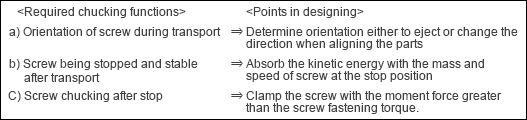
・In order to ensure proper positioning in the screw chuck section, the following three requirements must be met: a) orientation of screw during transport is correct, b) screw is stopped and stable after transport, c) screw chucking is reliable after screw is stopped and stable.

・To ensure proper positioning in the screw chuck section the following three chucking functions are required:

image

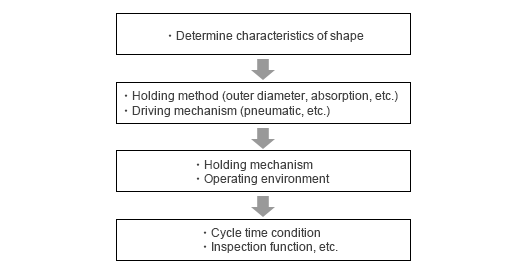
・The following process can be referenced as the procedure for designing the chucking mechanism:

image

・When the spring force is used for the stopper mechanism for screw in transport, or for clamping mechanism for screw, the conditions (transporting speed of screw, etc.) and mechanism must be adjusted to maintain the following spring force:

image

・Positional deviation caused by vibrations also needs some countermeasures.Selecting a parts feeder or alignment unit, and optimizing the feeding speed, etc. are issues to be addressed as they are related also to the noise generated by the automation device.

(3)Significance in process design for screw fastening process

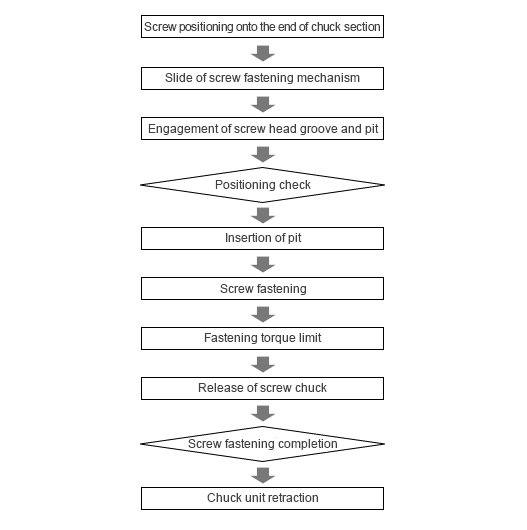
・The following chart shows a typical process design.Determination process of "Positioning check" is set as an independent process, since this process is necessary for ensuring the reliability of positioning and the stable control of screw fastening torque.

image

月別 Archives

Pages

Powered by Movable Type 6.0.3

About this Archive

This page is an archive of entries from February 2018 listed from newest to oldest.

January 2018 is the previous archive.

March 2018 is the next archive.

Find recent content on the main index or look in the archives to find all content.