September 2012 Archives

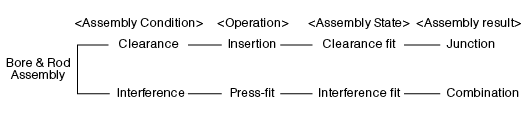
Assembling bores and rods are classified into two assembling procedures based on the dimensional relationship between the two parts.

Bore & Rod Assembly

Here, the glossary of press-fitting that requires forces for assembly is explained.

[Table 1] Glossary of press-fitting work
Press-fit Glossary Explanations on glossary and application examples English terms
Static Press-fitting Press-fitting procedure using static forces without impacts.
Example:
Press-fitting of punches into mold fixture bases.
Static press fit
Vibratory Press-fitting Press-fitting procedure with vibrations applied.
Example:
Light press-fitting of easy to break parts.
Vibratory press fit
Impact Press-fitting Press-fitting procedure employing impact effects.
Example:
Press-fitting of dowel pins and locating pins.
Shot fit Hammering fit
Push-fitting Press-fitting procedure for o-rings, gaskets and springs where the parts are pushed into places along a shaft axis.
Example:
Press-fitting of E-type retaining rings and ball bearings into holders.
Push fit
Shrink-fitting Assembly procedure of fitting shafts into bores where the bores are enlarged by heating.
Example:
- Used when high accuracy and high torque press-fitting is required. - For rotating cutting tools (end mills, etc.) to be mounted on shrink fit holders, fixing drive gear rims on hubs.
Hot press fit
Expansion fit An opposite of the above where the shaft OD is made small by cooling, then inserting into the bore.
Example:
- For large parts and easy to break parts to avoid breakage by press-fitting.
- For fitting and fixing of shaft bushings.
Cold press fit

Explanation on press-fitting procedures

- Press-fitting is a procedure to fit two parts of a shaft diameter and a bore diameter where a targeted interference is utilized by spreading by the parts fit.
- The surface pressure and friction of spreading this interference apart is applied as the press-fitting pressure. The way to apply this press-fitting pressure classifies the press-fitting operation.
- Obtaining of this press-fitting pressure requires some preparation operations with associated difficulties such as accurate locating of two parts and managing of gripping forces, but the press-fit pressure would commensurate the resultant parts combing reliability.

Defective troubles regarding screw fastening are classified, and the countermeasures on screw fastening device troubles are explained.

(1)Screw fastening defects and the factors classified

Screw fastening defects can be classified as the following.
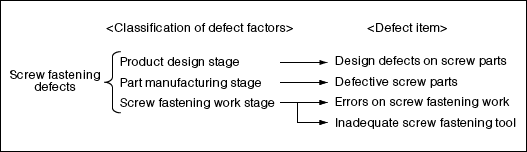
Screw fastening defects

Of the above, below are the screw fastening device related defects.

a) Errors on screw fastening work

Improper controls on the automated screw fastening unit
Defective screw fastening (Misalignment, Oblique fastening, etc.)
Screw positioning error


b) Inadequate screw fastening tool

Wear and damages on screw fastening bits
Wear on screw chuck
Inadequate maintenance on fastening tool


(2)Examples of screw fastening device trouble countermeasures

1)Screw fastening device (in case of pneumatic driver) trouble countermeasures

(1)Since the driver receives reactive forces during screw fastening, it is likely that some functional errors may occur at some usage intervals.
(2)In many cases, the problems are attributed to rotational motion instabilities due to wear on rotational shaft, foreign objects adhesion, rusts, and seizure. Apply lubricant oil and repeat forward and reverse rotations.
(3)Check air supply pressure of the pneumatic driver.


2)Countermeasure examples on inadequate screw fastening tool

(1)With an assumption that the screw driving bits are subject to wear deformation, maintain spares and periodically (quantity base managed) replace the bits.
(2)Screw chuck related parts are the same as the (1) above.


3)Management techniques for the stable operation of the screw driving device

In order to maintain the stable operation of the automated machinery, not only proper management of the automated machinery itself, but preventative measures such as quality control maintenance of assembly parts and finished goods will be effective.

[Examples of Managed Items]
Quality Control SubjectManaged Item Examples
Thread section forming qualityScrew hole position, pitch, thread diameterChips, burr abnormalities
Screw fastening quality of the finished goodsAppearance (scratches, damages)Tightening torque

The Screw Fastening Unit is the most important mechanism of the automated screw fastening device. The representative screw fastening methods and examples of the fundamental structure of automated devices are introduced here.

(1)Screw Fastening Methods

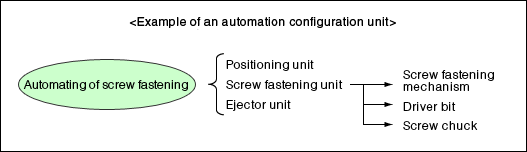
The representative structure of screw fastening unit is as follows.

<Example of an automation configuration unit>

There are following screw fastening methods for the screw fastening units. Variations of the fastening forces can be improved in the order as a>b>c {high accuracy}.

a) Torque Control Method: A method of transmitting the power of electric motor to the shaft of the screw fastening unit as rotational torque.
b) Angular Control Method: A method of controlling the screw tightening angle with motors with angular encoders.
c) Yield Point Method: A tightening force control method by detecting the deformation behavior of tightened screws.

(2)Example of a screw fastening unit

[Fig.1] is an example of an automated nut fastening device with 6 axes of parallel equipped pneumatically operated nut fastening actuators (nut runner). Nuts are tightened after the 6 axis nut fastening actuators are moved by the cylinder on linear guides.

[Fig.1] Example of a multi-axis parallel nut fastening device

Source:"Illustrated collection of automated mechanism" (Nikkan Kogyo Shinbun Ltd.) modified

Useful countermeasure production technology against screw parts misfeeding, which comprises a high percentage of the troubles, will be explained.

There is a large variety of features of screws depending on fastened product characteristics such as a) screw head shapes, b) thread shapes, c) screw hole shapes, d) presence of washer or not, e) material, surface treatment differences, and many others. Therefore, the screw parts feeding systems are required to adopt a wide variety of screw types.


(1)Screw parts feed system configurations

Screw parts feed system configuration is as follows.

Screw parts feed unit - - - Device that automatically stores - Aligns - Separates the screws. See [Photo 1]

[Photo 1] Example of a Vibratory Bowl Feeder

Screw distribution unit ---A device that supplies the screws from the alignment unit to the chuck of the automated fastening device.
It utilizes air pressure and etc. to transfer the screws through the distribution tube.


(2)Countermeasure examples for screw parts supply device

1)Countermeasure examples on screw parts feed units
 (1)In many cases, screw parts feeding misses (Causes: mixed contents, out of parts, hang ups due to burrs) can be effectively handled with error detections by photoelectric sensors and abnormality determination with a timer on the screw alignment feeder.
 (2)Feeder internals and chutes where the components travel must be kept clean in order to maintain smooth sliding of the components.

2)Countermeasure examples of screw distribution unit troubles
 (1)Because the screw transfer is based on sliding by air, the distribution tubes should be stabilized with gradual curvatures, and detailed maintenance on air leakages due to tube wear is important.
 (2)Proper distribution methods according to the screw shapes (head shapes, weight, length, etc.) need to be selected.


月別 Archives

Pages

Powered by Movable Type 6.0.3

About this Archive

This page is an archive of entries from September 2012 listed from newest to oldest.

August 2012 is the previous archive.

October 2012 is the next archive.

Find recent content on the main index or look in the archives to find all content.