June 2010 Archives

#047 Motion Mechanism Design - 17 : Orthogonality of XY Table Assembly - 2

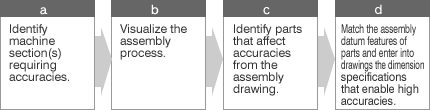
The flow of design drawing that enables accurate assembly work without high levels of training is organized below.

image

Explanation of the example

Explanation is along a~d shown above.

(a) Identify machine section(s) requiring accuracies.

Applicable section is the XY table in this case.

(b) Visualize the assembly process. (see [Fig.1])

image

(c) Identify parts that affect accuracies from the assembly drawing.

The parts are the 3 red lettered parts from b) above. (see [Fig.1])
 *Base
 *Y axis base mounting plate
 *Y axis base

(d) Match the assembly datum features of parts and enter into drawings the dimension specifications that enable high accuracies.

This is shown on [Fig.1]. The datum shown is referenced for specifying locations of assembling reference dowel holes.

[Fig.1] Parts related to X and Y axis assembly process

#046 Motion Mechanism Design - 16 : Orthogonality of XY Table Assembly - 1

The LCA example used here is from MISUMI catalog standard component application example:1, transfer mechanism with an XY table. In this example, two single axis units need to be assembled into an X(lower axis) Y(lower axis) unit perpendicularly. The key of cost savings is to start with a design that is inherently easy to perform the final assembly.
The subject of orthogonal mounting of a two-axis unit will be explained in three sessions.

(1) Approach to realizing assembly accuracy

Each component that constitutes an XY table (linear guides, ballscrew, linear bushing/shafts, etc.) has guaranteed straightness built in, but assembling the parts into an XY table requires certain level of orthogonal accuracy. If the design approach is inappropriate, it may not only end up as an expensive system due to much wasted efforts, but with shortcomings such as low reliability and difficulties in maintenance work.

The following is the basic design and production approach.

1. Design with ease of accurate assembly built-in.
2. Assemble along the intent of 1.
3. Measure and confirm the accuracy after the assembly.

(2) What is a design that is easy to obtain accurate assembly? (see [Fig.1])

An adept designer would build-in the required properties (orthogonality in this case) into the design drawings. To do this, the designer needs to visualize the following.

1. Assembly process of the mechanism
2. Machining of parts related to accuracy

The designer applies into the drawings the elements that induce accuracy in assembly based on the images 1. and 2.

[Fig. 1] Design with inherent ease in obtaining high accuracy

(3) Reason for embedding ease of assembly accuracy into drawings

The parts that require assembled accuracies are produced with machine tools capable of micron level accuracies over the length of the parts. Therefore, the parts can be produced with assembly guides offering built-in accuracies, eliminating needs for highly trained assembling personnel.

(4) How to build-in assembly accuracies into drawings? (see [Fig.2])

By following the concept below.

1. Determine the datum surface based on the assembly work image of (2)-1.
2. Align the datum sides of all parts based on 1., and build-in the accuracy by specifying on part shapes and dimensions.
3. Specify appropriate machining methods of parts related to assembly accuracy.

[Fig.2] Example of embedded accuracy in a drawing

#045 Motion Mechanism Design - 15 : Ballscrew Shaft Support Methods

Ball screw shaft end bearings' structure and design points, and convenient procurement methods are explained here.

(1) Methods to support ballscrew ends

There are three ballscrew mounting methods: Fixed - Fixed, Fixed - Supported, and Fixed - Free. The most common is the Fixed - Supported method. Each method requires design considerations not to cause excessive moment loads and radial loads on the ballscrew shafts.
On the fixed side, the bearing's inner race is fixed to the ballscrew shaft with a slip fit, and the bearing's out race is solidly mounted to a support unit housing to eliminate axial movements. Angular bearings are used for radial and axial loads. On the free side, the ballscrew shaft is not captured in order to account for any heat related shaft expansion. (see [Fig.1])

[Fig.1] Ballscrew shaft end support design

(2) Characteristics of ballscrew end supports

(a) Types of loads

Ballscrew is a machine element that transmits rotational torque to moving objects at high speeds. Since the shaft end bearings will be subjected to both axial and radial loads alternately, appropriate rigidity is required for the bearings and bearing holders.

(b) Differences in shaft end configurations

Ballscrew shaft ends have different configurations (diameter, shape) since the nut unit is assembled from one end after the shaft machining is completed. For that reason, the end bearing types are different making the designing cumbersome.

(3) Selecting the end bearings

For the reasons stated in (2) above, end bearings be different types and the end bearing holders will also be of different designs. In order to eliminate this necessity of designing two different bearing holders, MISUMI provides support units as standardized pairs. (see [Photo 1])

[Photo 1]

(4) Surface treatments of ballscrew end bearings

Ballscrew shaft and end bearings are lubricated and have less chance of rusting, but the bearing holders (support units) may develop rust on the outer surfaces. Rust protection means are recommended for equipment intended for clean room use.

#044 Motion Mechanism Design - 14 : Connecting a Motor Shaft and Ballscrew

Components used to transmit motor's torque (force) and rotation (moving distance) to a ballscrew may largely affect the system accuracy, reliability, and ease of assembly. Couplings are explained in this tutorial.

(1) Role of couplings

When connecting both shafts of a motor and a ballscrew, the arrangement may be accurate statically but can include possible variables dynamically, as show below.

1. Ballscrew shaft deflection when rotating.
2. Shaft deformation and stress due to heat expansion.
3. Deformation of ballscrew support unit.
4. Friction resistance variances due to bearing wear, after extended usage.

Therefore, couplings that can solve the variables from issues 1~4, instead of using a rigid body to connect the two shafts.

(2) Coupling types, construction, and characteristics

TypeConstructionCharacteristics
Slit typeA spiral slit is made in the center section of a metal (alum. alloy, etc.) cylinder body. One piece construction  offers spring function and shaft retaining function.Smooth torque transmission due to one piece construction. Can absorb large alignment error amounts. No backlash. Waterproof, oil resistant, chemical resistant.
Disc typeA disc is provided in the body center. Disc material and shape can be selected to adapt to wide range of transmission capabilities.Good adaptability to high torque and high torsional scenarios. No backlash. Electrically insulating type available.
Oldham typeTwo shaft hubs are connected by a resin spacer. (see [Photo 1])Small size for small torque applications. Good balance in torque transmission, torsional rigidity, and misalignment absorption. Good electrical insulating property.
Bellows typePhosphor bronze or stainless steel made bellows connects two shaft hubs.Good performance in transmitting constant rotational velocity. Suitable for connecting rotary encoders.
Rigid typeOne piece solid construction made of alum. alloys or stainless steel.High torsional rigidity and no backlash, but has no misalignment absorption capability.

[Photo 1]

月別 Archives

Pages

Powered by Movable Type 6.0.3

About this Archive

This page is an archive of entries from June 2010 listed from newest to oldest.

May 2010 is the previous archive.

July 2010 is the next archive.

Find recent content on the main index or look in the archives to find all content.