It is good to make cross section drawings to provide a better understanding of a complex mechanism with various mechanical components assembled by illustrating how the representative mechanical components are assembled. This section explains how to make a cross section drawing using the Bingo Machine as an example.
- The general rule is to draw the cross section that is cut at the base center line. However, you may draw the cross section that is cut at a point other than the base center line if necessary.
- When cutting at a point other than the base center line, draw a cutting line (thin dashed line) to illustrate the cutting position. ([Fig.1])
- Draw a thick solid line for both ends of the cutting line and for key points where the cutting direction changes. ([Fig.1])
- In addition, when you need to indicate the view direction of a cross section or when you make several cross section drawings separately, add an arrow and a symbol on both ends of the cutting line and include a description such as "Cross Section A - A" next to the cross section drawing. ([Fig.1])
- Note that the cross section of parts such as bolts/nuts, shafts, pins, rivets, or keys will not be drawn in longitudinal direction, in principle.
![[Fig.1] Drawing method of cross section drawing](http://www.misumi-techcentral.com/tt/en/lca/440.gif "[Fig.1] Drawing method of cross section drawing")
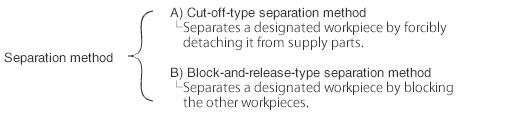
![[Fig.1] Separating a single workpiece by pushing (method A)](http://www.misumi-techcentral.com/tt/en/lca/439_1.gif "[Fig.1] Separating a single workpiece by pushing (method A)")
![[Fig.2] Simultaneous separation of multiple workpieces (method A)](http://www.misumi-techcentral.com/tt/en/lca/439_2.gif "[Fig.2] Simultaneous separation of multiple workpieces (method A)")
![[Fig.3] Example of separation by rotary motion (method B)](http://www.misumi-techcentral.com/tt/en/lca/439_3.gif "[Fig.3] Example of separation by rotary motion (method B)")

