September 2016 Archives

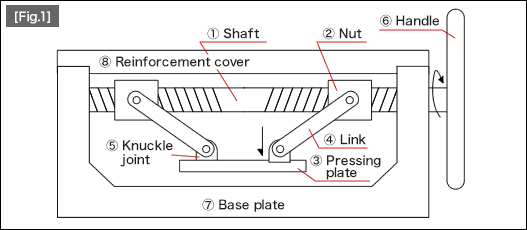
In this volume, we will look at an automation clever mechanism that converts rotary motion into linear motion in the vertical direction of the rotating shaft while multiplying the motion forces.

[Fig.1] is a diagram of this mechanism.

fig1

Application examples
1. Presswork mechanism to evenly distribute the adhesive coating
2. Presswork mechanism for printing
3. Flatness correction mechanism

Tips on selecting appropriate standard components

The parts (1) through (6) shown in the above figure can be assembled by using the standard components.

A cam is the typical mechanical component used in the rotary-linear motion conversion mechanism. In this volume, we will look into application examples of the cam.

Cams are the excellent choice because of the following characteristics:

1. Motion characteristics as speed, acceleration, and forces can be freely controlled by the output end to which the cam motion is transmitted.
2. When combined with the link mechanism, incorporating a cam into the structure allows you to design a compact, lightweight yet highly rigid mechanism in a simple structure.
3. Cams can shorten the overall cycle time as they can overlap and control multiple movements.
4. Highly reliable.

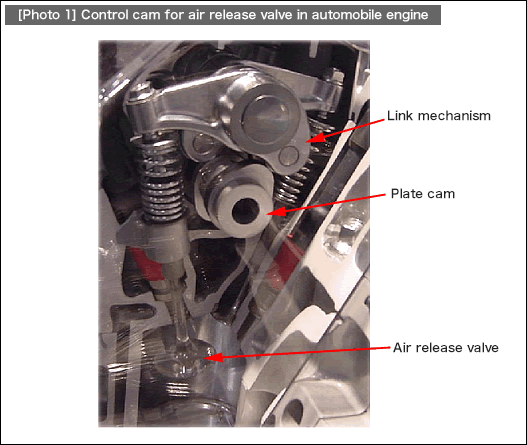
Based on these characteristics, cams are adopted in various applications including the terminal press fitting mechanism of a high-speed terminal press fitting machine, as well as the high-speed and complex timing control of an air release valve for an automobile engine. (See [Photo 1].) In the photo below, displacement of the plate cam is enlarged by the link mechanism. In order to ensure the high-speed responses, springs to prevent jumping have been installed.

fig1

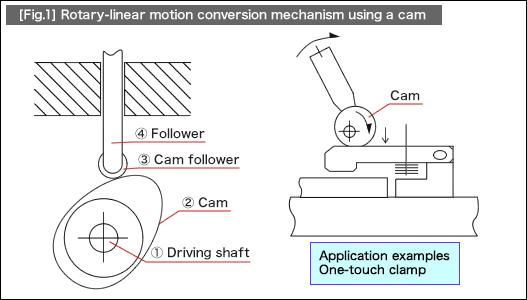
A cam introduced here as the basics of automation clever mechanisms works as a supportive element that allows for quick attachment/detachment of fixtures by transforming the linear motion displacement into forces, rather than converting rotary motion into linear motion, which was explained earlier as a superior characteristic of cams used in motion control.
In [Fig.1], the rotary-linear motion conversion mechanism using a typical plate cam and a reciprocating follower is shown left and the one-touch clamp mechanism next to it.

Application examples
•1.Clamping mechanism of one-touch lever operation system

fig1

Rotary motion can be converted into linear motion by using a screw. This volume introduces an automation clever mechanism that allows control of linear motion in various ways by adopting different types of screw structures. "Threaded" and "tapped" screws are used as a cam in this volume.

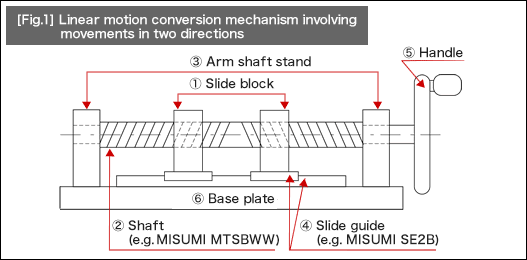
[Fig.1] is a diagram of the automation clever mechanism where two pieces of reversing screws are assembled onto a shaft.

fig1

If the handle installed on the right edge is rotated, it causes a linear motion of the slide block placed on the two tapped screws that are assembled to the opposing two screws. This structure can also be applied for a double-speed mechanism, where single rotation of the handle is transformed into a movement of twice the pitch of the rotation.

Application examples
1. Electric terminal positioning or scanning movement for inspection equipment
2. Adjustment mechanism for edge positioning of jigs compatible with various products
3. Double-speed mechanism

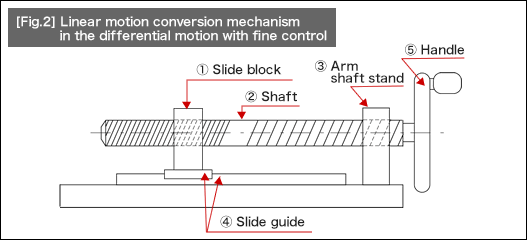
[Fig.2] shown here has a different screw structure to [Fig.1].

fig2

Moving the shaft connected to the handle by one pitch can create differential motion from the slide block movement. In other words, single rotation of the handle will move the shaft the distance of screw pitches towards the left side. Simultaneously, the slide block moves the distance of screw pitches in the reverse direction of the shaft movement (towards the right side). Since the relative motion of the shaft and slide block here is equal to the difference (differential motion) of these two movements, precise adjustment on the movement is possible. A fine thread screw has been adopted for the slide block parts in [Fig. 2]. However, using a screw with the same pitch as the right one can still produce the fine movement because this mechanism works by the differential motion.

Application examples
1. Auxiliary positioning mechanism for inspections using a magnifying microscope or positioning work.
2. Precision positioning mechanism
3. Speed reducer

In this volume, we will look at an automation clever mechanism that converts crank rotation into linear motion and makes the linear motion stroke twice that of the original one.

[Fig.1] is a diagram of this mechanism.
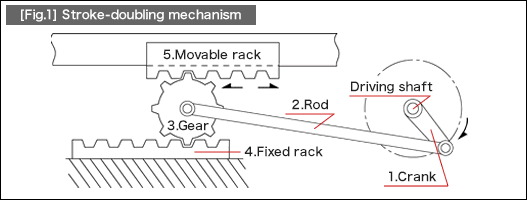
fig1

In this structure, the slider used in the standard slider crank mechanism introduced in #251 is replaced by a toothed gear. In addition, the slider guide is separated into a fixed rack and a movable rack. The crank motion on the driving shaft is transmitted to the toothed gear. Then, the stroke of rolling motion (L) over the fixed rack increases by 100% (2L) when it reaches the gear top. This stroke (2L) acts on the movable rack installed on the gear top.

(1)Application examples

The structure tends to be longer than originally intended if a pneumatic cylinder and a slide way (linear guide) are used or if a structure where ball screws are used for connecting a motor is adopted. This automation clever mechanism is an effective solution for making the fixture short and compact.

Application examples

1.Oscillating motion of a processing machine
2.Reciprocating linear motion mechanism for one-piece flow production fixture
(printing, wiping, pressuring, and others)
3.Inspection jigs

(2)Tips on selecting appropriate standard components

All of the parts shown in [Fig.1] can be assembled by using the standard components. This section explains the assembly of gears and racks.

The Module value (m) in the catalog is used to determine a combination of gears and racks. The components are compatible if items with the same module value are mixed. (See the below figure.)

Part No. Name Suggested standard components
3 Gear GEABS1.0 (Module Value) -40 (Number of Teeth) -10 (Tooth Width) - 10
4 Fixed rack RGEA1.0-500 (Nominal) --- Without hole alteration
<Alteration after purchase>
5 Movable rack Cut the fixed rack and use the separated parts
<Cut the gear 159 into two parts, 53-4 and 106-5, respectively>

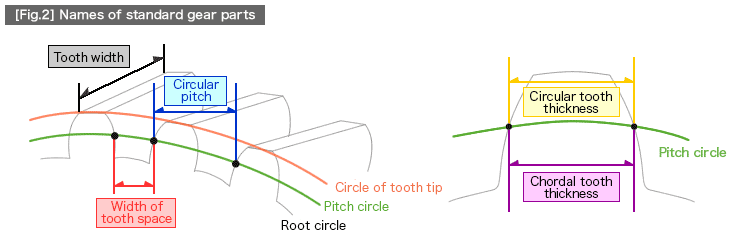
* Additional information (See [Fig.2])
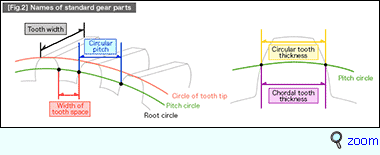
fig2
Module (m): Designation indicating the tooth size of a gear
When (d) represents the pitch circle diameter and (z) represents the number of teeth, the pitch (p) on the pitch circle, called the circular pitch, is calculated by using the following formula:

Circular pitch p = Πd / z

However, the above formula includes an irrational number Π, which is inconvenient for designs using integers. There, the formula with the module (m) is generally used for calculating the size of each tooth.

p / Π = d / z = m

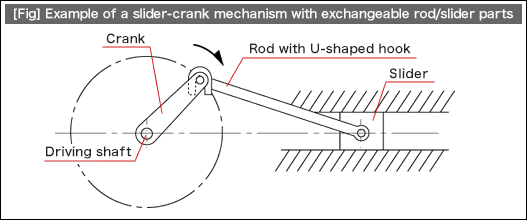
In the previous volume, we introduced a mechanism that is compatible with various models and equipped with an adjustable sliding stroke feature for the slider, as an application example of the slider-crank mechanism. In this volume, we will look at an automation clever mechanism that has a structure whose rod/slider parts in slider-crank mechanism can be exchanged in a simple operation.

[Fig] illustrates the mechanism with exchangeable rod/slider parts. A U-shaped hook is installed so that the tip of the rod can be easily connected to the hinge pin at the hinged end of the crank.

fig

(1)Application examples

For simple automation devices or fixtures made compatible with multiple models by connecting a processing unit to the slider unit, exchanging the slider unit after preparing a processing unit off-line can minimize the time required for model switching.

(1)Application examples
1. Drive mechanism of the squeegee unit for a simple screen printing machine:
Description: When materials are replaced owing to the pot life or when printing materials are replaced, it is possible to switch models quickly if you remove the slider parts with the squeegee integrated and exchange it with the slider parts with its squeegee position adjusted off-line.
2. Simple press mechanism with multi-model compatibility

(2)Precautions for application

Because of this simple coupling method, where only a U-shaped hook is placed over the rotating crank, this mechanism is not compatible with the following types of motion:

1. A high-speed rotating crank.
The self-weight of the rod may not be sufficient to follow the motion.
2. A large rotating radius.
Motion from the crank shaft to the U-shaped hook will not be transmitted effectively in some areas.
3. Motion involving unstable speed or oscillation.
The U-shaped hook may fall off.

(3)How to use a slider-crank mechanism

An area with less varying speed or with a linear trend of speed will generally be selected for use.

月別 Archives

Pages

Powered by Movable Type 6.0.3

About this Archive

This page is an archive of entries from September 2016 listed from newest to oldest.

August 2016 is the previous archive.

October 2016 is the next archive.

Find recent content on the main index or look in the archives to find all content.