October 2017 Archives

#312 Know-how on automation: Designing large automation devices

| No Comments | No TrackBacks

This volume explains the large equipment design of automation devices using the improved technology.

(1)Required performance for the large XY table

・Since many high-precision XY tables are commercially available as standard items, they can be referred to as an established technology in terms of the production technology.In this case example, the following requirements are added to the commercially available items in order to realize the high-speed driving and high-precision machining on a large-sized unit (long stroke):

* Large yet lightweight movable body is supported
* Made of materials that are insensitive to the long-term environmental fluctuation (such as temperature changes and vibration)
* Materials and structure are suitable for high-precision machining

・To meet these requirements, we developed our own model using granite stones, instead of adopting a commercially available XY table made of steel-based materials.

(2)Vital points in designing large XY table

The designer of the large automation device should consider design processes by acknowledging the following points.

<Vital points in designing large equipment>

  1. It is important to select a structural material that is insensitive to thermal displacement and vibration while the deterioration with age is minimal.
    Description: Granite stones are those used in the surface plate of precision measuring equipment (Fig.1) and have the characteristics listed in (1).
  2. Highly rigid structure (minimum deflection by the self-weight) --- See the next volume for details.
  3. Structural design allowing effortless precision adjustment during assembly
    Description: After fine-polishing the granite stone, adjust the flatness, perpendicularity and parallelism by ultra-precision machining.
    Fig.2 illustrates the sectional shape accuracy of 1.4m-long linear guide rails. The parallelism of the bottom reference plane against the top side is 0.003; the parallelism of the side reference plane against the lateral face of the rail is 0.008.
  4. Selecting inexpensive standard components that are compatible with large equipment design

[Fig.1] Granite surface plate for 3D measuring equipment

[Fig.2] Linear guide rails for large table

It is becoming more common that an automation device requiring extremely high performance (quality, cost, and delivery) must be developed in the concurrent engineering approach, meaning that the products and the automation device are developed in parallel. This volume explains the process of adopting innovative technology.

(1) Improved technology and innovative technology

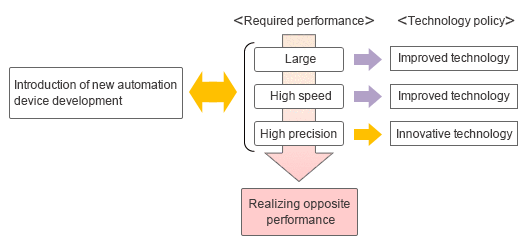
- The improved technology refers to a technology realizing the improved performance, which was developed by extending the automation element technology that has already been utilized in a similar automation device and proven effective in the actual practice.

- The innovative technology refers to a technology requiring technological development accompanied by solving new issues prior to adopting it in automation devices, as it was never utilized in a similar automation device although the fundamental technology exists.

- In this case example, technological development is carried out by distinguishing the improved technology from the innovative technology as described in the following table.

Feature to be adopted Example of development technology Description
Large
(Improved technology)
Large XY table 1.5m stroke supported (2 axes + auxiliary axis) structure guide
High speed
(Improved technology)
High-speed linear motor High-speed drive system (using non-contact guide + linear motor)
High precision
(Innovative technology)
Pneumatic hydrostatic bearing table made of granite stones Development of a mechanism allowing automatic high-precision machining on the high-speed large XY table for long hours
(2) Development policy to realize opposite performance

- To realize the opposite performance in the concurrent engineering approach, it is essential to predict possible technological risks during the planning stage, while setting up a series of tasks assigned to related personnel from the planning, design, to production phase in a simple and consistent manner.

Development policy to realize opposite performance

- To make this happen, the development management must be enforced in line with the development policies described hereinafter.

< Development policy example for adopting innovative technology >
  1. Minimize the overall risks by keeping the innovative technology involving unknown factors to 30% or less.
  2. Do not mix the improved technology with the innovative technology in the components of each development technology.
  3. Focus on the development of the innovative technology.
  4. To utilize the innovative technology into practical application, follow the consistent approach.

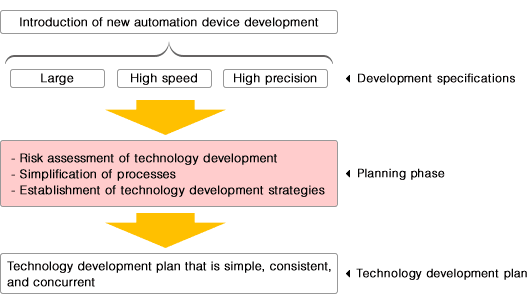
In the midst of adverse market conditions, the products manufactured by using automation devices are required to support large variety of products and to have higher quality and performance, while being available for lower price. To accommodate such needs, the automation devices must also meet the higher performance requirements - Quality, Cost, and Delivery.However, when developing an advanced automation device, there are many cases where technologically opposite qualities are required.This volume explains how to proceed with the development of automation devices successfully.

(1)What to do in the planning stage of developing an automation device

・When developing a new automation device, there are opposite specification details to be achieved.For example, to develop a device that is large and meets the high-speed and high-precision requirements, these features are difficult to realize as they contradict one another.

・When a device becomes large, the driving distance becomes longer. Therefore, it is difficult to realize the assembly accuracy. In addition, the increased device weight makes the high-speed design and the acceleration speed control difficult.If you make the device high-speed, the deformation force caused by factors such as the moment of inertia will make the high-precision design difficult to realize.

・When developing an automation device requiring new technologies, it is important to consider how to develop the machine in the planning phase and define how to realize the opposite specifications.

・In this case example, the large and high-speed design was achieved by using the improved technology, which is an improvised version of the existing technology. To resolve the contradiction that occurs by incorporating the high-precision design, an innovative technology was adopted in the development process.

image

Case examples:

・This case is about the development of an automation device that uses a laser to sublime and eliminate the fine straight lines of an organic thin film, which is generally produced by etching.

・In the etching process, a fine straight-line pattern is formed by a high-precision mask. For the machine to be developed, it is necessary to realize the drive table that is large yet fast and accurate.

・Adopting this automation device can transform the production environment to cleaner and more compact one since the huge production line including the chemical management process is no longer needed.

General description

This volume introduces the specifications of the simplified cleaning equipment designed for smaller lots, cleaning process design, and the conception picture of the simplified cleaning equipment (simple automation supported) that conforms to the specifications and design.

Explanation
(1) Specifications of simplified cleaning equipment suitable for smaller lots

1) Equipment size
The machine operator must finish cleaning using the manual or simple auto mode of the simplified cleaning equipment within the time required for the compact machine tool to finish processing the goods. Therefore, the cleaning equipment must be designed in a size that can be installed at a reachable location from the operator.

2) Cleaning quality
Even when using the simplified cleaning equipment, contaminants that should be eliminated in that process must be washed off consistently. Adopting an electric motor for driving the cleaning brush is recommended for achieving stable cleaning performance.

3) Workpiece transfer
To clean the entire circumference of the workpiece, the one-way transfer design must be adopted. To make the equipment lightweight, compact, and simplified, a simplified linear guide (similar to the linear bushing) that is manually operated is adopted for the mechanism in the conception picture. In addition, a simple auto method should work as well.

4) Cover
The ideal cover is transparent enough to make the cleaning status visible. If you adopt a shape and/or a material that prevents contaminants from being stuck in the corners or gaps inside of the cover, you will be able to minimize reattachment of the contaminants.

(2) Cleaning process design

- When removing machining fluid and chips after the machining process, it is recommended to eliminate the solvent immediately before allowing the machined workpiece to dry up. For this reason, the simplified cleaning process is designed similar to the batch cleaning process. It must have the rinsing process where the solvent is washed off with water.
- Therefore, the simplified cleaning process should consist of the following two steps: (1) Solvent immersion + (2) Solvent rinsing.
- In the solvent immersion step (1), the solvent is prepared by putting the solvent into a stainless steel container. Right after the machining, the machine operator dips the workpiece into the solvent for the specified duration (to be determined in accordance with the previous and subsequent tasks).
- In the solvent rinsing step (2), the machined workpiece with the (1) solvent attached will be washed by the simplified cleaning equipment, followed by water washing to rinse off the solvent.

(3) Conception picture of simplified cleaning equipment

- Fig.1 shows a conception picture example for the simplified cleaning equipment, which is developed based on the proposed specifications of this equipment and the process design details.

[Fig.1] Conception picture of simplified cleaning equipment

月別 Archives

Pages

Powered by Movable Type 6.0.3

About this Archive

This page is an archive of entries from October 2017 listed from newest to oldest.

September 2017 is the previous archive.

November 2017 is the next archive.

Find recent content on the main index or look in the archives to find all content.