May 2016 Archives

Knowing the concept of resolution of forces is useful for analyzing how the applied load on a bearing is working towards the bearing guide wall. We will learn about the resolution of forces in this volume.

(1) What is the resolution of forces

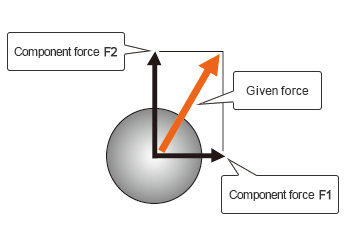
- The resolution of forces is a process of breaking down single force into two or more forces whose combined effort will be equal to the original force.

- Component force is a division of single force.
image

- The resolution of forces is an opposite analysis method of the composition of forces.

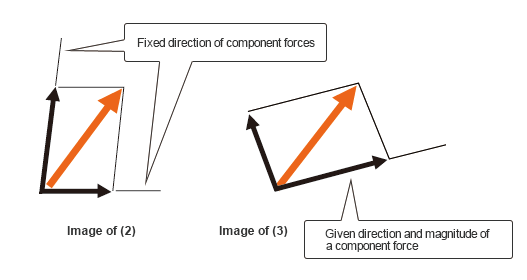
- The resolution of forces generally has conditions applied to the direction of component forces.
For example, the following conditions may apply:
1) Directions of two component forces form a right angle (the above figure)
2) Directions of two component forces are fixed at certain angles
3) Direction and magnitude of a component force are given
image

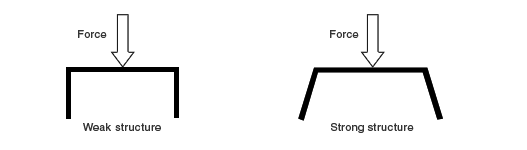
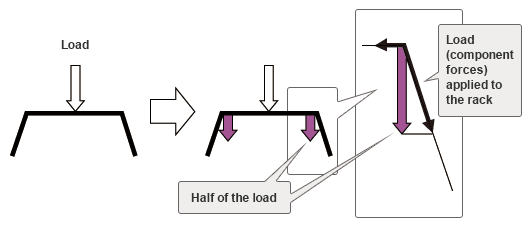
This is an example of the rack structure. The load applied to the rack constitutes a component force.
image

b) Resultant force of more than two forces

fig

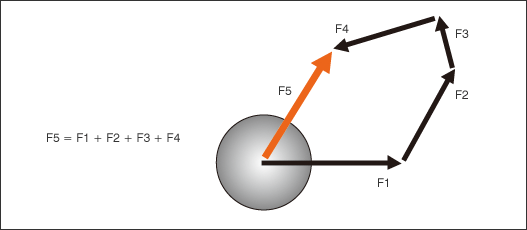
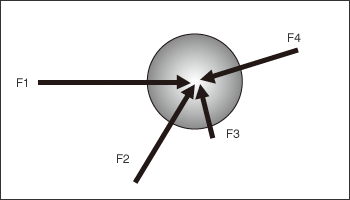
- In this section, we will learn about the composition of multiple forces on the same planar surface that are being applied to a center point of the ball.
- In the above figure, four different forces (vectors) F1, F2, F3, and F4 are applied to the center of the ball O.
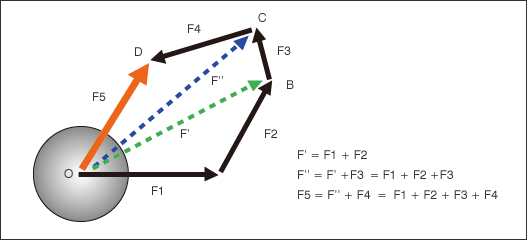
- In this case, the resultant force is represented by an arrow of the last side (F5) of a polygon connected by four vectors.

fig

= Description =

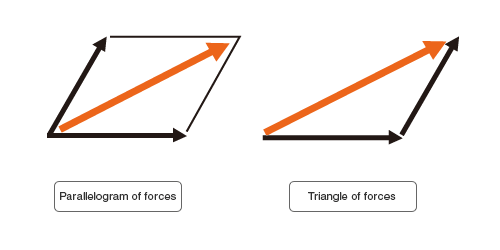
- In the previous volume, we learned that the diagonal line for the parallelogram of forces represents the resultant force of two forces.
- The same result can be obtained by analyzing a triangle of forces in geometric configuration.

fig

- It is possible to compute the resultant force of multiple forces by using this triangle of forces for the analysis.
- Even when multiple forces are applied to the ball, you can calculate the direction and magnitude (F5) of the ball's movement using the resultant force.

fig

In addition to the mechanical component that does the work, the entire structure is affected by force transmission and durability for all mechanical devices. In this volume, we will learn about the concept of force transmission from the relationship of "composition and resolution of forces".

(1) Composition of forces

In general, multiple forces are applied to a mechanical component. The effect of these forces combined can be expressed as the single force. The combined force here is called a "resultant force".

a) Resultant force of two forces along the crossing lines of action

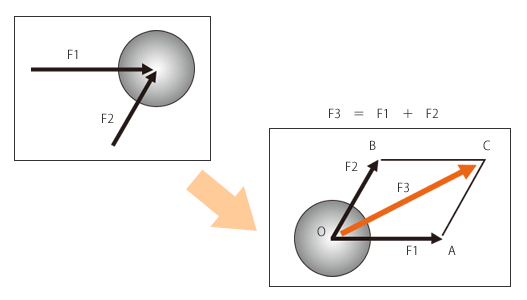
As shown in the below figure, the resultant force can be explained by to which direction and how much force being applied to the ball when two forces F1 and F2 (in different direction and magnitude) are applied to the ball.

How to compute the resultant force of two forces

= How to compute the resultant force of two forces =

- Draw a parallelogram consisting of the two sides F1 and F2.
The parallelogram OABC in the right figure is called "parallelogram of forces".

- Of the two diagonal lines of this parallelogram, the diagonal line directing to OC (direction of force) drawn from the same point of application of F1 and F2 and the length (magnitude of force) represent the resultant force (force composition) of the two forces F1 and F2.

- Therefore, the ball moves in the orange arrow direction (F3) at the force ratio represented by the length of the arrow.

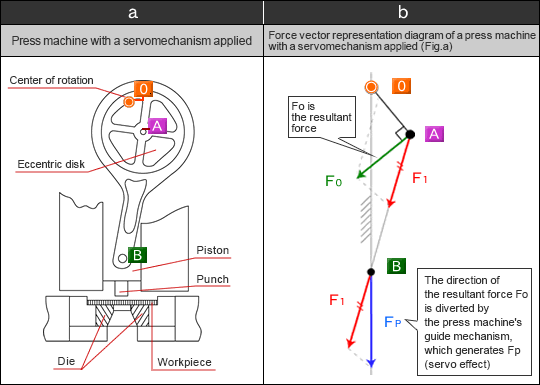
- As a case example of analyzing resultant forces, we prepared these graphic illustrations of the press machines with servomechanisms applied.

illustrations

When we design an automation device, it is necessary for us to understand the force, action and moment of the resultant force, as well as the acceleration of the motion and its effects. In this category, we will learn about mechanical engineering and automation device design.

(1)Mechanical devices and mechanics

A mechanical device is comprised of the following components:

Fig

The last two units mentioned here are the mechanical components strongly related to static mechanics without involving motion. Understanding forces, resultant forces, or resolution of forces will improve design quality of the mechanical components.

Fig

(2)Force and its expression

- When a force is applied to an object, it changes the state of an object from rest to motion or vice-versa.

- When a force is applied, it changes the motion state of an object or causes the object to deform.

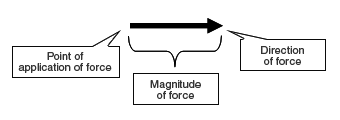
- The state of force is expressed by the point of application and the line of action indicating the force direction. The magnitude of force is expressed by the length of the line of action. The arrow indicating all of these elements is called a "vector".

Fig

- Symbol N (Newton) indicates the magnitude of force. 1 N is equal to the force needed to accelerate a 1 kg mass at a rate of 1 m/s².

(3)Composition of forces

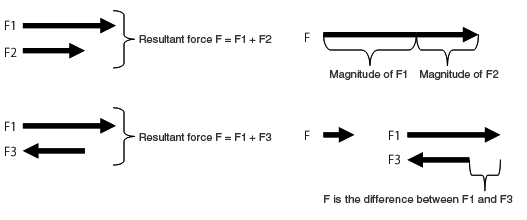
- In general, multiple forces are applied to a mechanical component. The effect of these forces combined can be expressed as the single force. The combined force here is called a "resultant force".

Resultant force along the same line of action

Fig

月別 Archives

Pages

Powered by Movable Type 6.0.3

About this Archive

This page is an archive of entries from May 2016 listed from newest to oldest.

April 2016 is the previous archive.

June 2016 is the next archive.

Find recent content on the main index or look in the archives to find all content.