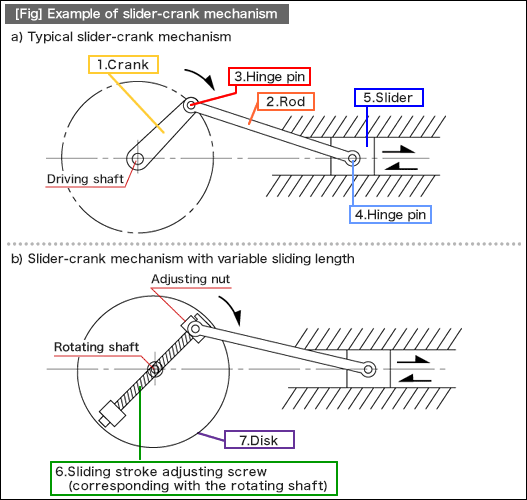
[Fig] a) is a slider-crank mechanism, which is a typical structure converting rotary motion into linear motion, achieved by connecting a slider and a crank with a rod. This mechanism is also utilized as a system that converts reciprocating linear motion of an automobile engine into rotary motion. (See [Fig.1] a.)
[Fig] b) is an example of the mechanism that has the same functions as [Fig] a), in addition to the sliding stroke adjustment feature for the slider. To add this feature, the sliding stroke adjusting screw is placed on top of the rotation shaft center of the rotation disk. The sliding stroke can be adjusted by the adjusting nut located on one end of the sliding stroke adjusting screw. This is an effective method if the mechanism shown in [Fig] a) needs to have a function that is compatible with various models. In addition, if high-speed rotation or operation for long hours is required, it is necessary to consider design items related to the reliability matters described here.
| 1. | Rotation balance of rotating body (the entire structures on the disk) | |
| 2. | Strength of rotating shaft | |
| 3. | Prevention of adjusting nut-loosening (e.g. double-nut system) | |
| 4. | Selection of wear-resistance parts for the area subject to wear |
•Example of standard component uses
|

![[Fig.1] Reciprocal linear motion conversion mechanism by spiral groove](/tt/en/lca/079.gif)
![[Fig.1] Example of safety mechanism in a linear motion unit](/tt/en/lca/497_2.gif "[Fig.1] Example of safety mechanism in a linear motion unit")
![[Fig.2] Example of safety mechanism in a linear motor driving unit](/tt/en/lca/497_3.jpg "[Fig.2] Example of safety mechanism in a linear motor driving unit")

