・ There are such products available that incorporate two sensors facing each other to ensure positioning with greater accuracy as a product design for increased processing data rate.
・ In this case, the sensors cost high and therefore, the designed assembly process may adopt temporary installation with fastening screws to prepare for possible reprocessing of any assembled products found insufficient in the accuracy of positioning in the assembly process (Fig.1).
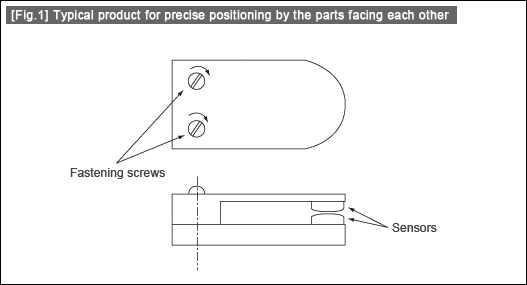
・ In this production method, the components are fastened to each other with adhesive after proper accuracy is found to have been obtained by the temporary fastening with screws.
・ The positioning with use of fastening screws will inevitably cause factors for positioning errors as listed below (Fig.2).
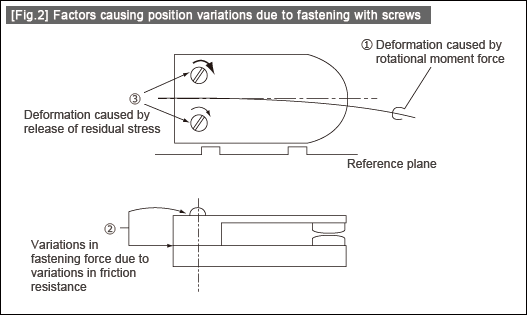
(1) Deformation of parts caused by the rotational moment force generated by the tightening torque of fastening screws
(2) Variations in applied clamping force due to variations in friction resistance on the contact surface clamped by fastening screws
(3) Deformation caused by residual stress and its release of tightening torque
・ Those listed above in (1) through (3) will greatly depend on the number and arrangement of fastening screws.
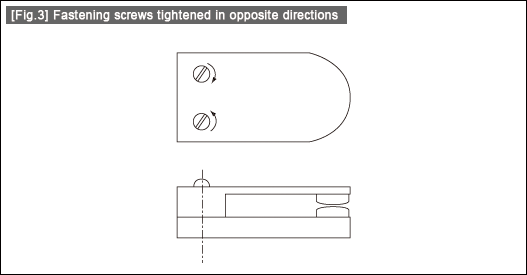
・ One of the solutions to (1) and (3) includes tightening two fastening screws in opposite directions. Even in this case, the accuracy of positioning will be limited to a certain level due to differences in timing of tightening two screws and/or other factors (Fig.3).
Precautions
・ Even when tightening torque is controlled with a torque wrench, there are many other variable factors (e.g., parallelism between the surfaces to be fastened, friction resistance) involved and therefore variations in quality may not be totally eliminated, depending on the level of proficiency in the work.
![[Figure1] Etching sheet and positioning holes (indicated by arrows)](http://www.misumi-techcentral.com/tt/en/lca/504_01.jpg "[Figure1] Etching sheet and positioning holes (indicated by arrows)")
![[Figure 2] Typical magnetic sensor](http://www.misumi-techcentral.com/tt/en/lca/504_02.jpg "[Figure 2] Typical magnetic sensor")
![[Figure3] Features of accuracy of etched holes](http://www.misumi-techcentral.com/tt/en/lca/504_03.gif "[Figure3] Features of accuracy of etched holes")
![[Figure4] Influence of variations in the diameter of etched hole](http://www.misumi-techcentral.com/tt/en/lca/504_04.gif "[Figure4] Influence of variations in the diameter of etched hole")
![[Figure5] Typical design allowing a dowel pin to slide up and down](http://www.misumi-techcentral.com/tt/en/lca/504_05.gif "[Figure5] Typical design allowing a dowel pin to slide up and down")
![[Figure1] Cursor lines in the microscope[Figure2] The reference lines on the workpiece are becomes hard to see.](http://www.misumi-techcentral.com/tt/en/lca/502_1.gif "[Figure1] Cursor lines in the microscope[Figure2] The reference lines on the workpiece are becomes hard to see.")
![[Figure3] Positioning with a clearance left between the cursor lines in the microscope and the reference lines on the workpiece](http://www.misumi-techcentral.com/tt/en/lca/502_2.gif "[Figure3] Positioning with a clearance left between the cursor lines in the microscope and the reference lines on the workpiece")
![[Figure4] Typical cursor lines for precise angular adjustment](http://www.misumi-techcentral.com/tt/en/lca/502_3.gif "[Figure4] Typical cursor lines for precise angular adjustment")
![[Figure5] An example of easy-to-identify cursor lines](http://www.misumi-techcentral.com/tt/en/lca/502_4.gif "[Figure5] An example of easy-to-identify cursor lines")

