The direction-changing mechanism is a mechanical component that alleviates restrictions such as arrangement or size on the mechanism design when transmitting forces from the driving shaft to the driven shaft. In other words, this mechanism changes the direction of forces or motion from the driving shaft without transmitting them as they are. In the next two volumes, we will study the typical examples of a direction-changing mechanism.
(1)Direction-changing mechanism using bell-crank
[Fig.1] is an example of the direction of motion changing between two links on the same plane of a 90-degree bell-crank.
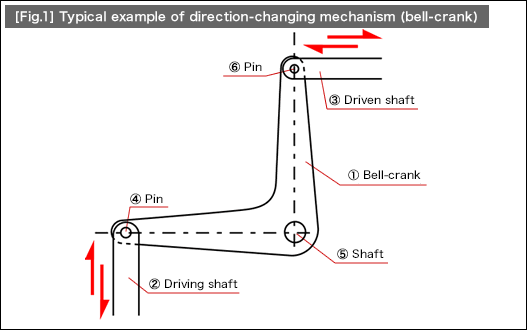
The bell-crank shown here is a component consisting of two links connected at a certain angle on the same plane. In [Fig.1], the vertical reciprocating motion of the driving shaft (2) is transformed into the horizontal reciprocating motion of the driven shaft (3).
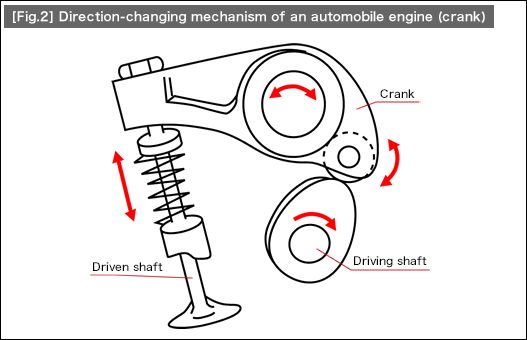
[Fig.2] illustrates the direction-changing mechanism (crank) adopted for automobile engine parts.
= Cautions on designing direction-changing mechanism using links and a bell-crank =
In the case of [Fig.1], forces from the driving shaft will be transmitted through the pin (4) to the bell-crank. The forces rotate around the shaft (5) and travel to the driven shaft (3) through the pin (6). When designing this structure, the following two points must be kept in mind:
| a) | Select appropriate fit dimensions for pin diameter/hole and shaft diameter/hole for smooth movement | |
| b) | Adopt abrasion-resistance measures |
The table here shows a dimensional relationship among pin diameter, shaft diameter, and the corresponding hole for the three types of motion statuses. All dimensions are based on the "clearance fit".
|
For how to select fit dimensions, details will be introduced in another volume.
In the next volume, we will learn about the direction-changing mechanism using springs.
![[Fig.] Example of intermittent motion mechanism using friction force](/tt/en/lca/089.gif "[Fig.] Example of intermittent motion mechanism using friction force")
![[Fig.1] Typical example of oscillation conversion mechanism](/tt/en/lca/086_1.gif "[Fig.1]")
![[Fig.2] Example of rotary-oscillating motion conversion mechanism with the swing angle control during operation](/tt/en/lca/086_2.gif "[Fig.2]")

