December 2015 Archives

#219 Universal Design: What is Universal Design?

| No Comments | No TrackBacks

In line with the rapid aging of society in Japan and on a global scale, it is becoming more important to incorporate design concept in consideration of older adults and people with disabilities. In response to changes including diversification and aging of consumers and enhancement of consumer protection in particular, it is inevitable to adopt this concept in the product development and designing stage. This section explains universal design and introduces the related design concepts.

What is Universal Design?
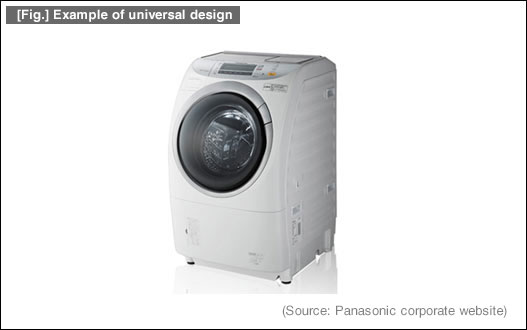
  • Universal design refers to the concept of designing products and the built environment to be usable to the greatest extent possible by everyone without special alterations or unconventional design work.
  • This design concept was emerged in the United States around 1985. It also has been adopted in Japan since the early 1990s.
  • The following seven principles of universal design have been developed.

    = The Seven Principles of Universal Design =

    (1)Equitable Use: The design is useful and marketable to people with diverse abilities.

    (2)Flexibility in Use: The design accommodates a wide range of individual preferences and abilities.

    (3)Simple and Intuitive Use: Use of the design is easy to understand, regardless of the user's experience, knowledge, language skills, or current concentration level.

    (4)Perceptible Information: The design communicates necessary information effectively to the user, regardless of ambient conditions or the user's sensory abilities.

    (5)Tolerance for Error: The design minimizes hazards and the adverse consequences of accidental or unintended actions.

    (6)Low Physical Effort: The design can be used efficiently and comfortably with minimum fatigue.

    (7)Size and Space for Approach and Use: Appropriate size and space is provided for approach, reach, manipulation, and use regardless of user's body size, posture, or mobility.

  • The seven principles of universal design can be applied to the principles of designing production facility and tools used in production lines. Especially, these principles will be the important hints on designing devices designated for older adults.
  • The design concepts similar to universal design are as follows:
    ∗Design For All
    ∗Barrier Free Design
    ∗Inclusive Design --- <Inclusive: Covers all aspects in a comprehensive manner>
Figure

As mechanical systems require their mechanism drawings, it is necessary to prepare a design drawing for pneumatically/hydraulically driven systems. This section explains the design drawing of a pneumatically driven system.

  • The basic rules of mechanical design are defined in the followings: JISB0001 Technical drawings for mechanical engineering, JISB0002-1, 2, 3 Technical drawings - Screw threads and threaded parts, and JISB0401-2 ISO system of limits and fits.
  • In the same manner, the basic rules of pneumatically/hydraulically driven systems are defined in the followings: JISB0125-1: Fluid power systems and components - Graphic symbols and circuit diagrams - Part 1: Graphic symbols, JISB0125-2: Fluid power systems and components - Graphic symbols and circuit diagrams - Part 2: Circuit diagrams, and JISB0142: Fluid power systems and components - Vocabulary.
  • In the basic rules of mechanical design, the following design rules have been determined: (1) type and thickness of a line and (2) simplified notation system of each mechanical component (machine element), such as springs, screws, and shafts. In the process of designing a pneumatically driven system as well, the followings have been defined: (1) type and thickness of a line and (2) simplified notation system of parts comprising of each pneumatic system (refer to Vol.30 and 31).
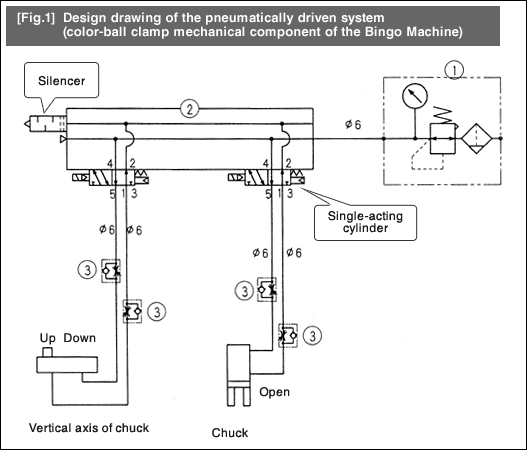
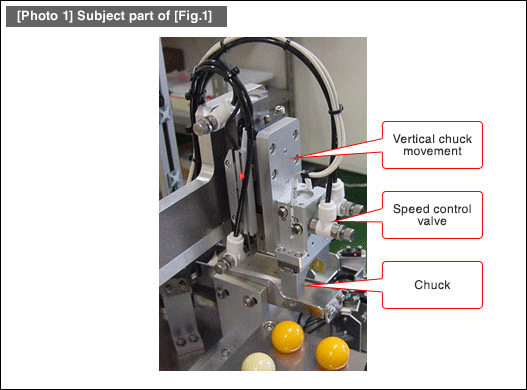
  • [Fig.1] is an example of a design drawing on a pneumatically driven system installed in the color-ball clamp mechanical component of the Bingo Machine. The part number (1) is a filter regulator, (2) is an accumulator, and (3) is a speed control valve. The other components include a single-acting cylinder and a silencer.
  • Since this design drawing includes parts specifications, the drawing also illustrates components, specifications, piping layout, open/close status of the chuck parts along with the positional relationship of the vertical chuck axis.

    Figure

    Figure

月別 Archives

Pages

Powered by Movable Type 6.0.3

About this Archive

This page is an archive of entries from December 2015 listed from newest to oldest.

November 2015 is the previous archive.

January 2016 is the next archive.

Find recent content on the main index or look in the archives to find all content.