June 2016 Archives

To design a structure of mechanical equipment, it is necessary to consider where you design the center of gravity, such as by designing the support legs (casters) according to the gravity center of the entire unit, lowering the center of gravity for the movable body, for example. We will learn about the center of gravity in this volume.

(1) What is the center of gravity

- Every object has an equilibrium point that balances the object in any position or condition. In other words, if the object is supported at this point, the object can remain in the stable resting state in any position or condition. This point is called "center of gravity" (or "center of mass").

- The center point of a ball will be the center of gravity. The center of gravity for a planar quadrangle is the intersection of diagonal lines. The center of gravity for a triangle is the intersection of median lines.

- For a complex shape, the center of gravity is determined by considering this shape as being made up of several elementary shapes.

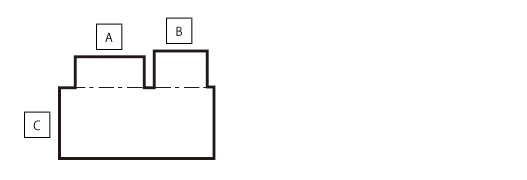
- The figure shown below is an aggregate of three quadrangles (A, B, and C). Each center of gravity is the intersection point of the diagonal lines. Consider that each weight applies to these three centers of gravity. Then, the point of application of their resultant force is the center of gravity.
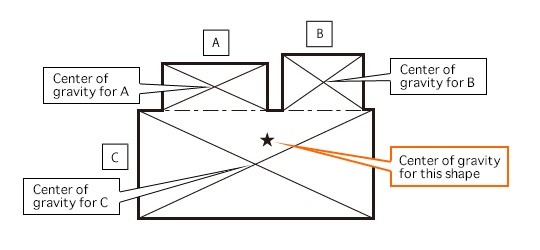
image

(2) How to calculate the center of gravity for complex shapes

- Split a complex shape into an aggregate of simple shapes. Split it into three quadrangles (see the below figure).
image

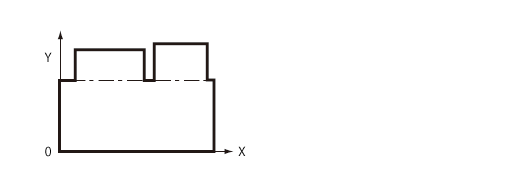
- Define easy-to-understand X-Y orthogonal coordinates for this shape (see the below figure).
image

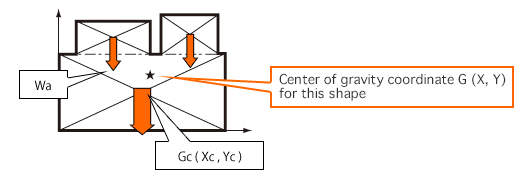
- Compute the weight of three quadrangles and name each of them as Wa, Wb, and Wc.
Each center of gravity is expressed as Ga, Gb, and Gc, respectively. Their coordinates are Ga (Xa, Ya), Gb (Xb, Yb), and Gc (Xc, Yc) accordingly.
image

- The entire weight is expressed as W = Wa + Wb + Wc

- Formula for the moment of force from the coordinate origin O is as follows:
Wa × Xa + Wb × Xb + Wc × Xc = W × X
Wa × Ya + Wb × Yb + Wc × Yc = W × Y

Based on the above two formulas, the center of gravity G (X, Y) will be calculated in the following formulas:

X = (Wa × Xa + Wb × Xb + Wc × Xc) ÷ W
Y = (Wa × Ya + Wb × Yb + Wc × Yc) ÷ W
In this volume, we will learn about the equilibrium of forces when forces apply onto an object at different points of application.

(1)Equilibrium of forces when forces apply at different points of application

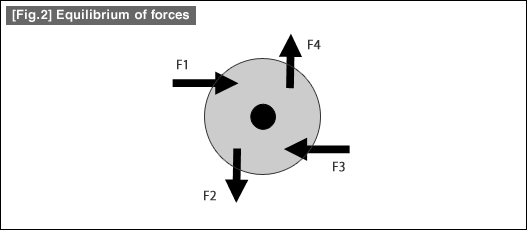
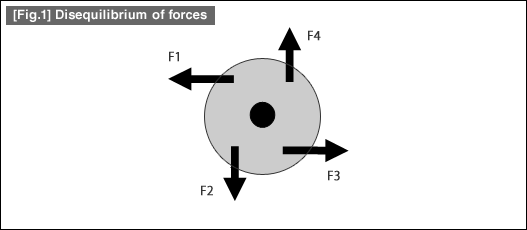
- When the forces are applied to a disk at four different points of application as shown in the below figure, you can predict that this disk will rotate in a counterclockwise direction. Therefore, the forces applied to this disk are not in an equilibrium state.

Fig1

- If forces in different directions are applied at the same points of application as those shown above, the disk stops rotating and enters into a resting state. In this case, the forces applied at different points of application are in an equilibrium state.

Fig2

(2)Equilibrium conditions for forces from different point of application

The forces are in an equilibrium state when the following conditions are met for forces from different point of application.

a)The resultant force (Fi) of all forces becomes zero.

ΣFi = 0

b)The sum of moments of these forces (Mi) applied to an arbitrary point becomes zero.

ΣMi = 0

In the case of [Fig.2],

For a) : The resultant force of F1 and F3 is zero. The resultant force of F2 and F4 is also zero.

< F1 + F2 + F3 + F4 = 0 >

For b) : F1 and F3 have the same arm of moment in the opposite directions. Therefore, the moment is in an equilibrium state.

< M1 + M2 + M3 + M4 = 0 >

When the object is motionless even with two or more forces applied on the object, these forces are in an equilibrium state.

(1) Equilibrium of forces applied on a single point

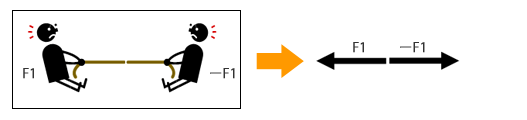
- For a tug of war, the rope position does not move when this rope is being pulled towards opposite directions at the same strength of forces. This is an equilibrium state of forces (See the below figure).

image

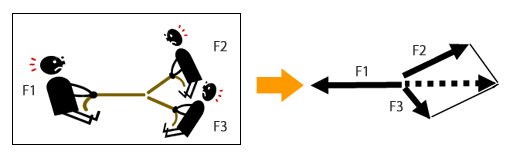
- When the resultant forces are the same in opposite directions, it will create an equilibrium of forces even though the forces are not applied on the same line.

image

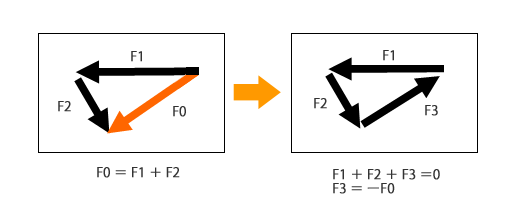
- When a force is applied from the opposite direction of the resultant force, forming a triangle of forces, these forces are in an equilibrium state. In this case, the polygon of forces is closed in the same direction (see the right image shown below).

image

(2) Case example of force equilibrium in mechanical equipment

- For high-speed and high-precision motion control of a heavy movable body, the mechanism with equilibrium of forces applied may be incorporated into the design in order to reduce the load burden on the movable body.

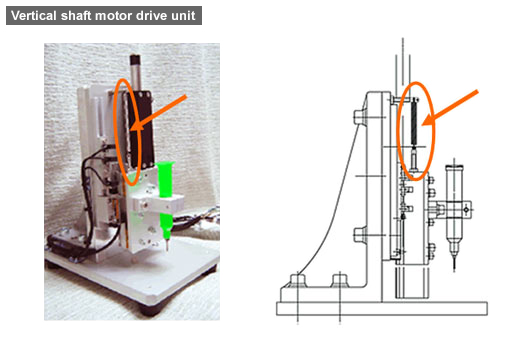
- For the vertical drive control mechanism in particular, keep the forces in equilibrium by adding a spring (see the images below), an air cylinder, or a pulley on one side and placing a weight on the other side.

Vertical shaft motor drive unit

In order to bring out the high-speed drive performance of a linear motor (shaft motor), the spring suspension structure has been adopted for weight reduction of the vertical movable body.

By applying a force at a position distanced from the point of application of force, the object with the force applied will be affected by the turning force. We will learn about the action of force in this volume.

(1)Moment of force

- By applying a force at a position distanced from the point of application of force, the object with the force applied will be affected by the turning force. The effect of this force is called a "moment of force".

- The moment of force increases in proportion to the distance from the point of application of force.

- The distance from the center of rotation to the point of application of force (vertical distance) is called an "arm of moment".

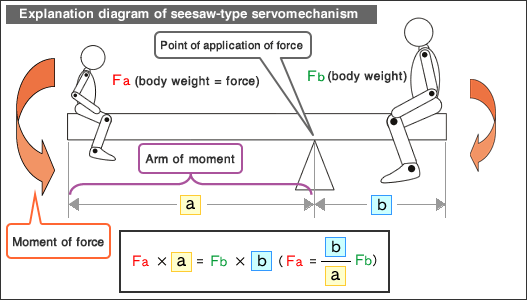
- It will be easier to understand the moment of force if you think of how a seesaw works.

fig

- In the above figure, the moment of force (M) for the seesaw can be computed by the relationship between force (Fa) and the length of arm of moment (a) in the following formula:

M = Fa x a

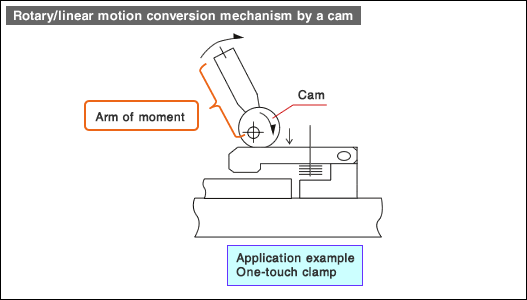
- The moment of force is utilized in various mechanisms such as the clamping mechanism (see the below figure) and the servomechanism (tightening by wrench).

fig

月別 Archives

Pages

Powered by Movable Type 6.0.3

About this Archive

This page is an archive of entries from June 2016 listed from newest to oldest.

May 2016 is the previous archive.

July 2016 is the next archive.

Find recent content on the main index or look in the archives to find all content.