July 2015 Archives

In the previous sessions, we have introduced a parts supply system, collection mechanism, and sensing technology, using the Bingo Machine as an example.In this section, we will introduce the overall operation of the parts supply and collection system using specific examples.

  • The parts supply system is comprised of the following tasks:
    Parts Supply = Storage + Alignment + Feeding + Separation
  • Feeding is a mechanism that transfers parts from the alignment position to the work position.
  • Separation is a mechanism that picks up only the required pieces of aligned parts for a single task.
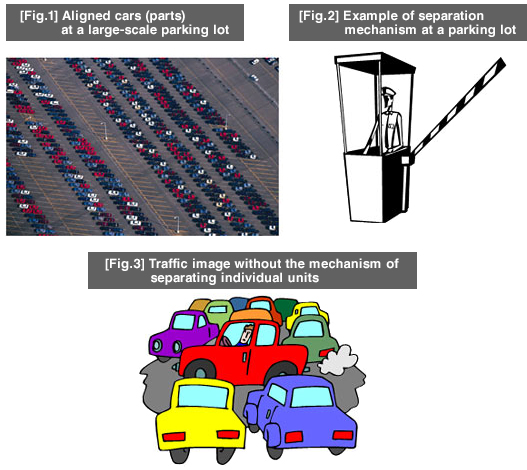
  • The entire system of the parts supply mechanism is extremely similar to the control system and structure of a large-scale parking lot.
    Operations in the
    parts supply system
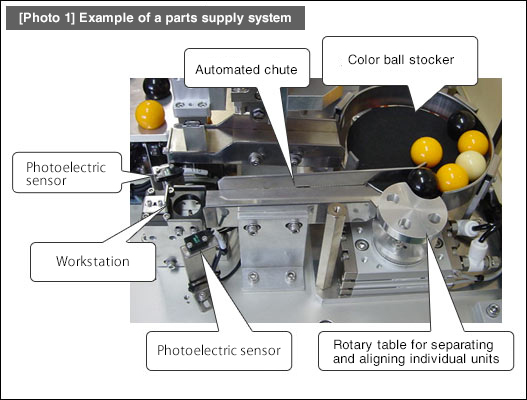
    Examples in the Bingo Machine [Photo 1] Examples in a large-sized parking lot
    Storage Color ball stocker
    Parts feeder ball
    Large-sized parking lot ([Fig.1])
    Alignment
    (including separation of individual unit)
    Rotary table for separating individual unit Guide path of single lane design
    Feeding Self-weight rolling chute Guide path of single
    lane design in the helical structure
    Separation (escapement) Workstation with photoelectric sensor Control by a parking
    guide before the toll booth ([Fig.2])
    or public street
  • A structure without the mechanism of separating individual units brings about chaos as shown in [Fig.3].
    Figure

    Figure

When designing machinery equipment containing a movable body, the designer needs to check in the early stages of the designing process that unforeseen problems do not occur throughout the moving range of the movable body. This section introduces the design technique for a movable body.

  • Two-dot chain lines (also called imaginary lines) are used for illustrating the operating state. Dashed lines (also called hidden lines) are used for illustrating invisible (hidden) structures.

    Figure

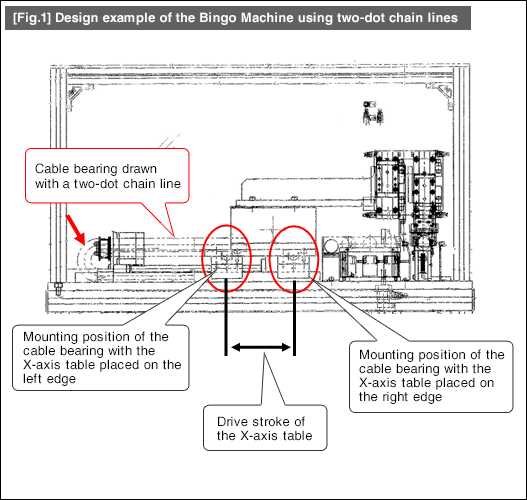
  • Draw a two-dot chain line (imaginary line) to illustrate the maximum stroke position in the movable range when designing a movable body in the assembly diagram.
  • The designer must check that the condition of the movable body does not cause any structural problems at this maximum stroke position.
  • In the example of the Bingo Machine shown in [Fig.1], two-dot chain lines indicate the cable bearing state at the maximum stroke position of the X-axis table.
  • Based on the state of the two-dot chain lines in [Fig.1], you can verify the following:
    (1) It is designed with sufficient room that the cable bearing does not touch the cover even when the X-axis table moves to the leftmost position.
    (2) In the plan view seen from above (not [Fig.1]), the cable bearing does not get in the way of the manifold regulator of the air cylinder installed on the back.

    Figure

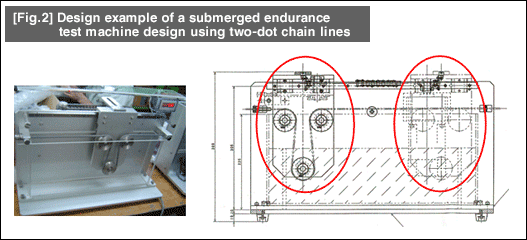
  • [Fig.2] is an example of the submerged endurance test machine. The movable body is illustrated at two positions: left end (solid line) and right end (two-dot chain line).

    Figure

月別 Archives

Pages

Powered by Movable Type 6.0.3

About this Archive

This page is an archive of entries from July 2015 listed from newest to oldest.

June 2015 is the previous archive.

August 2015 is the next archive.

Find recent content on the main index or look in the archives to find all content.