September 2011 Archives

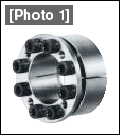
Methods of fastening two coaxial rotating parts (shaft and hub pair: shaft and sprocket, gear, pulley, etc.) include: (1) keyed fastener, (2) screw fastener, and (3) friction locking methods. This section describes an easy-to-lock-and-unlock, reliable friction locking device, the standard Mecha-lock (FACE FA Standard Parts Catalog P993−996: [Photo 1]) Photo 1

(1) Principle of friction locking

The screws of a friction locking device tighten to apply radial force to the outside diameter surface of a shaft and the inside diameter surface of a hub to produce the frictional force that coaxially locks the shaft and the hub.

(2) Structure of Mecha-lock

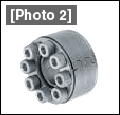
The Mecha-lock selected for use in the work transfer conveyor is a tapered sleeved MLNP10. (See p. 996 of the catalog and Fig. 1.)

[Fig. 1] Cross-sectional view of the tapered sleeved Mecha-lock

Tightening the locknuts produced the nominal force by the wedge effects from the outer ring and the inner ring. The frictional force produced by the nominal force locks the motor shaft and the sprocket. Photo 1
Advantages Disadvantages (remarks)
  • Easy assembly and disassembly. Reusable an unlimited number of times.
  • High degree of freedom in relative positioning of two rotating parts as assembled.
  • No extra machining required on the shaft. Inexpensive and robust.
  • Tight assembled brings high performance for vibration and impact.
  • Provides a centering effect.
  • Shaft outside diameter tolerance of h8 and hub inside diameter tolerance of h8 recommended.
  • Surface roughness: To be finished to 3.2a or less to stabilize the frictional force.
  • Tighten the lock screws with a torque wrench to ensure even application of the clamping torque.
  • Select a Mecha-lock to match the materials of the shaft and the hub (yield stress).

A transfer conveyor belt is usually driven at a low constant speed. Accordingly, a gear head induction motor with a reduction ratio of 60:1 is selected here as a driving power source. To transmit this driving power efficiently to the flat belt pulley for driving the conveyor belt, a chain-driven power transmission system (Photo 1) is applied here:

[Photo 1] Chain-driven power transmission system

(1) Characteristics Comparison between Chain-Driven Transmission System and Other Systems

The table below shows the comparison of typical power transmission systems. A chain-driven power transmission system is selected here for high transmission efficiency and ease of design (with high flexibility for the design of two shafts space distance):

Comparative performance parameter Chain Timing belt Gear
Design flexibility of shafts space Good Good Very poor
Transmission efficiency High
(98% or higher)
Medium Medium
Synchronization performance Good Good Very good
Noise and vibration High Low High
Maintainability Poor
(Lubrication required)
High Poor

(2) Sprocket chain design method

Explanation of the load calculation method is omitted here because of the low speed and not-heavy transmission load on a sprocket chain. The number of sprocket-teeth and the number of chain links can be determined according to the procedure below. A safety cover over the chain is required.

  1. Determine the distance between the motor shaft and the flat belt driving pulley shaft.
  2. Determine the ratio of the number of teeth on the two sprockets (speed ratio).
  3. Determine the number of teeth on the smaller sprocket. .
  4. Determine the number of teeth on the larger sprocket from the speed ratio.
  5. Select a product series from the sprocket chain catalog.
  6. Use the formula below to calculate the number of chain links corresponding to the chain length .
  7. Round up the calculated value to the nearest integer to determine the number of chain links. After drilling long holes for base fixing in the motor mounting bracket, adjust chain tension during assembly.

Number of chain links (LP) =
1 / 2 (N1 + N2) + 2CP + [(N1 - N2) / 2π ] 2 � CP

N1: Number of teeth on the larger sprocket
CP: Shafts space distance expressed as a number of teeth
N2: Number of teeth on the smaller sprocket
LP: Number of chain links

-Note:
In case of a low speed system, the smaller sprocket should have 12 or more teeth on it while the larger sprocket should have 120 or fewer teeth on it.

-Example

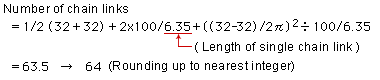
When distance between the motor shaft and pulley shaft = 100 mm, sprocket teeth ratio = 1:1, and number of teeth = 32:

Number of chain links

#086 Motion Mechanism Design - 3 : Conveyor Belt Brackets

| No Comments | No TrackBacks

A work transfer conveyor carries work pieces on the conveyor belt and hence needs support structures below the conveyor belt. This section explains the low cost work supports (belt support brackets) that are easily adjustable to conveyor height.

(1) Relative positions between belt support brackets and conveyor

In case of the work transfer conveyor shown as an example, work piece takes the following three types of actions on the conveyor belt at the three locations. At each location, a non-contact sensor monitors the presence or absence of work pieces to control the operation of the conveyor belt. Therefore, the conveyor belt needs support from underneath with the belt support to specifically stabilize the positions of the work pieces at the sensor locations (See Fig. 1):

  1. Placement
  2. Positioning
  3. Pre-ejection pause

[Fig. 1] Function of belt support brackets

(2) Belt support brackets shaped for easy adjustment

Functionally, the work transfer conveyor does not require precise parallel alignment between the top side of the conveyor belt and the base plate. Accordingly, the belt support bracket shapes are preferably designed under the assumption that the assembly will not be parallel. Additionally, there should be three separate belt support brackets to stabilize the three types of positions explained in (1) above, and each bracket should be designed to consist of two parts to allow height adjustment (see Fig. 2):

[Fig. 2] Typical easily height adjustable belt support bracket consisting of two parts

(3) Designing belt support brackets at low cost

The design cost should be minimized from the following points of view:

(1) Reduction in number of parts

Reduction in the number of parts is advantageous and minimizes manufacturing costs. For functional reasons, however, the number of belt support brackets is set at three. Hence, the three brackets should have identical shapes to minimize design and machining costs.

(2) Reduction of manufacturing cost

Parts manufacturing cost is divided into the material cost and machining cost to develop a low cost design.

- Part manufacturing cost minimization

Select a commercially available standard material that requires minimal outside machining. Two-millimeter thick cold-rolled steel sheets (JIS SPCC) are selected on the basis of the weight of the conveyed work pieces. SPCC sheets characteristically excel in dimensional accuracy, surface smoothness, and the workability properties of bending, drawing, cutting, and welding.

- Machining cost minimization

Machining cost minimization means reducing the time required for machining. This is almost synonymous with minimizing the amount of material removed. The bracket structure selected here is weld-reinforced for strength and requires no machining except for the drilling position adjustment holes (see Fig. 3):

[Fig. 3] Weld-reinforced belt support bracket

#085 Motion Mechanism Design - 2 : Conveyor Belt Tension Mechanism

| No Comments | No TrackBacks

A tension adjustment mechanism for easy adjustment of belt tension for the work transfer conveyor and its design method are presented here. Since rotation torque is transmitted using friction in a mechanism with a flat belt, the conveyor belt tension, the contact angle between the pulley and the belt, and the friction coefficient are important design parameters. In particular, the belt tension is a factor directly affecting the force of friction, and an inappropriately adjusted belt frequently causes problems, such as meandering. Therefore, the conveyor belt tension adjustment mechanism is a very important system.

(1) Overview of Work Transfer Conveyor Belt Holding Mechanism

The tension of the flat belt is generated by the tensile force from the two barrel-like flat belt pulleys held by bearing holder sets pulled toward both ends (see Photo 1). The design of the mechanism in which tension is placed on the flat belt (conveyor) when the two flat belt pulleys are in parallel is a feature of the conveyor belt tension adjustment mechanism.

[Photo 1] Work Transfer Conveyor

(2) Construction of Conveyor Belt Tension Adjustment Mechanism

Photo 2 is an enlarged view of the conveyor belt tension adjustment mechanism. The unit consists of the flat belt pulleys holding the flat belt and the bearing holder sets mounted on an adjusting plate (roller plate), and the adjustment mechanism positions the belts parallel to the roller plate.

This mechanism is composed of Misumi's FA standard parts (bracket for adjusting screw, adjusting screw, and positioning adjusting screw block).

[Photo 2] Conveyor belt tension adjustment mechanism

(3) Design of Roller Plate

A reference drawing of a part other than standard parts is shown in Fig. 1.

[Fig. 1] Typical design of roller plate

Easy adjustment and maintenance of the assembly are thanks to this construction along with adoption of standard parts for cost reduction.

月別 Archives

Pages

Powered by Movable Type 6.0.3

About this Archive

This page is an archive of entries from September 2011 listed from newest to oldest.

August 2011 is the previous archive.

October 2011 is the next archive.

Find recent content on the main index or look in the archives to find all content.