December 2016 Archives

#269 Ball Screws -6: Glossary on Ball Screw Accuracy

| No Comments | No TrackBacks

Terminology related to ball screw accuracy is explained in this table.

TermsExplanation
Thread grooveThreaded area where a screw shaft faces a nut. A steel ball rotates in this area.
Ball screw leadThe distance that a nut travels in the axial direction for one revolution of the screw shaft.
Screw shaft leadThe distance measured in parallel to the axis of opposing two points on the adjacent thread grooves within a section where an axis of the screw shaft exists.
Specified leadThis is same as the nominal lead in general.
Actual leadActual lead measured for a ball screw.
Cumulative specified leadCumulative lead resulting from rotating a screw for a given number of revolutions based on the specified lead.
Cumulative actual leadAverage trend determined from the lead diagram based on the result of successive measurements or cumulative lead obtained from measurement on a section containing a screw shaft axis.
Actual mean leadA straight line representing the trend of cumulative actual lead.
Lead errorDifference between actual lead and specified lead. The value is positive if the actual lead is larger than the specified lead. Otherwise, the value is negative.
Actual mean lead deviationCumulative actual lead minus cumulative specified lead.
VariationThe maximum value of the cumulative actual lead enclosed by two straight lines drawn parallel to the actual mean lead as defined in the following three items:
a) Variation for the effective travel distance of a nut or the effective thread length of a screw shaft.
b) Variation for any 300 mm interval in the effective thread length of a screw shaft.
c) Variation for one revolution made within the effective thread length of a screw shaft.

[Fig.1] Lead accuracy of precision ball screws (JIS B 1192)

[Fig.2] is an example of inspection data for precision ball screws. The solid line represents measured data.

[Fig.2] Example of inspection data for a precision ball screw

Description of inspection data
  • Cumulative reference of this ball screw (target value) = 0.0 µm --- Setting value
  • The green arrow [1] is the actual mean lead deviation = -15 µm (data readings)
  • The orange arrow [2] is the variation -a) <variation for the effective thread length> = 6.0 µm (data readings)
  • The red arrow [3] is the variation -b) <variation for any 300 mm interval> = 4.0 µm (data readings)

#268 Ball Screws -5: Accuracy and Grade

| No Comments | No TrackBacks

JIS B 1192 defines ball screw accuracy of the precision ball screws. This section explains the accuracy and grade of ball screws.

The major factor in determining ball screw accuracy is called "lead accuracy". (See the Note* for details.) The two evaluation items of "lead accuracy" and "appearance" are called "ball screw grades" and used for the classification of quality.

Notes*
Lead accuracy: [Fig.1] defines the deviation and variation for the effective travel distance of a nut or the actual mean lead of the effective thread length of a screw shaft, variation for any 300 mm interval in the effective thread length of a screw shaft, and variation for one revolution within the effective thread length. The permissible values are listed in [Table 1] and [Table 2].
Appearance: The surface of a ball screw should be free from cracks or defects, such as scratches, burr, and rusting that will compromise its intended function.

[Fig.1] Lead accuracy of precision ball screws (JIS B 1192)

[Table 1] Variation and actual mean lead deviation of the precision ball screws (permissible value),[Table 2] Variation of the precision ball screws (permissible value)

= JIS =
-The accuracy grades for ball screws are classified into six grades (C0, C1, C3, C5, C7, and C10).
-Screws in the four grades (C0, C1, C3, and C5) are referred to as precision ball screws. The rest of the grades (C7 and C10) are defined as standard ball screws.

= ISO3408-1: 1991 =
-The accuracy grades for ball screws are classified into five grades (1, 3, 5, 7, and 10). Grade 1, 3, and 5 screws are designed for positioning. Grade 7 and 10 screws are designed for feeding.

#267 Ball Screws -3: Structure

| No Comments | No TrackBacks

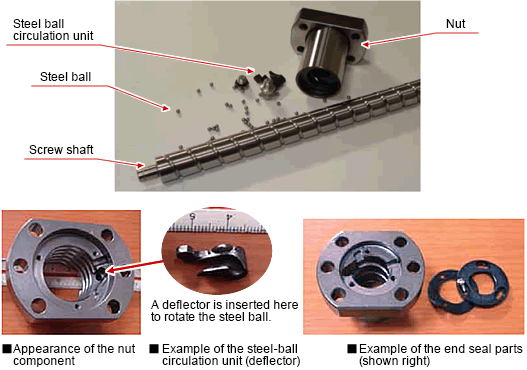
A standard ball screw is comprised of the following components:

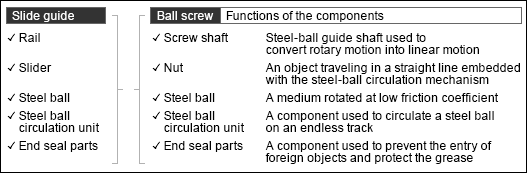
1. Screw shaft 2. Nut 3. Steel ball 4. Steel ball circulation unit 5. End seal parts :Ball screw components

Compared to slide guides, this structure is probably easier to understand. A slide guide is a unit that produces linear motion along the rail. On the other hand, a ball screw is a unit where screw shaft rotation causes a nut to travel in a straight line.

Slide guide is Rail, Slider, Steel ball, Steel ball circulation unit and End seal parts. Ball screw is Screw shaft, Nut, Steel ball, Steel ball circulation unit, and End seal parts. Screw shaft ... Steel-ball guide shaft used to convert rotary motion into linear motion. 
Nut ... An object traveling in a straight line embedded with the steel-ball circulation mechanism.
Steel ball ... A medium rotated at low friction coefficient.
Steel ball circulation unit ... A component used to circulate a steel ball on an endless track.
End seal parts ... A component used to prevent the entry of foreign objects and protect the grease.

photo

#266 Ball Screws -1: History

| No Comments | No TrackBacks

The increasing demand for making the device faster, more accurate, more durable and more reliable has resulted in the rapid spread of ball screws. [Fig.1] shows the "Amount of Sales and Trend in Shipment of Ball Screws, January 2006" published by Japan Machine Tool Builders' Association. You can see from this graph that the amount of sales and quantity has almost doubled in the two-year period. From #266, we will look at the ball screws from the basics to advanced knowledge.

[Fig.1] Amount of sales and trend in shipment of ball screws

(1)History of ball screws

-In the United States, the basic structure of a ball screw was patented in 1874 as a linear feed mechanism built into press machines. (See [Fig.2].)
-The actual use of ball screw products started when the US automotive manufacturers adopted ball screws into their steering parts in the 1950s. [Fig.3] is a structural example of a ball screw mechanism adopted for the steering device installed in the back of the handle shaft.

[Fig.2] US-patented ball screw mechanism. [Fig.3] Application example of steering device

In this volume, we will look at a case example of a "double-lever" created by connecting levers utilized in the boost mechanism. The double-lever method not only delivers the boost action in the simple seesaw-type principle but also allows the force direction to be changed.

[Fig.1] - a) illustrates the boost mechanism for the double-lever method. The amplified force (F) is determined by the relationship between the arm length ratio and the equilibrium of forces.

[Fig.1] - b) is a simple fixture (tool) called a "block holder", utilizing the double-lever method. This mechanism is often adopted for tools designed to carry heavy square-shaped items like bricks and blocks.

[Fig.1] Boost mechanism for double-lever method

Although the seesaw-type boost allows the operation of heavy objects with less of force, it is important to remember that the principle of the workload <Workload (Kgm) = Force (Kg) × Movement (m)> always applies. Less amount of force means more movement. If manpower is required for larger strokes or reducing a particular task cycle (such as moving or bending) does not make the entire task inefficient, it is possible to amplify the forces or movement based on this workload principle.

Application examples
  1. Workpiece (block) conveyance fixtures
  2. Washing and Rinsing clamp
  3. Conveyance clamp in heat-treating furnace

月別 Archives

Pages

Powered by Movable Type 6.0.3

About this Archive

This page is an archive of entries from December 2016 listed from newest to oldest.

November 2016 is the previous archive.

January 2017 is the next archive.

Find recent content on the main index or look in the archives to find all content.