April 2011 Archives

#073 Sliding Guides - 3: Linear Bushings and Shafts

| No Comments | No TrackBacks

Linear bushings and shafts are used quite frequently. See "LCA Mechanism Examples".

[Fig.] LCA Example with <a href=Linear Bushings and Shafts" name="[Fig.] LCA Example with Linear Bushings and Shafts" width="527" height="230" />

Shafts and bushings each require some fabrication for installation, but the costs could be reduced by adopting the mounting designs for standardized products such as MISUMI FA Mechanical components.

Standard ComponentsRepresentative TypesApp. Characteristics
ShaftsMaterial
SUJ2(High Frequency Induction Hardening)
Note 1,2)
SUJ2(High Frequency Induction Hardening:58HRC+hard chrome plating:800HV)
Note 3)
・Wear Resistant
・High Speed, Wear Resistant
Mount Method
Tapped/Threaded, Retaining Ring Groove/Keyway
Stepped
Select by shaft fixing method
Linear BushingsConfig./Material
Shaft Mounts
Linear Bushings (Straight/Flanged Types) (Retainer: Plastic, Metal)
Linear Bushing Holders, Housing Units (Retainer Material: Plastic, Metal)
Oil-free Bushings (Copper Alloy Type)
Shaft Mount Supports
High Accuracy, High Load Capacity
Allowable Environmental Temp.
Light weight for moving applications
Allowable Environmental Temp.
High Load Capacity, For Low Speeds, Chemical Resistant, No Lubrication Use
Guide SetsConfigurationMiniature Ball Guide Sets
Low Friction, High Accuracy, For Simultaneous Linear/Rotary Applications

Note 1)About SUJ material
Bearing Steel. S for Steel, U for Used, and J for Journal. Journal is a rotating contact section of a bearing arrangement.
Note 2)About High Frequency Induction Hardening
A hardening method where only the surface of steel is hardened by efficiently induced electrical current by a high frequency oscillator
Note 3)About Hardness
There is no theoretical definition for Hardness, and is expressed using comparative values obtained by pressing hard balls or diamond indenters on test specimen. HRC (Rockwell hardness: Hard-ball Method) is used for SUJ and SUS hardness measurements, and Hv (Vickers Hardness: Vickers Pyramid Indentation Method) for hardness of minute section of hard chrome plating is generally used.

#072 Sliding Guides - 2: Friction and Wear

Friction forces are generated when solid objects in contact make relative motion. These friction forces must be managed properly with lubrication and etc, or may result in troubles shown below.

1.Friction of solid objects resulting in seizures.
2.Wear begins and accelerates.
3.Increased power losses.

It is important to manage the friction and wear.

(1) About Friction

There are to types of friction.
 a)Sliding Friction
 b)Rolling Friction

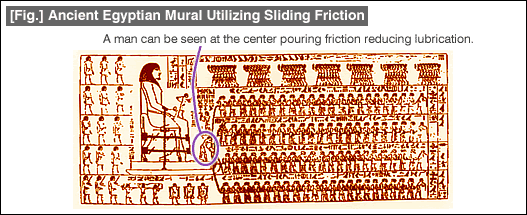
The sliding friction is the type seen with Gib Slides (previous Vol.), skies and sleds. The [Fig.] shown below is an ancient Egyptian mural. It depicts a scene of transporting a large stone statue. A man can be seen at the center pouring friction reducing lubrication.

image

Show below are friction coefficients of various material combinations.

Material CombinationsFriction Coefficient μ
Mild Steel vs. Mild Steel0.4
Hard Steel vs. molybdenum disulfide0.15
Skies vs. Snow0.05

The rolling friction can be represented by Linear Motion Guides (previous Vol.), miniature ball guides, and etc. where friction occurs with balls and rollers. If the sliding friction is to be defied as the "Sled Era", the rolling friction can be dabbed as the "Rolling Cart Era".

Rolling friction coefficient examples are shown below. (Sliding friction coefficient and rolling friction coefficient cannot be compared equally.)

Material CombinationsRolling Friction Coefficient f(cm)
Hardened Steel vs. Roller/Balls0.0005〜0.001
Mild Steel vs. Mild Steel0.02〜0.05
Pneumatic Tire vs. Road0.05〜0.15

(2) About Wear

When solid objects are in contact without any lubrication between them, minute surface features are in directly coupled states. Friction occurs when this coupled features are decoupled by sliding motion, and this is the friction resistance (force). When the decoupling occurs, minute sections of material is ripped away where contacting. This is the wear. When the friction increases, the wear simply increases also.

Proper lubrication is needed to prevent wearing. Selecting appropriate lubrication is important, especially for mechanisms with high motion speeds and clean room applications.

#071 Sliding Guides - 1: Introducing Various Sliding Guides

The sliding guides are fundamentally comprised of guides (also called the shafts, rails) that constrict the motion trajectories and moving members (also called the bearings), and the following characteristics are required.

1. Support the moving loads.
2. Small and stable moving force.
3. Provide assured long term stable accuracies under high speed/acceleration operations.

The items 1 and 2 above are static performances (not associated with motion), and 3 is a dynamic performance (associated with motion). Sliding guide selection and structural designing will require basic knowledge shown below.

image

Here, representative linear sliding guides, rotary guides, and curve guides are explained.

(1) Linear Sliding Guides

Linear sliding guide is a mechanism allowing linear movements with accuracy and with little friction of linear motion units such as air cylinder driven units.

Linear Sliding Guide TypesCharacteristicsMISUMI FA Catalog Products
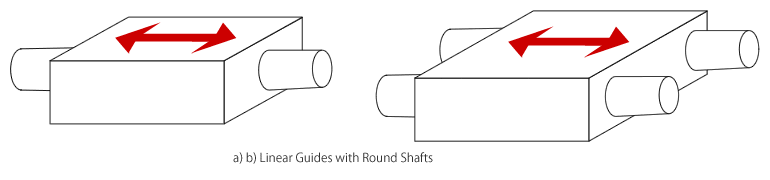
Linear Guides with Round Shafts ([Fig] a, b)
-Single shaft config. if rotation regulation not needed
-Large DIA guides for load support
-Friction reduction mechanism can be added
-Linear Bushings
-Oil-free Bushings
-Jig Bushings
-Miniature Ball Guide Sets
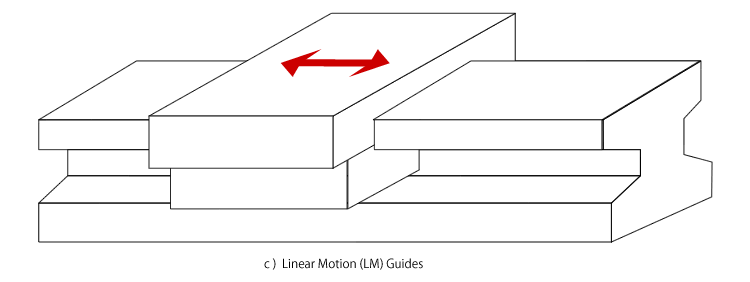
Linear Motion (LM) Guides (Guides) ([Fig] c)
-Selectable performance criteria: Friction reduction, High rigidity, High accuracy
-Linear Guides
-Slide Way
-Slide Tables
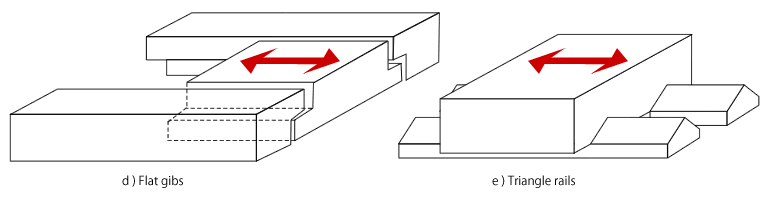
Gib Guides (Flat gibs, Triangle rails) ([Fig] d, e)
-Wide variety of performance levels such as low cost and ultra high performance (#) achievable due to low parts counts.
-Linear Guides
-Guide Rails (#: Air bearings, etc.)

(2) Rotary Guides

Similar thoughts as above are also applicable to rotary shaft guides (ball bearings). Inertia applicable on linear motion does not apply to rotary motion, and advanced ball bearing technologies are used to obtain high speed guiding characteristics.

(3) Curve Guides

For curve (circular-arc, etc.) guides, linear motion guides formed into curvature driven by motors and ultrasonic motors are used.

月別 Archives

Pages

Powered by Movable Type 6.0.3

About this Archive

This page is an archive of entries from April 2011 listed from newest to oldest.

March 2011 is the previous archive.

May 2011 is the next archive.

Find recent content on the main index or look in the archives to find all content.