March 2017 Archives

#282 Spring Design -10: Materials for Springs

| No Comments | No TrackBacks

Spring characteristics are added by their materials, the heat treatment process, and forming methods (hot/cold forming).

(1)Hot forming and cold forming

=Hot forming

A forming method involving quenching and tempering in order to add necessary strength for the springs after they are formed into shape.

=Cold forming

A forming method involving quenching, tempering, or wire extension for the materials to which necessary strength is already added.

(2)Material for springs

The following table summarizes typical spring materials and application.

[Fig.1] Typical metal materials for springs
Symbol Name Application Major application Method
For general use Conductivity Heat resistance Corrosion resistance Fatigue resist
SW-B Hard steel wire - - - - Small coils for
general machinery
Springs
SWP Piano wire - - - Same as above Same as above
SWO Carbon steel oil-tempered
wire for springs
- - - - Medium to large coil
springs for general
machinery
Same as above
SWOSC Oil-tempered
chromium
silicon alloy steel wires
for springs
- - - Same as above Same as above
SUS-WP Stainless steel for springs - - Coil springs requiring corrosion resistance Same as above
SUP6 Silicon-manganese steel - - - - Small coil springs for general machinery Hot forming
SUP9A Manganese-chromium steel - - - - Medium to large coil springs for general machinery Same as above
SK4 Carbon steel - - - - For general and economical disc springs -
SUS304 Stainless steel - - Leaf springs and disc springs requiring corrosion resistance -

[Table 2] Characteristics of plastic springs
Advantages Disadvantages
-Capable of forming a complex shape
-Lightweight and rust-free
-Flexible and slightly elastic
-Decoration such as coloring can be added
-Low strength
-Low surface hardness
-Low heat resistance
-No support stiffness

  Based on the characteristics summarized in [Table 2], plastic springs are adopted for fixing hooks used with tubes and electrical wires.

#281 Spring Design -9: How to Secure Springs

| No Comments | No TrackBacks

Fixing both ends of a spring is an important measure for stabilizing behavior. There are well-suited ways of fixing both ends depending on the type of spring, such as helical compression springs and helical extension springs. In this volume, we will introduce how to secure the ends of springs along with the characteristics of each method.

(1) How to secure helical compression springs

In considerations of the degree of freedom of the secured spring, avoiding buckling, and prevention of load-point displacement, the methods shown in [Fig.1] are adopted for securing both ends of helical compression springs. As for the tips, use a Coil Spring Washer (SPGCC, for example) by MISUMI for its ease of production if you use the securing method shown in (b). Otherwise, prepare a guide hole on both ends and place the spring into it.

[Fig.1] Examples of securing helical compression springs. (Source: Design, manufacture & testing methods of springs edited by Japan Society of Spring Engineers (Nikkan Kogyo Shimbun, Ltd.)), [Fig.2] Washer for coil spring

(2) How to secure helical extension springs

Hooks on both ends of helical extension springs are available in various shapes. a) is the most standard shape. See the characteristics of b) and c) in the following table.

Hook shapeCharacteristics
V-hookThis shape is frequently adopted for measuring equipment because it can minimize the allowance (backlash) between the mating side and spring hook area.
Square hookThis shape is adopted only when the mating side is shaped as a flat plate.

[Fig.3] Typical hook shapes (Source: JIS B 2704)

[Photo 1] Helical extension springs and posts on both ends

a) For circular hooks, adopting posts for extension springs by MISUMI (e.g. ASPO, ASPL) makes the adjustment easier. (See [Photo 1].)

#280 Spring Design -8: Various Spring Characteristics

| No Comments | No TrackBacks

Since the degree of deformation by load can be corrected sensitively or insensitively for non-linear springs, you can be creative with how they are utilized. This volume introduces representative examples of such springs with non-linear characteristics. For details on how to design various springs introduced here, refer to books, such as "Design, Manufacture & Testing Methods of Springs" edited by the Japan Society of Spring Engineers and published by Nikkan Kogyo Shimbun, Ltd.

Application examples
  • Suspension springs for jigs compatible with multiple models in varying load weight
  • Adjustment springs for inspection jigs involving manual labor
  • Auxiliary springs for weight reduction of parts such as covers
  • Compression springs designed to open/close a clamp quickly
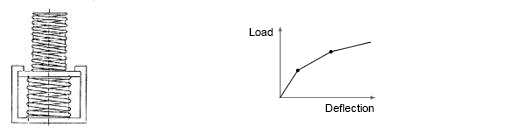
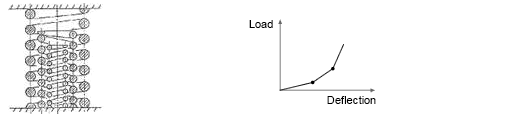
(a) Combination springs

image

Multiple helical compression springs connected in series and load-deflection characteristics

image

Multiple helical compression springs stacked in combination and load-deflection characteristics

(b) Leaf springs

image

Bonded leaf springs with sliding support unit on both ends and load-deflection characteristics

(c) Spiral springs

image

Hair spring (used for measuring gauges) and load-deflection characteristics

(d) Disc springs

image

Disc spring and load-deflection characteristics

(e) Diaphragm springs

image

Diaphragm spring and load-deflection characteristics

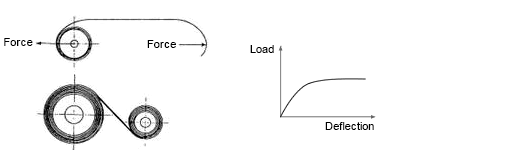
(f) Constant force spiral springs

image

Constant force spiral spring and load-deflection characteristics

(g) Constant force springs

image

Constant force spring and load-deflection characteristics

#279 Spring Design -7: Surging Phenomenon of Springs

| No Comments | No TrackBacks

Surging refers to oscillation specific to a coil spring. When an external force having a frequency component close to the spring's natural frequency acts upon the spring, an oscillation phenomenon called surging occurs owing to the mass of the spring. When high-speed compression or tensile forces are applied to a coil spring by a cam, surging occurs by the spring itself resonating with the high-frequency components of the cam's head-discharge curve.

(1)What is surging

-When a coil spring absorbs shock, the coil wire undergoes torsion, which is transmitted as a shock wave. This shockwave is called a surge wave.

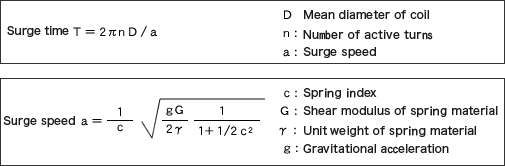
-The amount of time (T) in which this surge wave moves along the spring wire and travels back is called surge time. The surge time and speed can be calculated using the following formula:
fig

-When a coil spring is subject to forced oscillation, the resonance phenomenon surging occurs if the cycle corresponds to the surge time T or becomes the half or one third of the surge time T.


(2)How to prevent surging

(1)Changing the cam shape

Change the cam design to minimize the amplitude of vibration generating from the spring's natural frequency and cam's rotation speed in the resonant frequency range.

(2)Adopting a variable pitch spring

Variable pitch springs have the characteristic of a change in deflection altering their natural frequency. Surging can be avoided by adopting a variable pitch spring that does not cause resonance.

#278 Spring Design -6: Natural Frequency of Springs

| No Comments | No TrackBacks

This volume explains the oscillation property of a spring when a block with mass (M) is placed on the spring with the constant (k).

  • When you release the load of this block that was pressing the spring toward the direction shown in [Fig.1], the energy storage property of the spring causes the block to continue oscillating in a vertical direction. [Fig.1] One degree of freedom oscillation model
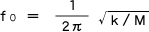
  • Oscillation frequency at this time is the natural frequency (f0) calculated using the following formula: formula
  • The term "Natural frequency" refers to oscillation properties specific to a spring, indicating how many times the vibration is repeated within a certain amount of time.
  • The value of natural frequency is determined by the two variables: the mass (M) of a load placed (or a handing load) and the spring constant (k). Therefore, even when you stretch out the spring or when you slightly pull the spring before releasing, the natural frequency stays the same.
  • [Fig.2] explains the effect of the mass (A), the effect of the spring constant (B), and the effect of vibration frequency (C), using actual examples. [Fig.2] Characteristics and vibration isolation effect of the spring system
  • Here are some examples utilizing this spring's natural frequency as effective properties.
    Case examples effectively utilizing the spring's natural frequency
    Pressing machine } Vibration-proof design and vibration-proofing material
    Automobile
    [Example] Use with a damper to absorb shock from the device.
    E.g. Semiconductor equipment ----- vibration-proof design and vibration-proofing material
    [Example] According to the vibration frequency transmitted from the surrounding area, anti-vibration measures, use of vibration-proof rubber, coil springs, and air suspension are incorporated, as appropriate, into semiconductor equipment (such as precision positioning equipment) that is susceptible to even subtle vibration.
    Notes
    The term "Vibration isolation" (vibration control, vibration absorption) refers to a measure preventing oscillatory propagation to the surrounding area by supporting the vibration-generating equipment with vibration-proofing material.
    Vibration removal refers to a measure taken for equipment to be protected from the effect of vibration transmitted from the outside.
  • Choose a spring whose natural frequency (f0) does not correspond with that of the entire machine (f). (The entire machine is viewed as the spring system here.) Otherwise, the machine needs to be designed to have a different natural frequency from the spring's frequency.
  • When the spring's natural frequency (f0) corresponds with that of the entire machine (f), it causes a resonance, maximizing the machine vibration that may trigger accidents, including equipment damage as chatter marks or fracture.

月別 Archives

Pages

Powered by Movable Type 6.0.3

About this Archive

This page is an archive of entries from March 2017 listed from newest to oldest.

February 2017 is the previous archive.

April 2017 is the next archive.

Find recent content on the main index or look in the archives to find all content.