To improve your skills of designing an automation device, it is necessary to gain as much design experience as possible and to increase your knowledge by learning about various types of automation devices.However, especially with the stiffness design required for the high degree of precision in positioning and machining, the designers are expected to have the implicit knowledge that can be acquired through working with advanced design structures.This section introduces points on preparing drawings by incorporating the stiffness into the design structure.
- A force applied to all the mechanical devices including the automation device has a point of application.
- In most cases, the mechanical devices are designed with the enhanced performance of assembly and machining work using this point of application.
- In the case of a mechanical device that drives at a high speed, the inertia force applies at the position where the acceleration changes.
- The machining and inertia forces are balanced with the reaction forces that work in the opposite direction. This is why the mechanical device itself is able to stand still in a stable position.
- The mechanical device must have the sufficient structural strength that is larger than the reaction forces.When you design a structure that is strong enough to overcome the reaction force, the strength must be guaranteed throughout the usage period of the mechanical device.
-
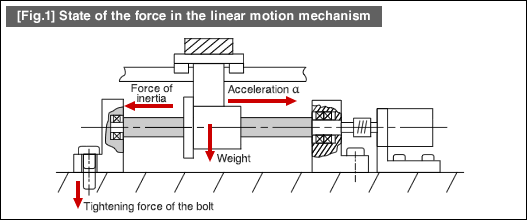
- To incorporate the greater structural strength than the reaction force into the design drawing, multiply the thrust value by the safety factor and adopt the machine dimensions that can withstand the reaction force several times greater than the actual thrust.
- However, the strength calculated by the above method will be applied to the major design components only (support components, screws, rack unit, etc.) without being reflected to all the related parts.
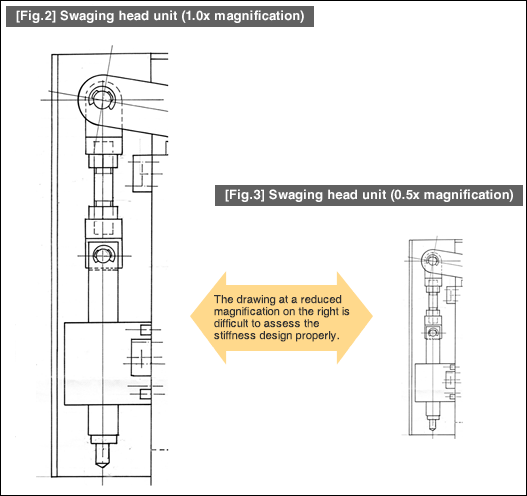
- To incorporate the stiffness design in the actual designing stage, create a drawing of a particularly important component at 1.0x magnification. It is important to view the drawing so that you can avoid the intuitively weak structure when you design the detailed shape (See [Fig.2]).
- We tend to magnify the drawing of a complex component in the design process. However, if we do this, it is important to know that using a different magnification compromises our intuition to assess the stiffness design accurately (See [Fig.3]).
![[Fig.1] Example of easy-to-assemble components with two parts placed in parallel (copied from Low Cost Automation Tutorial #.46)](/tt/en/lca/458_1.gif "[Fig.1] Example of easy-to-assemble components with two parts placed in parallel (copied from Low Cost Automation Tutorial #.46)")
![[Fig.2] Example of a component design with positioning holes for assembly & [Photo 1] Assembly of the workpiece holder](/tt/en/lca/458_2.jpg "[Fig.2] Example of a component design with positioning holes for assembly & [Photo 1] Assembly of the workpiece holder")

