October 2012 Archives

#134 Mastering Ball Screws - 4 : Increase in Ball Screw Speeds

| No Comments | No TrackBacks

For chip mounters, robots and CNC machine tools, achieving higher ball screw speeds is an important agenda. Speed optimization techniques will be explained in this discussion.

(1) High speed optimization of ball screws

Since a ball screw is a mechanical element that converts motor's rotary motion into linear motion, there are two following means to increase the speed.

(1) Increase the linear motion distance per one rotation → Use of large leads
(2) High rotational speeds → Increase RPM (simultaneously attaining high accuracy)

Since the accuracy increase is also needed at the same time as the ball screw speed increase is needed, (1) and (2) must be satisfied simultaneously.

(2) Issues of increased rotational speeds

Ball screw speed increasing is associated with the following high level difficulties.

a) Orbital speed of the steel balls: Speed limitations based on dmn value --- dm: Ball diameter, n: Rotational speed
b) Critical speed of a ball screw
c) Thermal deformation increase by heat rise
d) Increased vibrations and noises
e) Load (inertia, etc.) increase due to high speed motion and high accel./decel.

Explanation
a)As the steel ball's orbital speed (dmn value) increases, damages to the ball recirculation circuit components, such as tangs of return tubes, due to repeated shocks will become nonnegligible.

[Fig.1] Example of return tube damage

b)When the ball screw is rotated at high speeds, it will reach a critical speed where the natural frequency of the long narrow shaft suspended at both ends will brings a resonance vibration phenomena at a certain speed.
c)Ball screw temperature will rise as the speed increases due to the friction torque increased between the steel balls and the shaft. This temperature rise causes heat expansion and the accuracy will be degraded.
d)Ball screw nuts have complex recirculation paths with internal discontinuities (not smooth). As the ball travel speed increases, associated vibrations and noises will also increase.
e)Since the ball screw imparts high speed and high acceleration motion on objects, the loads on the ball screw increases.

#133 Mastering Ball Screws - 3 : Ball Screw Operating Performances

| No Comments | No TrackBacks

Feed screw is a mechanical element used to convert rotational motion to linear motion, or to generate large forces. The types and required performances are as follows.

Feed screwLead screwA feed screw with the same contacting arrangement as a surface contact slide beaing.
Ball screwA feed screw with the same arrangement as a point contacting rolling motion bearing.
Hydrostatic screwA feed screw that transmits forces in non-contacting arrangement via air or hydraulic fluids.

(1) Ball screw's operating performances

Ball screw operating performance is characterized by its very small friction resistances. This is due to its structure that transmit forces with rolling motion of the steel balls similar to ball bearings.

(1) Static friction torque
-The static friction torque is a static friction resistance during the rotary motion as opposed to a linear motion static friction resistance.
-It is thought that the ball screw's static friction torque occurs right when the feed screw begins to turn where the steel balls slightly slide instead of roll.
-This sliding of steel balls and the screw groove that generate the static friction torque mostly causes the ball screw wear.
-The static friction torque differs depending on the rotational direction (For./Rev.) of the screw shaft.
-Also, it differs with the position of ball recirculation paths (Positioned low or high, etc.).

(2) Dynamic friction torque
-This is a rotational dynamic friction torque as opposed to the linear motion dynamic friction torque.
-This is a friction resistance in dynamic condition, and is affected by the amount of preloads determined by steel ball size in relation to the screw groove size, as well as the lubricant characteristics.
-The dynamic friction torque will vary according to the screw shaft rotational speed.
-In case of oversized ball arrangement, the dynamic friction torque dramatically increases depending on the oversize amount. (See [Fig.1])
-In case of Double Nut arrangement, as opposed to the Single Nut arrangement, larger number of steel balls used and longer length of contacting screw groove reduces dynamic friction torque variations due to averaging effect. (See [Fig.1]b)

[Fig.1] Explanation on relationship between Nut Construction and Dynamic Friction Torque

(3) Friction torque variations
-Friction torque variations affect motor's speed variations, thus the linear motion velocity irregularities and positioning accuracy variations can be caused.
-Allowable torque variation rate is defined in JIS B 1192.
■Example
A C3 grade ball screw with an effective thread length of 4000mm or less with reference torque of 0.2~0.4Nm is allowed a torque variation of ±45%.

#132 Mastering Ball Screws - 2 : Ball Screw Preloads

| No Comments | No TrackBacks

There is a measure, "Preloading", to increase the feed accuracy and rigidity of ball screws. The conditions of minute clearances between the ball screw's ball grooves and the steel balls largely affects the characteristics of ball screws.

On the "Axial Clearance" column of the ball screw selection chart shown on Pxxx of MISUMI FA Mechanical Standard Components catalog, there are listings such as:

* Preloaded Product* 0.005mm or less* 0.010mm or less* 0.030mm or less

■Preload means (Definition: JIS B 1192)
A force applied internally to ball screws by assembling in a group of steel balls or using a pair of nuts that are axially mutually displaced, in order to reduce backlash and increase the rigidity of the ball screw.

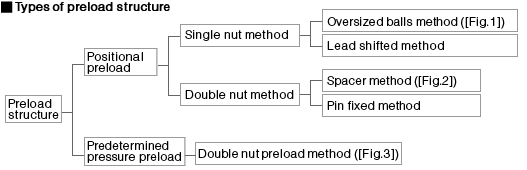
Types of preload structure

■Terminology Explanations
TerminologyExplanation
Positional preloadPreloading method using the positional relationship of the screw shaft and the steel balls.
Oversized balls methodPreloading method to obtain a constant force by employing slightly larger sized balls than the screw grooves.
Lead shifted methodThe preload is applied by machining the nut with a groove offset at the center in the amount of desired preload amount.
Spacer methodA preloading method using a spacer between a set of nuts in the amount of the desired preload.
Predetermined pressure preloadThe preload is applied with a spring.

[Fig.1] Preload structure by oversized balls(Source: NSK Catalog),[Fig.2] Preload structure by double nut with a spacer(Source: NSK Catalog),[Fig.3] Double nut structure with predetermined pressure preload methodr(Source: NSK Catalog)

A ball screw attains its nut linear motion by recirculating the steel balls along the screw groove withing the nut. The steel ball recirculation method within the nut differentiates the motion characteristics of the ball screw. The steel ball recirculation methods are explained here.

There are following steel ball recirculation methods.

Steel ball recirculation methodExplanation
(1)End cap methodSteel balls are recirculated by the end caps mounted on each end and ball recirculation tunnels withing the nut's inner wall. Good with high speed operations.
(2)Flop over method (Deflector method)Deflectors are embedded on the nut outer tube to return the balls over the screw shaft land per each lead. Suitable for compact designs.
(3)Return tube methodReturn tubes formed to recirculate the balls are mounted on the outer perimeter of the nut. Easy to assemble design is suitable for mass production, but the physical size tend to be large.
(4)Guide plate methodIt uses guide plates or deflectors instead of the return tubes, and is good for making the design compact.

[Fig.1]Various structures of ball screws

月別 Archives

Pages

Powered by Movable Type 6.0.3

About this Archive

This page is an archive of entries from October 2012 listed from newest to oldest.

September 2012 is the previous archive.

November 2012 is the next archive.

Find recent content on the main index or look in the archives to find all content.