March 2016 Archives

#229 Safety Design - 1: What is Intrinsic Safety

| No Comments | No TrackBacks

The "Safety of Machinery" section in JIS Handbook (72) defines the codes on machine safety applicable to automation devices and machine tools. We will learn about safety design of machinery hereinafter.

(1)Intrinsic safety of machinery

The codes on the intrinsic safety of machinery include the following three measures:

1)The safety design has been built into or embedded in the machinery.
2)The machinery has a foolproof feature that prevents accidents or disasters even in case of an incorrect operation of the machine equipment.
3)The machinery has a fail-safe feature that the equipment responds in a safe manner even in case of malfunctions or damages of the machine equipment and parts.

(2)Intrinsic safety design measures implemented by machine designers

·To minimize risks including accidents, the following two methods are available: a) Safety design measures implemented by machine designers, b) Measures for users.

·a) Safety design measures implemented by machine designers include the followings:
1)Intrinsic safety design measures <See the end of this section.>
2)Safeguarding and complementary protective measures
3)Information for use

·b) Measures for users include the followings:
4)Safety improvement organization
5)Use of protective equipment
6)Training

figure

Case examples:
∗Gaps of 4 mm or less ------ The risk of harm to human body becomes zero.
∗Power of 80 W or less ----- Same as above

·The intrinsic safety design measures are the most important process among all the risk reduction measures and should be considered and implemented as the first step.

In the previous sections, we learned the weight reduction techniques in the two methods: a) reducing the material weight, b) designing lightweight and high-strength structures. In this section, we will learn how to build a lightweight and high-strength structure at its optimal design by considering these methods together.

(1) How to design a lightweight and high-strength structure for automation devices

The equipment structure of an automation device consists of the following two elements:

Elements constituting an automation device structure

(2) How to design a lightweight and high-strength structure using the optimal shape

- Expand the above two elements into more detailed subjects so as to understand the overall design objective.

- Keep this overall objective in mind, and check the advantages and disadvantages against the similar structure designed in the past. This way, you can minimize the risk of failure when designing lightweight and high-strength structures.

[Fig.] Subjects to consider for a lightweight and high-strength structure using the optimal shape

(3) Accumulating and utilizing knowledge

- The designer of an automation device needs to check a considerable number of elements including those listed on the right side of the above figure.

- Therefore, the best way of minimizing the workload is to make improvements on the design of a certain type of the automation device and apply the accumulated knowledge to the similar design.

We introduced an example of "lightweight and strong structural members" using bamboo in the previous section. The strong bend-resistance achieved by the hollow architecture is described by a technical term "second moment of area". This section explains the second moment of area in an easy-to-understand manner.

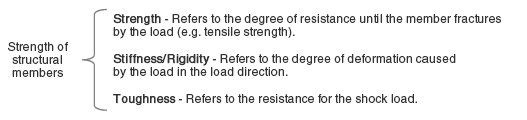
(1)Terms describing the strength of structural members

The strength can be described by the following terms depending on what it refers to.

Figure

Bamboo trees have large "stiffness" because of their hollow cylinder with nodes. In addition, they also have high "toughness" for their tissue structure being more densely distributed as they become closer to the epidermis. Since they excel in both stiffness and toughness, we can conclude that bamboo trees are the lightweight yet strong structural member.

(2)Cross-section shape and bending strength

The second moment of area (written as an alphabet "I") is a technical term that refers to bend resistance for the bending force applied to bar-shaped structural members. This second moment of area can be modified by the cross-section shape of structural members. Therefore, it is possible to design a lightweight and highly strong structure by adopting the optimal cross-section shape.

Cross-section shape Cross-section area (A) Second moment of area (I) Computational comparison of the same area
Square

Width: b Height: h
When b=31.4 and h=10, A=314.
At this time, I=2,617.
<The bending strength is approximately 1/3 of the circular cylinder listed below>
Circle (circular cylinder)

Radius: r
When r=10, A=314.
At this time, I=7,850.
Hollow cylinder

Outer radius: R
Inner radius: r
When R=15 and r=11.2, A=314.
At this time, I=27,388.
<The bending strength becomes approximately 3.5 times more than the above-mentioned circular cylinder for the same cross-section>

The formula of second moment of area (I) for various cross-section shapes is listed in the MISUMI FA Standard Catalog Technology Data: Area, Gravity Center, and Second Moment of Area (P1-1890).

Lightening and hollow architecture are the common methods used for reducing the weight of structural members. This section introduces the effect of hollow architecture using the relationship of "bamboo structure and strength" as an example. <Reference: "Katachi to Tsuyosa no Himitsu (The Secret of Shape and Strength)" by Juuhachi Oda, published from Ohmsha, Ltd.>

= Toughness of bamboo =

・The external structure of bamboo trees can be described as a linear cylinder that becomes slightly thicker at the root. In addition, nodes are found at certain intervals along the inner cylinder.

・By ignoring the bamboo branches, bamboo trees have a cantilever structure anchored at the root area serving as a fixed support end.

・Aside from the theory, the bamboo structure can be described as follows:
(1)The bamboo's cylinder structure makes the object of the same cross-section three to four times stronger than the solid cylinder structure.
(2)The dimension structure of bamboo trunks that have thicker roots and thinner tips provides the maximum stiffness among all the other structures of the equivalent weight.

・This structure prevents bamboo from being bent even during the heavy snow season.

・Bamboo tree's material composition also contributes to its strength. The tissues in vertical direction are more densely distributed as it becomes closer to the epidermis. The functions of reinforced fiber similar to CFRP composite materials introduced in Vol.462 are working in this mechanism (see [Fig.1]).

・As seen from this bamboo example, we can prepare strong yet lightweight structural members by adopting hollow architecture to a structural member of the same cross-section and by designing the shape effectively (see [Fig.2]).

[Fig.1] Cross-section of bamboo (vertical tissues are distributed more densely as it becomes closer to epidermis)

[Fig.2] Relationship between bamboo's structural characteristics and strength

月別 Archives

Pages

Powered by Movable Type 6.0.3

About this Archive

This page is an archive of entries from March 2016 listed from newest to oldest.

February 2016 is the previous archive.

April 2016 is the next archive.

Find recent content on the main index or look in the archives to find all content.