(1) Linear Bushing Lengths and Guide Performances
There are four length types of MISUMI Linear Bushings [1] Single, [2] Double, [3] Long, and [4] Singles (exclusively designed for dual use). The bushing length difference affects the following guiding performances.
a)Load Capacity
b)Guiding Accuracy |
|
a) Relationship of Bushing Length and Load Capacity
Longer bushing has more ball bearings, and the load on each ball bearing in contact will be smaller. This effect can be confirmed from the fact that the load ratings increase as the lengths of bushings [1], [2], and [3] increase. Therefore, selecting a linear bushing with longer length improves the load capacity (Extended life, and increased reliability) (Fig.1)
![[Fig.1] Relationship of Bushing Length and Load Capacity](http://www.misumi-techcentral.com/tt/en/lca/images/080_1.gif)
b) Relationship of Bushing Length and Guiding Accuracy
As the bushing length increases, the accuracy improvements can be expected as follows.
 | A) | Accuracy improvement by averaging effect of guide rail (shaft) errors (Averaging Effect: see * below) ([Fig.2]) |
| B) | Accuracy improvement by reducing errors due to clearances ([Fig.3]) |
| * | Averaging Effect on Shafts: By increasing the bushing length and the number of ball bearings, error elements such as unevenness and swells on shaft surface are averaged, and the effects of the error elements are reduced to less than half. |
![[Fig.2] Graphical Explanation of Averaging Effects](http://www.misumi-techcentral.com/tt/en/lca/images/080_2.gif)
![[Fig.3] Relationship of Bushing Length and Clearance Errors](http://www.misumi-techcentral.com/tt/en/lca/images/080_3.gif)
Therefore, load capacity and guiding accuracy can be improved by increasing the length of linear bushings. For this reason, [4] Singles (exclusively designed for dual use) are used for higher accuracy applications in some cases. ([Fig.4])
![[Fig.4] Example of Single <a href=](http://www.misumi-techcentral.com/tt/en/lca/images/080_4.gif) Linear Bushings in Dual Use" name="image" width="527" height="250" />
Linear Bushings in Dual Use" name="image" width="527" height="250" />
(2) Explanation of Rail (Shaft) Deflection Calculations ([Fig.5])
Deflection of shafts for linear motion mechanism composed of linear bushings and shafts are calculated as follows.
δ=W・a3・b3/3・E・I・L3
a:Distance from supported end to the load point.
b:Distance of supported end opposite of a to the load point.
L:Shaft support span distance.
E:Young's Modulus
I:Shaft Sectional Moment of Inertia
I=π・d4/64≒0.05d4
d:Shaft Radius
When a=b=L/2, δ=W・L3/0.96・E・d4. In order to reduce the shaft deflection, design with increased shaft diameter (affects by 4th power), or reduce the supporting span distance (affects by 3rd power). |
|
![[Fig.5] Graphical Explanation of Shaft Deflection Calculation](http://www.misumi-techcentral.com/tt/en/lca/images/080_5.gif)
(3) Characteristics and Application Examples of Materials and Surface Treatments
Construction materials and surface treatments of linear bushings are as follows.
| Outer Cylinder Material | Surface Treatment | Retainer Material | Ball Bearing Material | Application Example |
| SUJ2 | - | Resin/SUS440C Equiv. | SUJ2 | General slides requiring wear resistance |
| SUJ2 | Low Temp. Black Chrome | Same as Above | SUS440C Equiv. | Glare intolerant optical equipment
Precision positioning for clean room use |
| SUJ2 | Electroless Nickel Plating | Same as Above | Same as Above | Slides for clean room use with chemical resistance
Slides requiring wear resistance |
| SUS440C Equiv. | - | Same as Above | Same as Above | Low loading clean room use and food/medical related equipment |
|
Characteristic Comparison of Surface Treatments
| Outer Cylinder Material | Surface Treatment | Characteristics |
| SUJ2 | - | - SUJ2 is steel and will rust |
| Same as Above | Low Temp. Black Chrome | - Low friction coefficient superior in wear resistance
- Formation of thin and uniform layer
- Black plating color does not reflect light, and has good heat absorption |
| Same as Above | Electroless Nickel Plating | - Often used in clean rooms for good chemical resistance and corrosion resistance
- Hard plating layer retains glossy finish
- Plating layer is non-magnetic |
|
![[Fig.1] Typical 3-axes XYZ Drive Mechanism](http://www.misumi-techcentral.com/tt/en/lca/images/081_1.gif)
![[Photo 1] IC Chip Pallet Transfer Machine and Belt Drive Mechanis](http://www.misumi-techcentral.com/tt/en/lca/images/081_2.gif)

![[Fig.2] A Structure Example of Improved Motor Power Efficiency and Precision Using Pulleys](http://www.misumi-techcentral.com/tt/en/lca/images/081_3.gif)
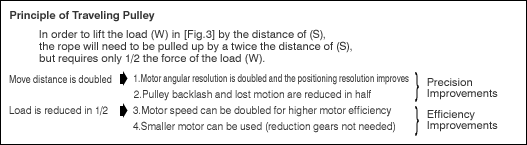
![[Fig.3] Principle of Traveling Pulley](http://www.misumi-techcentral.com/tt/en/lca/images/081_5.gif)


