June 2017 Archives

#295 Know-how on automation: Transfer -3

| No Comments | No TrackBacks
General description

Based on the comparison of planned arrangement of feed rollers (a total of three (3) proposals), the features of roller transport system have been explained.This case study will help increase the practical skills to select appropriate drive systems for the required considerations for mechanical design of transfer systems.

Explanation
1)Application to mechanical design of roller transport system

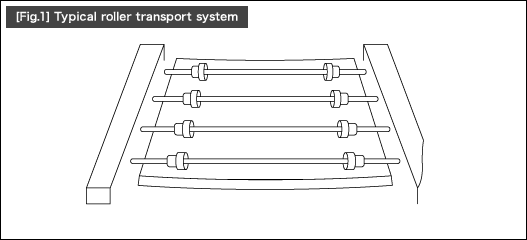
The roller transport system is configured with feed rollers and other mechanical sections. This session explains a total of three (3) plans for arrangement of feed rollers (Fig.1).

Plan A): Two (2)-rows independent arrangement of feed rollers (Fig.1-a)
・If glass substrates vary greatly in deflection or O-rings are worn partially or unevenly, poor or inconsistent contact between substrates and rollers can result, leading to possible curved transport.
・In the designing of roller materials and diameters, consideration may be given so as to make the feed rollers at the respective ends serve as main rollers and the feed rollers in the middle act as sub rollers, thereby ensuring stable transfer.

Plan B): Three (3)-rows independent arrangement of feed rollers (Fig.1-b)
・In order to minimize the effects of deflection of thin substrates in Plan A), the substrates are supported and transferred on the rollers arranged in 3 rows.
・By installing rubber-made O-rings on the outer circumference of rollers to transmit the frictional force, increased and stabilized friction coefficient and enhanced ease of maintenance are expected.

Plan C): Three (3)-rows arrangement of feed rollers connected through one ring (Fig.1-c)
・This Plan can involve the following problems: Direct susceptibility to any differences (related to friction coefficient) between the three (3) O-rings in contact with the substrates, increased parts processing cost, and/or increased person-hours for assembling and/or maintenance for stabilized tension of O-rings.

Among the 3 Plans, the Plan shown in Fig.1-b is more favorable for transfer of glass substrates of reduced thickness and weight.The next session explains the capability of transfer in a straight flow using the mechanical design based on Plan B.
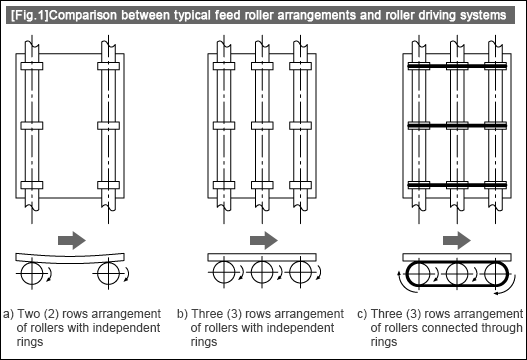
Comparison between typical feed roller arrangements and roller driving systems

#294 Know-how on automation: Transfer -2

| No Comments | No TrackBacks
General description

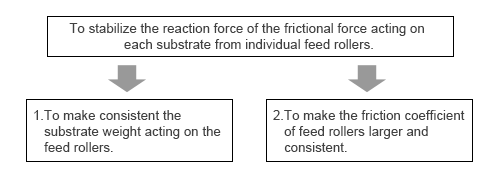
One of the considerations for mechanical design for stable transport of glass substrates is equalizing the weight of substrates acting on the feed rollers and increasing and equalizing the coefficient of friction at the contact points between the substrates and individual feed rollers.

Explanation
1)Rules and principles about roller transport

・In the case of roller transport, the principle of transport function is the control of frictional force to move the individual loads being transported.
・In practice, the rotational force of the drive motor for transport is transmitted to the feed rollers. Then, due to the weight of each substrate acting on the feed rollers and the coefficient of friction of feed rollers, the frictional force is produced in the tangential direction. By means of the reaction force to the frictional force, each substrate is transferred. (Fig.1).
・Therefore, as a rule, such mechanical design is required that can cause the frictional force to be generated at the point of contact between individual substrates and feed rollers for ensuring steady transport.

2)Consistency with the principle of roller transport

・For stable transport of substrates based on the roller transport, the following considerations are important.

Fig

・To increase the number of feed rollers as a solution in the mechanical structure described in 1 to minimize possible effects of any deformed substrates and equalize the substrate weight acting on individual rollers to the full extent practicable. (Fig.2).

・To install structural members of larger friction coefficient (e.g. rubber) onto the outer circumference of feed rollers as a solution in the mechanical structure described in 2. (Fig.3).
・In this case, the friction members installed onto the outer circumference of feed rollers should be of easy-to-replace design and the replacement members should be commercially available.
・For example, rubber-made O-rings and urethane rubber can be adopted.Rollers included in MISUMI FAparts are also commercially available as standard components.

[Fig.1]Principle of roller transport

[Fig.2]An example of stabilized weight acting on the rollers

[Fig.3]An example of increased and stabilized friction coefficient of feed rollers

#293 Know-how on automation: Transfer -1

| No Comments | No TrackBacks
General description

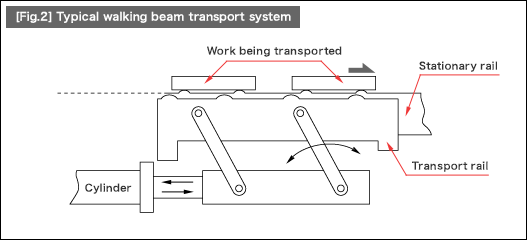
In a total of six installments, explanation is provided about designing of mechanical structure for transfer of thin sheets to respond to the trend for weight reduction. For transfer of glass substrates, two (2) major systems are available, roller transport (Figure 1) and walking beam transport (Figure 2). This session focuses on the roller transport system.

Explanation
1)Points to differentiate mechanical designs (The pursuit of rules and principles)

The transfer mechanism requires high versatility in its capabilities. Then, transport systems become similar to each other in design. In practice, however, where further advanced capabilities become required, those systems designed by understanding and incorporating rules and principles will be able to meet the specific application needs based on the original design or with only some improvements. Such systems that have a potential for quick response to varying needs will provide critical differentiation power, thereby contributing to the product development competition requiring shorter turnaround time.

2)Transport problems caused by glass substrates of reduced thickness and weight

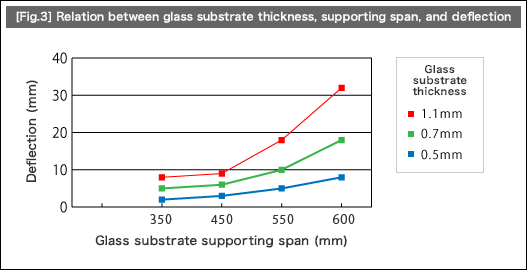
-Regarding glass substrates, as the thickness becomes smaller, the deflection due to own weight abruptly increases as shown in Figure 3.
-As can be seen from the Figure, for glass substrates of 0.7 mm or less in thickness, a two-point holding system will be impractical for transport when the substrate holding span is larger than 450 mm.
-In addition, the glass substrates will be likely to become broken or fractured due to trouble during transport.

-Reduced thickness and weight causes the production line to become likely to suffer transfer problems listed below.

  1. Substrates are fed into the production line with the residual stress produced in the manufacturing of flat glass being left. Then, the state of the residual stress changes due to the effects of heat in the production process (bonding, printing, heat treatment, etc.), leading to complicated waviness in the initial substrate profile.
  2. Each substrate is transported by the frictional force produced depending on its own weight acting on the several feed rollers supporting the substrate. In practice, however, the frictional force can vary greatly at the contact points between the substrate and individual rollers due to any deformed substrate. If the frictional force on the feed rollers at the respective ends are not equal to each other, the substrate will be transferred curvedly.
  3. In the cleaning process, the substrates are transferred in the wet state, and then their coefficient of friction becomes smaller as compared to when they are in the dried state. As a result, in the cleaning process, the transport force becomes reduced and the transport speed becomes uneven, resulting in increased transport failures such as piled-up substrates.

The above-described possible transport problems due to reduced thickness and weight must be resolved by the mechanical designers. The next session will explain the rules and principles about roller transport and their application to the mechanical design.

fig1

fig2

fig3

#292 Know-how on automation: Positioning - 10

| No Comments | No TrackBacks
General description

Where glass substrates are to be held on the processing stage by vacuum chucking, there can occur an incident of failure to ensure consistently stable holding of any glass substrates due to their warping.This session explains the production techniques to ensure steady and stable vacuum chucking of those glass substrates which have any warp.

Explanation
(1)Warped glass substrates and their vacuum holding

・Where glass substrates are loaded into the chemical process, position alignment, and other automated lines, some trouble in transfer and/or processing can result without adoption of appropriate methods for the profile and/or extent of any warp of glass substrates.
・As explained in #291, the effectiveness of vacuum-chuck holding of glass substrates greatly depends on the warp profile of glass substrates.
・Glass substrates vary in warp according to the manufacturing lot.This is due to the difference in residual stress produced on the front and back sides in the manufacturing process of glass substrates. The warp profile may be grouped into concave warp, convex warp, and combined warp (Fig.1).
・These glass substrates having a variety of warp profiles must be consistently held properly by vacuum chucking.

(2)Explanation about possible factors for failure in vacuum holding on the processing stage

・Depending on the profile and/or size of any warp of glass substrates, vacuum holding may fail.
・Regarding the glass substrates having concave warp, the central region can be vacuum-chucked but the outer region may fail to be vacuum-chucked because the vacuum chucking force is hard to act. (See #291).
・Regarding the glass substrate having combined warp, the glass substrates may be dislocated during the vacuum chucking.This is attributable to the vacuum chucking force acting unevenly because of uneven and deviated gap between the glass substrate and the processing stage (Fig.2).

(3)Solutions for failure in chucking in the vacuum holding

・To succeed in effective vacuum chucking of the central region of a glass substrate first then vacuum-chucking of the outer region after some time delay, thereby ensuring stable chucking of the glass substrate.
・Control of position and timing of the vacuum chucking may be attained as follows: For the former or control of vacuum chucking position, design the paths of hole independently for the central region and the outer region (Fig.3). For the latter or control of the timing of chucking, control the timing of the solenoid valve in the vacuum chucking control circuit.

[Fig.1] Warp profile of glass substrate

[Fig.2] Dislocation during the chucking of a substrate having a combined warp

[Fig.3] Solutions for failure in chucking of warped glass substrate

#291 Know-how on automation: Positioning - 9

| No Comments | No TrackBacks
General description

-As a prerequisite for realizing precise positioning, it is essential to firmly hold every work. For glass substrates, silicon wafers, and other thin sheet-like works, mechanical holding is difficult to adopt. As a result, vacuum chucking on the surface of the stage is often applied. In this method, however, the vacuum chucking may not work effectively in some cases for thin sheet works transferred onto the stage, depending on their flat conditions. To ensure consistent vacuum chucking, flatness of acceptable works must be standardized, or every work must be mechanically pressed against the stage surface to make the work flat for vacuum chucking.

Explanation

-In the case of glass substrates, silicon wafers, and other thin sheet-like works, work-holding based on the vacuum chucking is often adopted in the equipment in the process of printing on the front side of a substrate (Figure 1).
-This is due to the difficulty in adopting mechanical clamping for the thin sheet-like works and the ease of attaining the environment (ease of control of temperature, pressure, airflow, and other factors) necessary for assuring consistent quality in the printing process. This allows simplified mechanical structure by nature, thus providing advantages of increased cost effectiveness, including lower system prices and shorter tact time.
-This vacuum chucking method has a disadvantage of being susceptible to variations in the initial flatness of works being chucked.
-To absorb the plate thickness variations, the positioning mechanism must have the following characteristics:
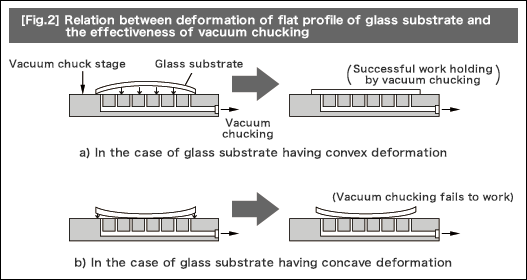
-Figure 2 illustrates how the effectiveness of vacuum chucking depends on the flat condition of works (glass substrates) being chucked.
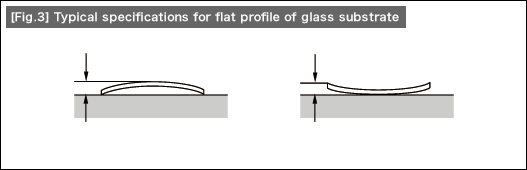
-In the case of vacuum chucking method, those works that have the flat profile with the outer region contacting the stage (convexly deformed) are vacuum-chucked more effectively (Figure 2-a)).
-In contrast, those works that have a flat profile with the outer region warped upward (concavely deformed) are less effectively vacuum-chucked (Figure 2-b)).
-To eliminate the susceptibility to different flat profiles of works being chucked, two (2)solutions are available as listed below.
1.To adopt the specifications for the initial flat profile of works being chucked. (Figure 3) → To eliminate loading of any concave-deformed works exceeding the specifications.
2.To incorporate the mechanical structure designed to press every work to be chucked against the stage from above in advance of vacuum chucking.(Investment to be required)

Precautions:

-The flat profile of thin sheet-like works greatly depends on the thin sheet-forming process of the works. Regarding glass substrates and silicon wafers, possible factors include the difference in the balance of residual stresses between the two sides, front and back, caused in the formation of thickness and/or in the polishing process for realizing surface roughness. Thus, for the established consistent quality of flatness, proper control of processing steps is essential.

fig1

fig2

fig3

月別 Archives

Pages

Powered by Movable Type 6.0.3

About this Archive

This page is an archive of entries from June 2017 listed from newest to oldest.

May 2017 is the previous archive.

July 2017 is the next archive.

Find recent content on the main index or look in the archives to find all content.