March 2010 Archives

#035 Motion Mechanism Design - 5 : Servo Motors

Characteristics of both servo motors in this tutorial as well as the stepper motors in the previous tutorial are well represented by their respective names. Stepper motors are controlled by steps (more accurately Pulses). Servo motors in this tutorial, like its name's origin "to serve as told", can be controlled as a servant.

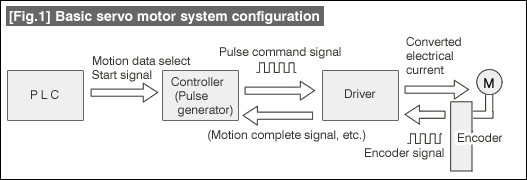
In order to do this, a rotation detector (called Encoder) is built into the motor. The encoder detects motor shaft's position and speed. The control scheme compares the motor's actual behavior against the internal program to perform a feedback control (position/velocity control).
image

The encoder turns the motor into a servant in this system. Since the servo motor has a built in rotation detector, alarm signals can be output when any abnormal stops or loads are encountered.

The control scheme targets to reduce the error between the detected pulses and the commanded pulses to zero so the net control accuracy can be 1 pulse (2 pulses in total). The accuracy increases as the encoder resolution increases.

There are some cautionary points such as the mechanical rigidity of the system. It may become difficult to achieve 1 pulse control due to lack of system rigidity requiring great efforts on servo parameter tuning. It is important to properly design the mechanical system in order to benefit fully from servo motors.

#034 Motion Mechanism Design - 4 : Stepper Motor

Electrical actuators that can be motion controlled with sequence programs are suitable for positioning applications and multiple variety production systems. There are motors with direction reversing capability, with brakes, and torque detection capability. Here, easy to control stepper motors suitable for LCA(Low Cost Automation) applications will be discussed.

(1) What is a stepper motor?

A stepper motor is a motor where its rotation (rotation angle/speed) is controlled by advancing or retarding the motor's built-in primary step angle with externally controlled number of pulses and frequency. In a case for 5-phase stepper motor system, the motor's built-in primary step angle is 0.72 degrees/step (360 / 500 pulses). In order to rotate a 5-phase motor 90 degrees, 125 steps will need to be programmed. Under no load condition, a step accuracy is 0.05 degrees and this high accuracy is not step to step cumulative.

(2) Stepper motor system configuration

A system configuration comprised of: PLC (Programmable Logic Controller) + Stepper motor controller + Stepper motor driver + Stepper motor is needed to control the rotation of a stepper motor (see [Fig.1]).

[Fig.1] Basic stepper motor system configuration

Programs in the PLC are converted into pulse signals (see [Fig.2]) in the controller, then converted into motor controlling electrical current in the driver.

[Fig.2] Pulse signals

(3) Motion controlling method

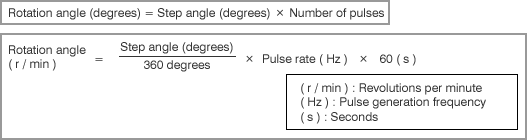
Rotation angle and speed are calculated by the following equations.

image

Example

Case for: Step angle:0.72 deg., Pulse rate: 100Hz...
12(r/min)・・・ 12 rotations per minute
Case for: Step angle:0.72 deg., Pulse rate: 1000Hz...
120(r/min)・・・ 120 revolutions per minute

(4) About "Origin position" (home position)

Since the stepper motors do not have own rotation angle references, mechanical home positions must be provided when used for LCA positioning applications.

#033 Motion Mechanism Design - 3 : Introduction of Small Motor Characteristics

Small motors can be categorized into: motors to obtain power by converting electrical energy to rotational energy, and motors for control where rotational position and velocity are regulated to achieve specific control purposes. The latter is mainly used for LCA(Low Cost Automation) purposes.
Here, the small motor characteristics are described.

Types and characteristics of various small motors
Main applicationType of small motorCharacteristics
Simple positioningMotors with electro-magnetic brake
Often used for Z axis control since the load does not fall since the "power-off" brake can retain the shaft during a power outage.
Overrun: 0.5~1 revolutions
Rating: Minutes
Simple velocity controlVariable speed motor
Overrun: 0.5~1 revolutions
90〜1400r/min(50Hz)
90〜1700r/min(60Hz)
High accuracy positioningStepper motor
Excellent response at low speeds, low vibration.
High resolution: 0.72 deg./ step
High accuracy: ±0.05 deg. (no load)
Open loop control.
Large holding torque.
High speed/High accuracy positioningServo motor (AC)
Excellent response at high speeds, low vibration.
High resolution: 0.044 deg./step
High accuracy: ±0.022 deg. (no load)
Semi-closed loop control
Abnormal load condition can be detected.
Motors for powerInduction motor・Overrun: 30~40 revolutions
Reversible motor
Overrun: 5~6 revolutions
Rating: 30 minutes
With a simple brake mechanism

<Partial reference from Oriental Motor Corp. material>

#032 Motion Mechanism Design - 2 : Drive Mechanism Design

An overview of controlling a linear motion mechanism (operation and velocity characteristics) with a ballscrew and a motor will be explained here. Since linear motion mechanisms with ballscrews and electrical motors have better controllability as compared with the ones with cams and cranks, they can achieve both high speed and high accuracy performances which have contradicted functions under using cams and cranks mechanism.

(1) Operating characteristics

The characteristic of a linear motion operation can be expressed in how the system performs stops at both ends, and at random positions in between the ends.

(a) Stops at both ends

In general, the end stop positions are regulated by placing sensors at the ends (prevention of overruns). Pneumatic devices such as air cylinders have end stop limitations due to their construction.

(b) Intermediate position stop

Stop position accuracies are required for most intermediate position stop applications. This affects the mechanism design, overall rigidity, and drive/control methods used. Applications requiring 0.01mm or so accuracy can be accomplished with a ballscrew and a servo motor with position sensors utilizing proper ramping profiles (for an acceleration/deceleration control) and backlash compensation.

(2) Velocity characteristics (see Fig.1)

[Fig.1] Velocity control examples for linear motion

In order to shorten the positioning time and achieve high positioning accuracy, component deformation produced by inertial force (inertial torque) must be reduced. To do this, acceleration (α) needs to be made as small as possible. However, the rise/fall times will become or make longer if acceleration (α) is simply reduced. A countermeasure for this is a multi-step velocity control method where acceleration is reduced to near zero at the start and the end, and largely increased during acceleration/deceleration.

(a) Multi-step velocity control method

This is one of the methods to achieve higher positioning accuracy at an intermediate position stop. By reducing the velocity in multiple steps as the target position approaches, the effects of decelerating load inertia is reduced. The multi-step velocity settings can be pre-programmed as high/med/low speeds, or motor pole counts can be sequentially switched to do this.

(b) Acceleration/Deceleration control method

This is a method where acceleration is reduced to near zero at the start and the end, and largely increased during acceleration/deceleration.

月別 Archives

Pages

Powered by Movable Type 6.0.3

About this Archive

This page is an archive of entries from March 2010 listed from newest to oldest.

February 2010 is the previous archive.

April 2010 is the next archive.

Find recent content on the main index or look in the archives to find all content.