March 2013 Archives

Soldering is to fuse joint molten solder onto surfaces of base substrates. However, since this jointing is not for structural strength, but to create joints with low electrical resistance with high reliability, much sophistication in production technology based on relevant knowledge in many academic disciplines.

(1) Three elements of soldering related construction materials

As shown in [Fig.1], optimal soldering is obtained with a relationship of the three materials. Therefore, the soldering technology will need to establish an optimum system with these material characteristics.
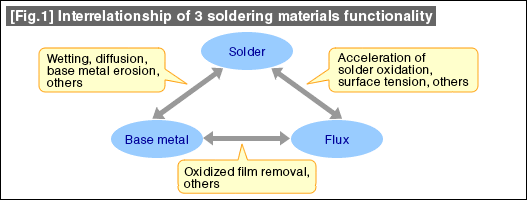
【Fig.1】Interrelationship of 3 soldering materials functionality

(2) Soldering technology and production technology

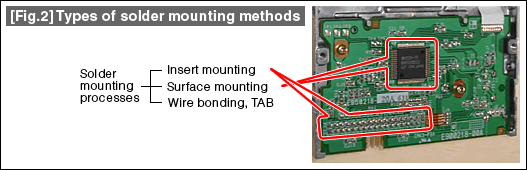
-Solder mounting process methods of electronic components are broadly divided as shown in [Fig.2]

【Fig.2】Types of solder mounting methods

-The Insert mounting methods are used more decreasingly in response to the trends in product size and weight reduction.
-Automating becomes easier as the board and circuit designs are made to use only one of the process methods in [Fig.2] (i.e. Surface mount only).
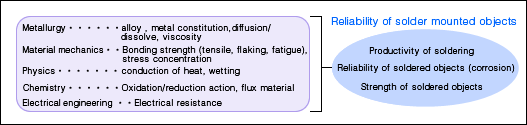
-The following technological disciplines are related to soldering techniques.

As one of the important production technologies to realize high density electronic component mounting, Micro Soldering technology can be listed. Various soldering process methods are introduced here.

(1) Importance of Micro Soldering technology

High density mounting of electronic components with high reliability results in realization of low cost, high quality, high functionality in small and thin packages. Therefore, the micro soldering technology is one of the factors that determine the competitive advantage within the realm of production technologies.

(2) Types of soldering techniques

Many soldering techniques have been developed based on diversity in the types of solder subjects. Adoption of the most appropriate soldering techniques for the characteristics of subject components and electric circuit boards is important.

(1) Classification of soldering heat sources

Soldering techniques classified by heat application methods are organized as follows.

Soldering method

(2) Classification of soldering processes

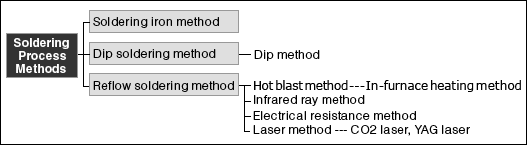
Soldering techniques classified by process methods are organized as follows.

Soldering Process Methods

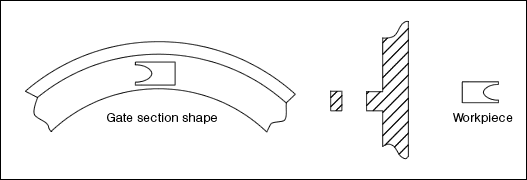
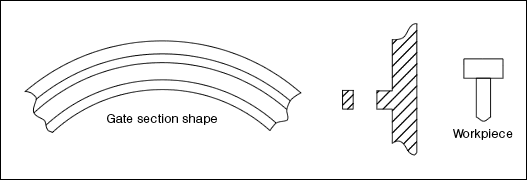
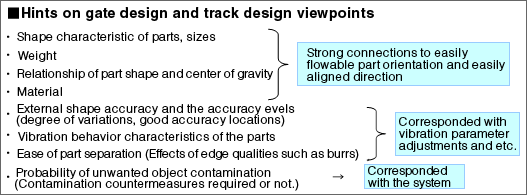
Here, relationship of gate design and workpiece shape is explained with gate designs as examples.

(1) Spacer method・・・Used often when the workpieces are easily identifiable by top/bottom configurations.

[Fig.1] Gate shape and applicable workpiece shape (Right)

Other gate examples

(2) Trap hole method ・・・ Used for complex and thin plate shaped objects that are required to be directionally aligned.

(3) Rail method・・・Used for sorting shapes and sizes of screws and pins

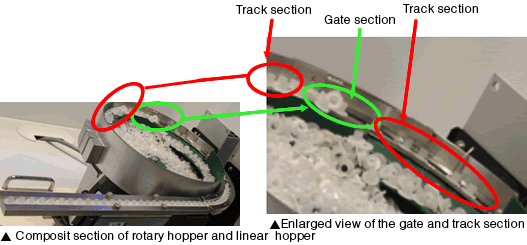
It is understandable that the parts sorting gate designs are very important for component alignment, as introduced in Vol. 154. Concurrently, designs of the travel paths (tracks) for the parts to be aligned are also important.

With capacitors as example, we have explained in the volumes 151 and 152 regaring the increasing levels of difficuly in parts reorientation due to the decreasing sizes of the surface mount components. It is also true that difficulty levels are on the increase of the component alignment technology using the vibratory feeders. The keypoint for this technology is in the gate designs and track designs, and in the sorting system that reject defective parts.

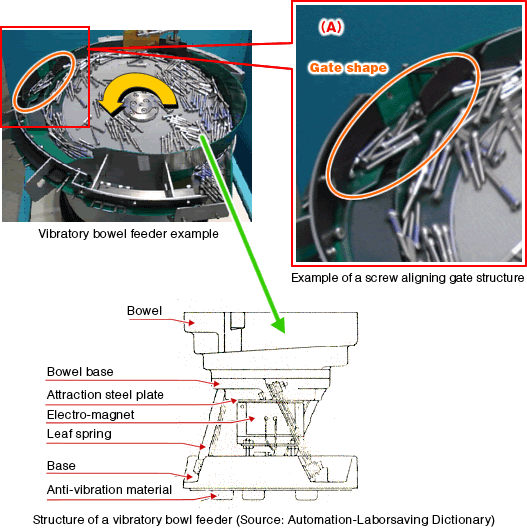
In the Vol. 153, an example of direction changes on a linear feed hopper was explained. In the Vol. 154, direction changes on a vibratory bowel feeder will be explained using an example.

Example 1: Direction changes of screws
-Screws are stored in a vibratory bowel feeder.
-Screws rotate counterclockwise receiving minute vibrations by a vibrating body beneath the bowel.
-Based on the screw orientation at the alignment location (A), the screws are sorted in only one direction by theGate Shape* (Explained in details in Vol.155 & 156), and fed through to be aligned.
-The vibrations will feed the aligned screws forward.

Issues with vibratory feeders:* Noise generated by vibrations
* Scratches and wear on the parts and the bowel.
* Generation of static charges

月別 Archives

Pages

Powered by Movable Type 6.0.3

About this Archive

This page is an archive of entries from March 2013 listed from newest to oldest.

February 2013 is the previous archive.

April 2013 is the next archive.

Find recent content on the main index or look in the archives to find all content.