December 2011 Archives

For the automation systems designers, abilities to determine the shapes of parts based on their intents and purposes at the time of designing. If the designer's level of understanding on machining methods is low, the part production costs can be unnecessarily high or he/she may end up designing parts that cannot be produced.

Machining methods and machining technology basics are explained below.
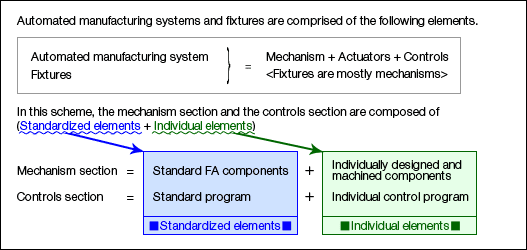
Automated manufacturing systems and fixtures are comprised of the following elements.

The latter costs shown above of individually designed and machined parts and the individually designed produced control programs occupy a large portion of the production costs on automated manufacturing systems and fixtures. Furthermore, since the workmanship quality of the individually produced elements largely affects the assembly efficiency, the final costs of the finished products are largely affected.
Therefore, the individual element portion is the area where the designer's abilities can really shine.
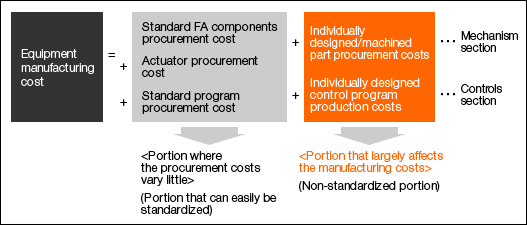
Equipment manufacturing cost

The individually designed and machined parts tend to be more difficult to machine since the special parts are designed to fill specific needs for the system or the fixtures and are not available off the shelf.

- Technical issues of individually designed and machined parts

  1. Many are of complex shapes
  2. Many are with specified dimensional tolerances
  3. They are to be made of special materials (high hardness, non-metals such as plastics and ceramics)

Seasoned designers would proceed with the designs by estimating the rough machining costs per the machining methods to be used.
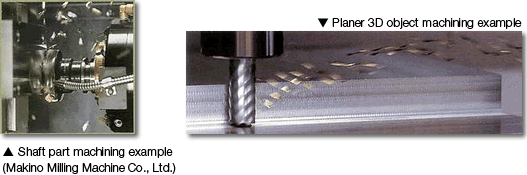
machining example

Due to the circumstances regarding manufacturing costs and assembly accuracy competitiveness, holding techniques that can cope with components with varying quality features. Here, we will discuss some work holding techniques and locating pin application examples that are not affected by parts with incomplete burr removals.

(1) About burrs on parts

The burr removal techniques were previously discussed in Vol. 289. Parts that are machine processed have burrs on them due to the elongating nature of the metals. (Photo 1)

[Photo 1] Various burrs on part edges

(2) When locating with external features

  • There are burrs on parts not chamfered. Therefore some relief features must be provided for the corners.
  • [Fig.1] shows the fundamental countermeasure for the burrs. Application variations of this would be to locate on external profile with pins, and other different shapes.

[Fig.1] Fundamental countermeasure for corner burrs, [Fig.2] Example of external profile locating of other shapes

(3) Application example of locating pins

Locating pins are used according to the quality (burrs) of the parts to be located.

a) When the parts are not de-burred ([Fig.3-1])

* Provide relieves at corners

* Avoid unnecessary surface contacts on both the sides and the bottom. (Avoiding foreign objects from coming into contact)

[Fig.3-1]

b) When the parts are de-burred ([Fig.3-2])

* Relief is not needed for parts that are de-burred on corners

* Corners are used to locate on both the sides and the bottom.

[Fig.3-2]

Locating a part will mean applying some forces on the part to avoid it from moving. If inappropriate forces and means to hold the part are applied, it may result in deformation. Here, locating methods that avoid such deformation will be explained.

(1) Operations with problematic deformation

Following operations and processes often result in deformation problems

  1. When fixturing parts on machining fixtures for milling >> Cannot obtain machining accuracies
  2. Deformation occurring when clamping work-pieces on automated assembly operations >> Unstable assembly operations
  3. Deformation of parts on inspection fixtures for profile inspections >> Low inspection reliability
  4. Others: Deformation due to physical reasons such as heat expansion and contraction --- <Omitted here>

(2) Why deformation occur

Cause for deformation is simples.

Binding force to secure work-pieces >

Deformation strength of work holding components

For machining operations, the parts to be machined will have to be clamped at force levels higher than that of the deformation strength of the part for safety reasons.

(3) Locating methods to avoid deformation

The basic of locating methods in avoiding deformation is to consider a locating feature with the following points in mind.

  1. Consider the deformation strength of the part section where holding forces are applied.
  2. If possible deformation is anticipated, use auxiliary support components when applying the holding force.
  3. Choose directions of forces that hardly cause deformations when applying the holding forces.
  4. Choose part locations where deformation will not result.

[Fig.1] Example of avoiding deformation using auxiliary support fixturing

[Fig.2] Relationship of fixturing force directions and tendency for deformation

Here, a fixturing method to avoid deformations was explained. However, in a strict sense, the examples [Fig.1] and [Fig.2] are fixturing conditions where some metal elastic deformation within tolerable ranges are allowed.

月別 Archives

Pages

Powered by Movable Type 6.0.3

About this Archive

This page is an archive of entries from December 2011 listed from newest to oldest.

November 2011 is the previous archive.

January 2012 is the next archive.

Find recent content on the main index or look in the archives to find all content.