(1) What is a coupling?
One of the machine elements connecting a motor to a rotating drive mechanism is a coupling. Demands for high accuracy, rigidity, speeds on rotating power transmission mechanisms are on the increase as advanced digital controls are implemented.
(2) Role of the couplings
When connecting a rotating motor and a shaft (ball screw, etc.) even accurately, varying conditions occur in motion.
- (1) Deflections of rotating shafts (ball screws, etc.)
- (2) Deflections and deflection stress of two shafts caused by heat expansion
- (3) Deformation of ball screw support section
- (4) Deviation of bearing wear friction after long usage durations
In order to resolve the variable elements (1) ~ (4) above, couplings (deflecting shaft connectors) are used.
(3) Functionalities required for couplings
a) High rigidity --- To cope with high accuracy and high speeds of servo systems
Explanation
If the coupling rigidity is insufficient, servo system delays (lost motion) occurs and positioning accuracy would be degraded, and causes resonance.
b)Zero backlash --- To cope with high accuracy of servo systems
Explanation
Zero backlash couplings without any sliding elements should be selected since mechanical backlash (clearance) is detrimental for servo systems. For the method of shaft mounting, friction fixed mounting is preferred over key fixed mounting.
c) Low inertia --- To improve servo system response
d) Damping characteristics --- To suppress drive system resonances
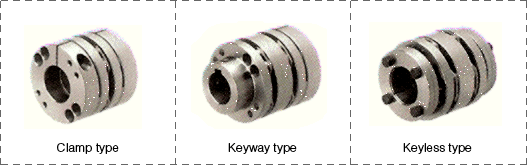
New products: Characteristics of high rigidity disc couplings
 | * | Product compatible to servo motors with excellent high speed and accurate controllability. |
| * | Due to their disc configuration, they have virtually zero backlash, but have high flexibility in shaft misalignments such as angular and shaft center misalignments. Easy to accomplish shaft aligning work. |
| * | The clamp style mounting eliminates a need to machine the shaft for keys. No concerns for shaft strength degradation. |
New product: High rigidity disc style couplings

![[Fig.1] Comparison of particulates by greases used on ball screws](http://www.misumi-techcentral.com/tt/en/lca/images/119_02.gif "[Fig.1] Comparison of particulates by greases used on ball screws")
![[Fig.2] Grease before and after the test](http://www.misumi-techcentral.com/tt/en/lca/images/119_03.jpg "[Fig.2] Grease before and after the test")

