January 2013 Archives

Relationship of machine designers and production technology is explained with surface mounting technology as an example.

(1) What is Surface Mounting Technology?

It can be said that miniaturization technology for the functional components including LSIs is the key technology to realize performance/functionality improvements and miniaturization for portability (high density) of electronic information devices and systems. The interface technology to interconnect these devices reliably and compactly is called [Surface Mounting Technology (High Density Surface Mounting Technology)]. ([Fig.1])

[Fig.1] Example of High density Surface Mounting Technology,【[Photo 1] LCD driver IC (bare chip) and 0.5mm DIA mechanical pencil lead,[Photo 2] Solder connection technology in an HDD,[Photo 3] Packaged PCB example

(2) Example ・・・ Changes in surface mounting technology

Since the surface mounting technology is the representative of the production technologies that has supported the miniaturization and improved packaging density, electronic device and component product trends have driven the developmental needs of the surface mounting technology.

■Surface mounting technology developmental needs example
-Component miniaturization (Narrow pitch connections, multi-pin, 3D packaging, etc.)
-High heat resistance (Auto-electronics compatible)
-High speed/Low cost
-Lead free technology
-Energy saving

(3)Items required for the mechanical designers in surface mounting production technology

From the examples above, the engineers who design the surface mounting equipment are required to have the ability to understand a wide variety of related production technologies as follows.
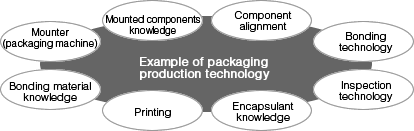
■Example of packaging production technology Mounter (packaging machine) Mounted components knowledge Component alignment Bonding technology Inspection technology Encapsulant knowledge Printing  Bonding material knowledge

#144 Low Cost Automation and Quality - 7: Pre-Curing and Quality

| No Comments | No TrackBacks

When the subject to be heat treated is an organic thin film with adhesive or thin film printing on vaporization process for diluents which control the viscosity of application or printing materials is placed, and a high temperature treatment process is placed to cause a chemical reaction.

In case of precision adhesive bonding process ・・・Used on LCD display outer peripheral section to minimize non-display area.

  -Controlling the viscosity of the adhesive to make it easily handled by a dispensor.

  -By using pre-curing, viscosity control diluent is vaporized.

  -While the adhesive is soft due to high temperature, pressure is applied.

  -The adhesive is cured while the pressure is being applied.


For printing processes on organic thin film ・・・Used on LCD display insulation membrane or orientation membrane.

  -Diluted with solvents to a viscosity where flexography printing system (photo) can handle.

  -Flexography

  -Diluent is vaporized by pre-curing

  -Pre-cured organic material is heat treated up to reaction temperature.


-By incorporating a heat treatment process that is in accordance with the characteristics of the adhesive for the thin film printing, micron accuracy level for the adhesive coatings, and sub-micron level accuracy level are being realized at production lines. The key point for this is the Pre-curing process.

-Walking beam style transfer devices are often used for pre-curing equipment. The number of the pre-curing stages are determined based on the tact time of the production line.

-The mechanism sections such as work push-up and clamping sections that come in contact with printed objects would have large temperature drops due to heat conduction, and likely to cause film thickness variation defects. Therefore, special attention is needed for the designs on these sections.

-In order to achieve such highly accurate printing film thickness, air flow condition around the printed objects during pre-curing process will need to be stabilized, as well as the environment that affect variations of the printing material characteristics such as temperature and humidity will need to be controlled. Therefore, operations by human hands, in many instances, cannot obtain stable film thickness accuracies.

フレキソ印刷装置

Heat treating is a process of applying thermal energy on materials and chemicals to manipulate chemical reactions to control the material characteristics, adhesion and bonding, removal of inpurities. On metals, materials are heated to some appropriate temperature below the melting point, then the rate of cooling down is controlled to obtain required hardness or other characteristics (quenching, tempering, annealing).

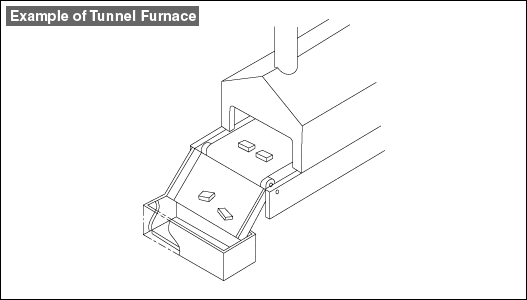
-For the heat treating equipment, there are manual batch type heat treating furnaces, and automated process furnaces where conveyors, transfer systems, and tunnel furnace are combined.

-For the heat treating equipment, there are manual batch type heat treating furnaces, and automated process furnaces where conveyors, transfer systems, and tunnel furnace are combined.

-On the other hand, automated heat treating furnaces are capable of precisely stabilized heat treatments by controlling the conveyor speed and temperature distribution of tunnel furnace entrance, central area, and exit area. However, once the system is powered down, it may take a long time for the furnace temperature to again become stable, and may incur higher electrical costs as well.

-As seen above, the automated methods would produce great results when highly accurate and stable heat treatments are required

-When even more accurate heat distribution is desired, the total thermal volume (how many item to be heat treated are loaded), and temperature curve by pre-heating process are controlled.

Example of Tunnel Furnace

月別 Archives

Pages

Powered by Movable Type 6.0.3

About this Archive

This page is an archive of entries from January 2013 listed from newest to oldest.

December 2012 is the previous archive.

February 2013 is the next archive.

Find recent content on the main index or look in the archives to find all content.