August 2012 Archives

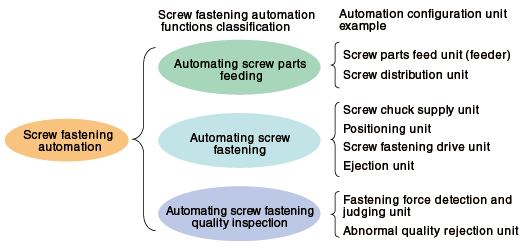
As a representative elemental assembly technology, in addition to swaging technology, there is the "Screw Fastening technology". Below explains the fundamental technologies required for screw fastening automation.


(1)Configuration for screw fastening automation

In order to automate the screw fastening, the system configuration including the before and after processes of screw fastening needs to be clarified. The screw fastening automation configuration can be classified as the following.

(2)Main troubles regarding screw fastening automation

When the screw fastening automation main troubles are functionally classified into 3 parts according to the outline above, it will be as follows.


1)Troubles regarding automating screw parts feeding

(1)Automated screw parts feeding system (parts feeder, etc.) clogs
(2)Screw parts chucking misses (mis-gripping, dropping)
(3)Defective screw parts (Inadequate accuracies, burrs and anomalies, Mixed parts, Magnetization)


2)Troubles regarding automating screw fastening

(1)Abnormal fastening forces (Inadequate or excessive fastening forces)
(2)Abnormal stoppages due to feeding of defective parts
(3)Malfunction of automated positioning system


3)Troubles regarding screw fastening quality inspections

(1)Loosening
(2)Over tightening
(3)Poor appearance (Scratches, bending/tilting, etc.)


60% of the troubles is comprised of screw components misfeeds and improper automated fastening process.
Swaging offers high productivity and excellent connection reliability, but is difficult to re-work. Therefore, it is important to optimize the process conditions at the time of mass production. Shown below are the representative control factors that affect the quality of swaging.

(1)Swaging quality

The quality of swaging can be represented by the following items.

a)Swage strength (Slip torque)
b)Appearance (Cracks, Bow deformation, Shaft deformation)

Explanations

a) Swage strength ---Slip and torque determined by deformation resistance, when pins (rivets) are inserted in pin holes and deformed, are evaluated. This is largely influenced by the materials of both components, naturally.
b)Appearance ---This is a quality control item of swage quality indirectly determined by visually inspecting the appearance of the swaged part, in order to avoid any negative effects on assemble operation.


(2)Swage quality control factors

Swage quality control factors are explained by classifying into 4Ms (1st M: Material, 2nd M: Machine, 3rd M: Methods, 4th M: Man).

1) Material/Parts related control factors
(1)Workpiece material characteristics (Relationship of two material characteristics - - Tensile strengths, elastic modulus differentials)
(2)Shape and accuracy of both parts swaged (Plate thickness, swaging amount, swage-crushed size, shaft swaging shape, burrs, etc.)
(3)Workpiece pre-processing state (Heat treatment - - Hardness, surface treatment - - Friction coefficient, surface layer strength, hardness, etc.)

2)Machine related control factors
(1)Swage drive characteristics of swaging equipment (Operational stability, Workpiece locating accuracy, Looseness, etc.)
(2)Swaging punch shape (Punch angle, Tip shape, etc. - - - - Transmission of deformation stress and its stability)

3)Swaging methods related control factors
(1)Pressurizing method (Fixed dimensional pressurization method, Fixed load pressurization method) and pressurization force
(2)Pressurization conditions (Presence or absence of heating, pressurization speed, etc.)

4)Operating personnel (Man) related control factors
(1)Stability of pressurization operation (pressurization forces, Force application time)
(2)Equipment maintenance


(1) Design points on swaging machine
1)Countermeasures on swaging head wear and deformation
2)Workability during swaging head replacement
3)Reliability of the positioning of swaged parts
4)Ample rigidity of load support structure during swaging operation
5)Operational safety

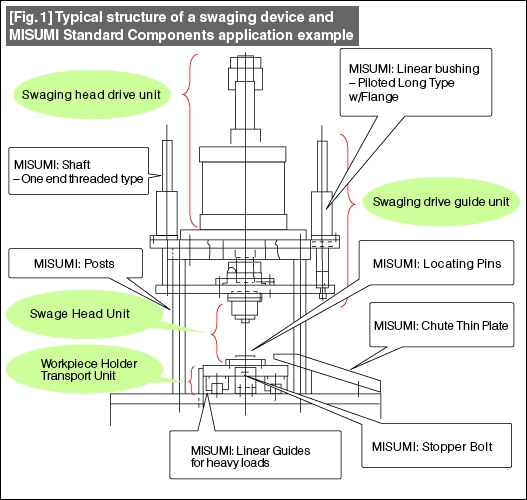
(2) Typical structure of swaging machine

[Fig.1] shows a typical structure of a swaging device and associated various units composing the system. Various MISUMI FA Standard Components frequently used for such applications are also introduced.

【Fig.1】Example of general structure of swaging equipment using Misumi standard parts

Source: "Illustrated collection of automated mechanism" (Nikkan Kogyo Shinbum Ltd.) edited

We shall continue on the types of swaging and the characteristics. Figures are sourced from an assembly component technology manual produced by Nikkan Kogyo Shimbun Ltd.

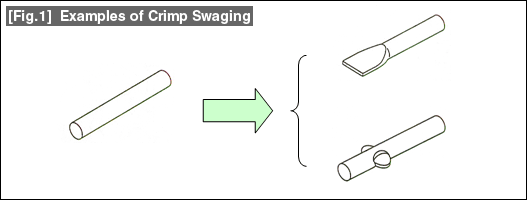
(1) Crimp Swaging

This is a swaging method that facilitates the connecting feature by crimp crushing outer circumference portions of round rods and pipes. It is typically used for simple rotating stopper pins and alike.

Fig.1 Examples of Crimp Swaging

Source: "Assembly Elemental Technology Manual", Nikkan Kogyo Shinbun Ltd.


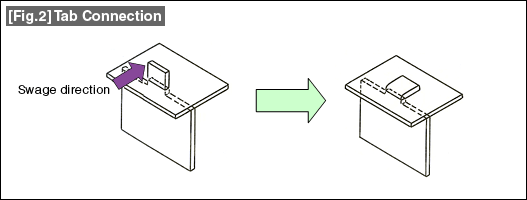
(2) Tab Connection

Used for connecting bent plates. A tab formed on one part is inserted into a slotted hole on another part, and the plates are connected together by the tab being (1) Folded, (2) Twisted, or (3) Crushed.

Fig.2 Tab Connection

Source:"Assembly Elemental Technology Manual", Nikkan Kogyo Shinbun Ltd.


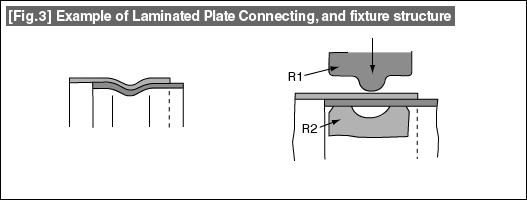
(3) Laminated Plate Connecting

This is a connection method where two thin plates or tubular shapes are connected together by laminating and bending the edges. A convex shaped swaging head is pressed on and the parts to be connected together are moved (rotated or slid) to facilitate the swaging.

Fig.3 Example of Laminated Plate Connecting, and fixture structure

Source: "Assembly Elemental Technology Manual", Nikkan Kogyo Shinbun Ltd.


月別 Archives

Pages

Powered by Movable Type 6.0.3

About this Archive

This page is an archive of entries from August 2012 listed from newest to oldest.

July 2012 is the previous archive.

September 2012 is the next archive.

Find recent content on the main index or look in the archives to find all content.