August 2009 Archives

#009 Linear Guide Mechanism other than Shafts

Combinations of shafts and linear bushings (or oil-less bushings) as rails and sliders are the simplest form of linear guide mechanism.

(1)Shortcomings of linear guide with shafts and bushings.

Following shortcomings can be noted.

Shortcomings of Shafts and BushingsCountermeasuresEvolution of linear guide mechanisms
Linear bushings cannot be used for rotary motion along the shaft circumference.Two shafts are used to constrict the rotary motionBall spline + Spline shaft configuration.
End supported shafts configuration does not provide enough rigidity against high downward loads.Use of larger diameter shaft and double linear bushings.Shaft guide rails + shafts + linear bushings

(2)Advances in linear motion guide devices

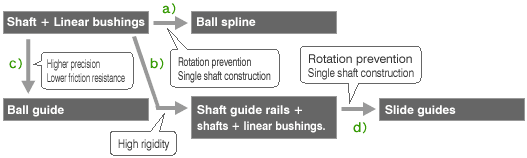
Simplified depiction of the advancements is as follows.
img

Explained by simplified pictorial

a)A ball spline has ball rolling grooves on the shaft, and free to move only in linear direction. (See [Fig.1])
Fig.1] Ball spline

b)A guide rail support is provided under the entire length of the shaft, increasing the shaft rigidity. Mating linear bushing has a lower section removed to account for the guide rail. (See [Fig.2])
Fig.2] Linear guide unit

c)Since a free moving ball retainer is the bearing element, no movement restrictions in either rotation or linear.

d)Principally similar in construction to b), but ball rolling grooves are provided on the rail to increase bearing contact surfaces for high load capability.
[Fig.3] Higher rigidity and long life design of Slide Gides

img

#008 Application Examples on Hollow Shafts

A hollow shaft has a hollow bore through the center of the shaft, and has the following characteristics.

Hollow shaft characteristics
1. The through bore can be utilized for various purposes.
2. Lighter in weight compared to solid shafts of the same diameter.
3. Notably, the through bore does not have high concentricity with the shaft, and cannot be used as an accurate guiding bore.

Each characteristic is explained in examples.

(1)Utilizing the through bore.
(a)Cooling of the shaft.
In order to prevent the shaft temperature rise due to friction, fittings can be mounted on the ends to introduce various cooling medium (air, water, etc.) through the hollow bore.

(b)Guiding electrical wire and other plumbing components.
Motor cables and air cylinder's air supply can be run through the bore in cases where way covers and other components are obstructing the routes. (See [Fig.1])

[Fig.1] Example of hollow shaft application

(2)Lighter in weight compared to solid shafts of the same diameter.

For applications where the shafts reciprocate, the weight of the shafts affect the sizing of actuator's prime mover. Cost reduction, energy savings, and motor heat reduction can be gained by keeping the prime mover as small as possible. However, the hollow shafts generate louder noises when subjected to bearing motion, as compared to other shafts in general.

[Photo 1] Hollow shaft application example

#007 Selecting Shaft Holders

| No Comments | No TrackBacks

L shaped shaft holders are available in four shaft mounting configurations. Characteristics for the four types are organized below as selection references.

The holders in [Fig.1 Side insertion type] and [Fig.3 Separate type] have similar appearances with a difference only in shaft mounting methods. It can be seen from the figures that the shafts are inserted/removed in different manners. The difference affects the moving table assembly procedure and maintenance work. Chart below compares the differences of the four types.

NameShaft mounting methodCharacteristics
Standard Type
(SHKLM)
Shaft is held directly with a hex socket set screw.
Shaft retention strength is not very high.
Not suitable for applications where rotation and axial force in imparted on the linear shafts.
Slit type
(SHKSM)
Shaft mounting bore has a slit at 12 o'clock, and a screw tightens the slit to retain the shaft.
Shaft retention strength is high and reliable.
The shaft can only be inserted horizontally, causing limitations in assembly/maintenance due to interferences with surrounding mechanisms.
Side slit type
(SHKWM)
-See [Photo 1]-
-See [Fig.1][Fig.2]-
A slit is located on the side of the shaft bore, and a screw is tightened to clamp the linear shaft.
Same as above.
This type differs from the top-slit type only in the direction of the screw tightening direction, but all three bolts can be tightened from above.
Separate type
(SHKPM)
-See [Fig.3]-
Shaft bore is horizontally cut and made into two separate pieces. Two screws are used to clamp down on a shaft.
The linear shaft can be placed either from the side or top, making for easier maintenance.
Higher complexity in work due to increased part count.

[Fig.1][Fig.2]

[Fig.3]

Other than the types shown in the table above, there are four other shaft holders such as T-type, bottom mount type, and side mount type. These can also be selected based on the perspective shown below.

Perspective for shaft holder selection
1. Assembly/maintainability
2. Placement relationship with surrounding components
3. Degree of mounted part strength
4. Ease of standardization

#006 Stopper Mechanism with Shaft Collars

| No Comments | No TrackBacks

A shaft collar retains itself on a shaft by clamping on it's circumference. This clamping shaft collars can be utilized as stoppers for the linear motion mechanism. Benefit of utilizing the shaft collars as stoppers is that stop position can easily be adjusted. Fig.1 shows a representative usage of shaft collar stopper mechanism, and the characteristics are listed below.

[Fig.1]  Example of a stopper mechanism using shaft collars.

A dual-shaft linear guiding system is driven by an air cylinder.
Slit-type shaft collars are used for the air cylinder position stopper. Two collars are tied together with a stopper plate for increased strength.
Stop position can easily be adjusted by loosening the slit-tightening screws on the collars.
Two linear shafts are tied together at ends with a connecting plate for increased structural strength.

Additionally, there are two mounting options available for the shaft collars: threaded hole type, and through hole type. The collars can be fastened from either side of the stopper plate, as shown on [Fig.2] below.

[Fig.2-a] Mounting: Threaded hole typ

月別 Archives

Pages

Powered by Movable Type 6.0.3

About this Archive

This page is an archive of entries from August 2009 listed from newest to oldest.

July 2009 is the previous archive.

September 2009 is the next archive.

Find recent content on the main index or look in the archives to find all content.