August 2015 Archives

Automation device parts are determined by the shape and dimensions. The two elements (shape and dimensions) chosen by the designer significantly affect both the parts cost and the assembly cost of an automation device. The previous lecture #210 introduced the effects on the parts processing cost. In this section, we will explain the effects on the assembly cost.

  • Pricing of an automation device will be determined by the following factors:

    Figure

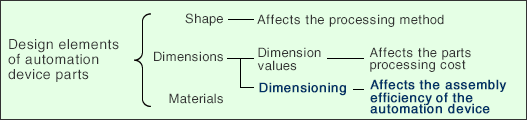
  • Automation device parts consist of the following three design elements (shape, dimensions, and materials).
    Figure

  • Shape, dimension values, and materials of the parts greatly affect the parts processing cost.
  • Dimensioning in the drawings is largely classified into the following two methods:

    Figure

  • Dimensioning based on the end face listed at a) has some disadvantages - it is likely to result in dimensional mistakes during an explosion from assembly drawing to detail drawing or combination errors in the assembly process.
  • However, dimensioning based on the end face will be used more frequently for designs requiring high-precision assembly.
  • Therefore, it is preferable to adopt the center baseline positioning as much as possible for assembly parts drawings of a common automation device.
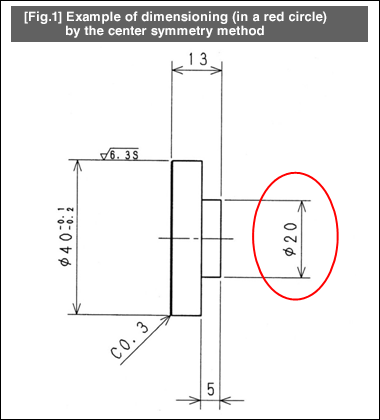
  • [Fig.1] is the design drawing of a circular part. Since this part is a circular shape, ID and OD dimensions are described based on the centerline.
    Figure

All mechanical devices are manufactured by assembling various components. Therefore, the parts drawings are the final information to output for all the mechanical devices, including automated machines. This section introduces points on preparing the parts drawings of an automated machine.

  • Pricing of an automated machine will be determined by the following factors:
    Pricing of an automated machine = Design cost + Parts processing cost + Cost of goods purchased + Assembly cost + Profit
  • The designer of an automated machine can improve the cost performance.
    To achieve this, the designer must have the following skills:
    (1)Design skills to complete the design in a short period
    (2)Design skills to reduce the parts processing cost
    (3)Design skills to eliminate unnecessary purchase cost (Example: adopting standard items, bulk purchase of the same item, avoiding over-engineered designs, etc.)
    (4)Design skills to reduce the assembly cost by adopting an easy-to-assemble structure
    (5)Design skills to make the appearance more attractive as well as to generate reasonable profit by its performance
  • Parts drawing design significantly affects pricing of the automated machine. The parts processing cost and assembly cost are directly affected.
  • To reduce the parts processing cost listed at (2), try to adopt existing parts available (MISUMI FA machined parts, for example) as much as possible.
  • It is important to design the parts drawing without providing unnecessary dimensional tolerances in order to keep the parts processing cost to the minimum.
  • Designers tend to include more dimensional tolerances on the parts drawing to ensure the final precision needed for the automated machine. However, it is necessary to understand that the processing costs for the parts processing stage add up with each dimensional tolerance designed.
  • [Fig.1] shows the drawing of chuck fingers on the hand for transferring color balls. It is necessary to match the position of two chuck units in order to hold spherical color balls steadily by two plane chuck units. For this reason, dimensional tolerances (red arrow) are applied to the positioning groove width.
  • A positive dimensional tolerance (red arrow) is applied to holes for the proximity sensor to minimize backlash and allow the parts to fit in the hole.
  • Instructions on the finish quality are provided for three areas. While keeping the entire surface rough, a smooth finish is required for the three areas (black arrow).

[Fig.1] Example of parts drawing design (without including unnecessary dimensional tolerances)

月別 Archives

Pages

Powered by Movable Type 6.0.3

About this Archive

This page is an archive of entries from August 2015 listed from newest to oldest.

July 2015 is the previous archive.

September 2015 is the next archive.

Find recent content on the main index or look in the archives to find all content.