April 2010 Archives

#039 Motion Mechanism Design - 9 : Sensor Usages - 3

Our discussion here covers an algorithm to obtain accurate Home Position using slotted photo sensors.

Method to accurately setup an accurate home position

The home position (= motor shaft angle origin position) is where the moving object's sensor target passes a photo sensor slot located in the middle. If the target passes with excessive speed, inertia of the moving object will cause a small overrun error causing inaccurate home position setting.
Homing routines are often performed when the system power is initially turned ON, and when emergency stops occur. It must be noted with caution that the routine may be performed manually at high speeds in order to save time.

Understanding the principle of machine homing and automating the routine with a homing program would save time.

Cause for errors during homing routines
The moving object passing the sensor at excessive speeds will generate errors due to overruns caused by the object's inertia.

For this reason, the sensor target must pass the sensor at low speeds. The algorithm below will shorten the time to perform the homing routine.

Accurate homing routine algorithm (see [Fig.])

[Fig.1] Accurate homing routine algorithm

1. Approach the home position from one direction at a high speed, stop immediately when the home sensor is passed.
2. Reverse the direction and approach at a low speed a point where the sensor turns OFF.
3. Set this OFF point as the Home Position.

Aim

1.will rapidly return the sensor target to the home sensor position.
2.enables the sensor to detect slowly moving target to avoid detection errors.

#038 Motion Mechanism Design - 8 : Sensor Usages - 2

There are various sensors used in LCA such as: micro switches that make physical contacts with work (MISUMI P/N MZW822, MZQ1, etc.); non contacting photo sensors (beam sensor: PEX11, photo-micro sensor: FPM24, etc.); and proximity sensor (PGXL8, etc.). Sensors must have environmentally extremely reliable outputs since the outputs determine the outcome of the control sequences to follow. Typical sensors and performances are introduced below. Select according to application specific needs.

(1) Characteristic comparisons of detection sensors

Switch typeMicro switch
Limit switch
Proximity sensorPhoto sensorPhoto sensor
Item
Detection methodContactingNon-contactingNon-contactingNon-contacting
Detection principleMechanical switchMagnetic field detectionThrough beamReflective
Detection accuracy
Detection distance
Response time
Life
Noise immunity
Environmental immunity (dust, water, etc.)

(2) Outline of various sensors

Contacting sensors (micro switches/limit switches) are disadvantaged in response time and operational life, but are often used where their superior noise immunity and actuation reliability are needed. Also, they are constructed to withstand many environmental adversities such as external forces, water, oil, dust, and wide temperature variations.
The proximity sensors that operate on magnetic field detection principle have sensing distance limitations. It is recommended to use within 70% of the maximum detection distance specification considering environmental temperature variations.

Photo sensors can be categorized into three groups based on the type of light receptor elements used.

Opposing through beam type
Reflex reflector through beam type
Two part construction with a reflector plate and a emitter/receptor element.
Reflective type
Single unit type containing emitter and receptor.

The through beam type is actuated when an object block the beam. The reflective type is actuated by a reflection from an object.

#037 Motion Mechanism Design - 7 : Sensor Usages - 1

Sensor usages for motion mechanism designs will be explained based on an application example diagram [Fig.1]

[Fig.1]

(1) Sensor application example in LCA

This simple automation system example with two motors produces: 1. Positioning, and 2. Pressing

1. A single axis positioning table composed of slide guides and a ballscrew.
2. A press mechanism with a cam & link converting rotary motion to up and down reciprocation motion.

(2) Sensor's role

Sensors are detectors of various physical and environmental conditions such as machine speed, position, contact pressure as information. The detected information would enable the automation system to be controlled.

images

In the example of [Fig.1], a non-contacting photo sensor is used each on the table position and the cam shaft's rotation angle. The sequence program operates based on the position signals from the sensors.

(3) Stepper motor and positioning sensor configuration

The example of [Fig.1] uses a stepper motor as the actuator. Since the stepper motor can be controlled for rotation angles and speeds independently, purposes of the sensors in [FIG.1] are as follows.

1. End of travel limits as overrun prevention sensors.
2. Home position signal output for positioning control.

There are three table control sensors provided in [Fig.1]. Two of which are for end-of-travel limits as overrun sensors, and the one in between is the home position sensor. The rotation angle of the cam shaft is detected with a combination of a slotted disc and a photo-micro sensor.

#036 Motion Mechanism Design - 6 : Timing Belt Drive

Discussed here is accuracy requirements of stepper motors using a simple single axis robot with a timing belt and a stepper motor.

[Fig.1] Timing belt driven single axis robot mechanism

(1) Calculating rotational accuracy needed for the motor

For converting motor rotations to linear motion, accuracies needed for the linear motion mechanism and the drive motor are as follows.

数式画像

This equation is a conversion of needed linear positioning accuracy and rotational accuracy per 360 degree rotation, easily understandable by the [Fig.2] show below.

[Fig.2] Needed motor accuracy and linear positioning accuracy

(2) Example

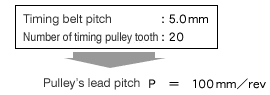
1. If timing belt and pulley selection candidates are as follows...

image

If linear positioning accuracy A is to be: A = ± 0.1mm...

image

2. If a ballscrew is used

The accuracy equation above can be used for ballscrew cases by replacing the pulley's lead pitch P with a ballscrew lead pitch.

月別 Archives

Pages

Powered by Movable Type 6.0.3

About this Archive

This page is an archive of entries from April 2010 listed from newest to oldest.

March 2010 is the previous archive.

May 2010 is the next archive.

Find recent content on the main index or look in the archives to find all content.