March 2018 Archives

The pressurized heating process in mass production requires a processing method where the same production pitch as those of the previous and subsequent processes can be maintained without having a buffer for storage.This section describes multilayer pressurized heating process technique.

(1)Multilayer pressurization process technique
1)Multilayer pneumatic pressurization method for rigid body

・In the case of a product consisting of two panes of bonded glass materials together, the same production pitch as those of the previous and subsequent processes can be maintained by laminating several slices of bonded glass materials.
・In this collective pressurization process in the composite fabrication, uniform contact stress can not be applied to each layer of the bonded glass body because of plate thickness variations of the bonded glass materials (Fig. 1).
・The plate thickness variations of bonded glass bodies can be eliminated by inserting spacers (pressure buffer sheets) having the same effect as that of the pressure buffer material discussed in D549, between the bonded glass bodies in order to absorb the variations to maintain even pressurization (Fig. 2).
・The requirements for the material of the spacer are as follows: (1) thin and uniform in terms of plate thickness, (2) free from local hardness or variations, (3) durable (tolerable for repeated use), (4) free from producing dirt and grime, (5) free from being electrically charged, (6) cost-effect.
・"Paper" spacer is possible for prototyping, but it is not appropriate for mass production because of issues in points (3) and (4) above.

[Fig. 1] Case of direct multilayer pressurization method for bonded glass body and pressure variations

[Fig. 2]Case of multilayer pneumatic pressurization method

・If the quality of pressure buffer sheet used for laminating pressurization is poor and produces local hardness, or if foreign substance is attached to the sheet due to static electricity, contact stress is applied locally to the section, which may cause the product to be defective.

2)Multilayer pressurized heating method for rigid body

・When a heating process is required for the case of Fig. 2, the property of thermal conduction also needs to be considered for characteristics of the pressure buffer sheet.

A pressurization method using rubber expansion body requires some empirical design technique such as a method of fixing the expansion body in place in the mechanism design, although it is advantageous in uniformity of pressurization.This section describes points to remember when designing mechanism of pneumatic pressurization method.

(1)Points to remember when designing mechanism of pneumatic pressurization method using rubber expansion body
1)Countermeasure for pneumatic pressure fluctuations by heating

・When a pneumatic pressurization method much like rubber expansion body is used with heating treatment, the energy inside the heating furnace will be greater than the pneumatic pressure in the room temperature, since the pneumatic pressure rises because of the heating temperature.The pressure conditions, thus, must be selected in consideration of this effect.
・If pressure rise due to heating cannot be addressed just by changing the pressure conditions, use of a pressure switch (mechanical or electrical), which reduces pneumatic pressure during heating process, might be one solution for the situation.
・When a heating furnace is used, it is simple to adopt a mechanical pressure release handle (for example, ball valve, Misumi BRKT) and to reduce the pressure by mechanically opening an open valve with a pneumatic cylinder, etc. (Figs.1 and 2).

[Fig.1]Overview of mechanical pressure reduction method with pneumatic pressurization method [Fig.2] Example of pressure release inside the heating furnace

2)Fixing rubber expansion body of balloon type

・The rubber expansion body as shown in Fig.1 is fixed with the platy metal frame onto the pressurization plate. It has to be fastened in such a way that smooth curved surface is formed without making wrinkles on the surface of the rubber expansion body.
・The shape of the metal frame for holding the rubber expansion body is thus important.
・Fig.3-a shows a commonly-used angular holding frame, whereas Fig.3-b shows a holding frame with large round inner corners.
・Fig.4 shows the states of circle parts of those rubber expansion bodies in Fig.3. The rubber expansion bodies are fixed to the individual holding frames and expanded.
・In Fig.4-a, the corners of the rubber expansion body are deformed in a complex manner.In Fig.4-b, the rubber expansion body is expanded with smooth curved surface.
・It is required to select the proper shape of holding frame as shown in Fig.4-b and the optimal volume of expansion of the rubber expansion body, and also to adopt a fixing mechanism free from air leaks during expansion even after use for long hours.

[Fig.3]Example of holding frame of rubber expansion body

[Fig.4]Comparison of shapes of holding frames of rubber expansion body and expanded states of rubber expansion bodies

Pressurization methods using the pressurization buffer material such as rubber elastic body are hardly free from effects from deformation property of pressurization buffer material or deterioration in property of elasticity due to aging.This section describes a pressurization method using the pneumatic pressure.

(1)Pneumatic pressurization method and pressure profile
1)Pressurization method using pressure buffer material

・In the case of pressurization method using the pressure buffer material, the contact stress acts intensively upon the circumference edge area of the workpiece in the directions indicated by the red arrows, which in turn deforms the pressurization buffer material locally in the inner side of the edge. This results in a sudden reduction of contact stress in the adjacent side of the circumference (Fig. 1).

[Fig. 1] Pressurization method using pressure buffer material and pressure profile

2)Pneumatic pressurization method

・Use of rubber expansion body much like a balloon which pressurizes the pressure buffer material section with the pneumatic pressure will make more consistent pressurization act on the workpiece based on the "Pascal's law" (Fig. 2).
・"Pascal's law" is a principle that when some force is applied to one point in the container with the fluid in it, contact stress with the same magnitude will impinge in the vertical direction of the surface of the container (Fig. 3).
・For durability of the rubber expansion body, it has to be at least 2 to 3 mm thick.This expansion body needs to be fixed to the pressurization plate without an air leak.
・The case of Fig. 2 can also be improved a good deal by selecting better rubber expansion body material, optimal condition, etc., even though a reduction of contact stress in the inner side of the edge area cannot be completely eliminated since intensive contact stress persists in the circumference edge of the workpiece.

[Fig. 2] Illustration of pneumatic pressurization method

[Fig. 3] Pascal's principle (left) and its application to equipment

Pressurization method generally determines its pressure profile.The pressure profile, however, changes even with the same pressurization method depending on the (1) area of pressurization surface in comparison with the size of workpiece, (2) the property of elastic body of pressure buffer material, etc.This section describes the pressurization method and pressure profile.

(1)Pressurization method and pressure profile
1)Pressurization method - A

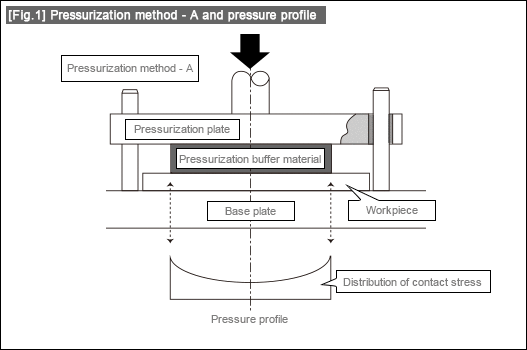
・Pressurization method - A is used in the case where pressure is applied to the area inside the circumference of the workpiece to pressurize the inner side of the workpiece using pressurization buffer material.
・The figure below illustrates the pressure profile in this case.The contact stress peaks at the circumference edge of the pressurization buffer material, and it begins to fall toward the center of the workpiece.
・Use of the pressurization buffer material will give some allowance for the parallel precision required for the opposing surfaces of the pressurization plate and the base plate, and rigidity of the whole mechanism.

Pressurization method - A and pressure profile

2)Pressurization method - B

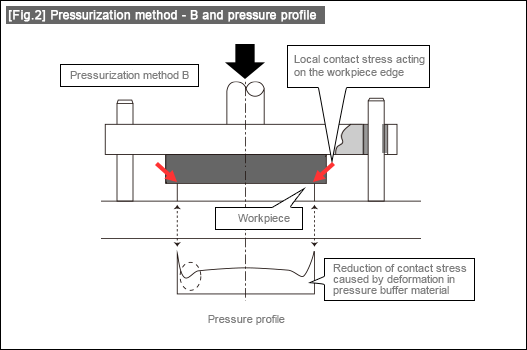
・Pressurization method - B is used in the case where pressure is applied to the whole area of the workpiece when the pressurization buffer material is larger than the workpiece (Fig. 2).
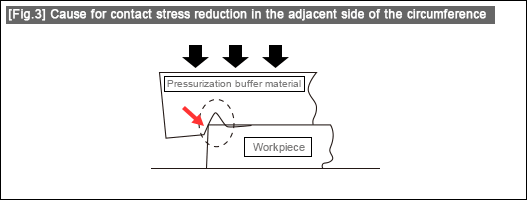
・In this case, the contact stress to pressure buffer material acts intensively upon the circumference edge area of the workpiece in the directions indicated by the red arrows.This intensive contact stress onto the edge area causes local deformation of the pressurization buffer material inside the edge area, which results in a sudden reduction of contact stress in the adjacent side of the circumference (Fig. 3).
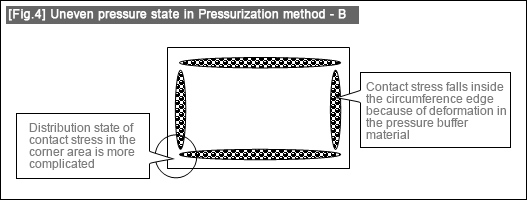
・This reduction of contact stress in the adjacent side of the circumference will cause unevenness of bonding or uniformity in a fine gap between two panes of glass substrates, which affects product quality (Fig. 4).
・Selecting appropriate property of elasticity such as hardness of pressurization buffer material can restrain reduction of contact stress in the adjacent side of the circumference to a certain extent, but there are no fundamental countermeasures effective for the issue.

Pressurization method - B and pressure profile

Cause for contact stress reduction in the adjacent side of the circumference

Uneven pressure state in Pressurization method - B

・In both pressurization methods A and B, distribution states of contact stress are more complex and the precision tends to deteriorates on the corners of the workpiece.
・The pressure buffer materials (rubber elastic body) also need replacement at a constant interval, etc. for management because there involve factors for variations in quality such as change in hardness or unrecoverable deformations caused by thermal effects from the heat treatment process or aging.

月別 Archives

Pages

Powered by Movable Type 6.0.3

About this Archive

This page is an archive of entries from March 2018 listed from newest to oldest.

February 2018 is the previous archive.

Find recent content on the main index or look in the archives to find all content.