July 2016 Archives

In this volume, we will learn about the third law of motion: law of action and reaction.

(1)Law of motion
3)Newton's third law --- sometimes referred to as the action-reaction law.

- If one object A exerts a force on another object B, then B simultaneously exerts a force on A. The two forces here are equal in size and opposite in direction.

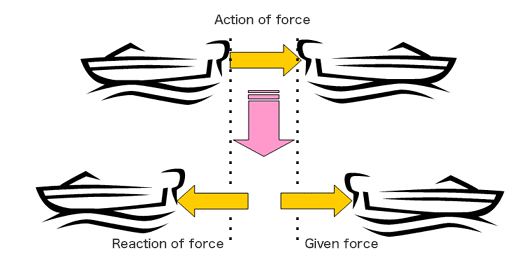
- When a ship A pushes another ship B, the both ships will be pushed against each other by the same magnitude of force in the opposite direction.
fig

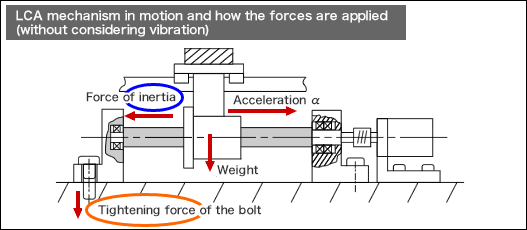
- Since we usually take this kind of reaction for granted, you may have a hard time understanding the concept, but you can really feel the reaction force at a sudden start while riding in the vehicle with a large acceleration.

- The action of force that you are pushed back against your seat is the vehicle's reaction force toward the moving force.

- This reaction force is a required strength value for support structures of the drive mechanism.
fig

In this volume, we will learn about the second law of motion. You can calculate the moving force required for given conditions of acceleration and mass using this law.

(1) Law of motion
2) The second law of motion

- A force applied to an object (movable body) causes it to accelerate in the direction of the force in proportion to the mass of the object.

- The relationship of force (F) and acceleration (A) can be described as F ∝ A.

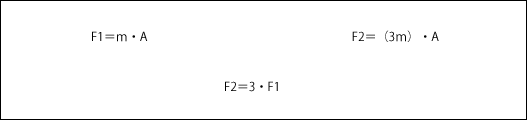
- When "m" represents this proportional multiplier, the second law of motion can be expressed as F = m・A. This formula is called "equation of motion".

- The proportional multiplier (m) is the mass of the corresponding object.

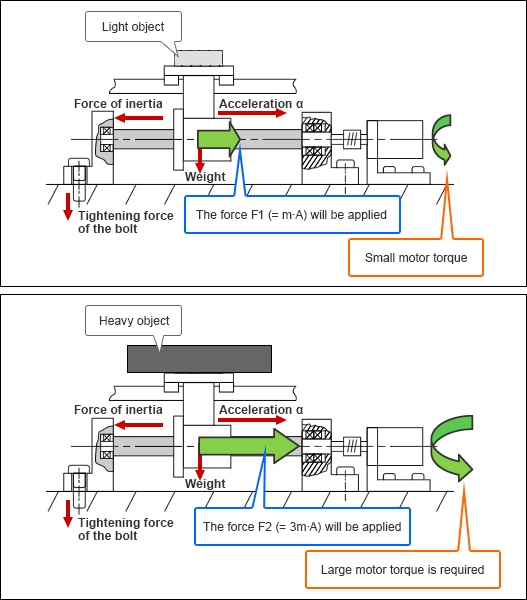
- Therefore, reducing the weight of a movable body decreases the required force for moving the body. This means that a smaller motor can be adopted instead.

- The gravitational acceleration g (m/s2) acts on the mass m (Kg). The gravity applied to the object is calculated as W = m・g (N: Newton), which is the weight of the object.

- Depending on the load weight transported on the movable table, the required capacity of a rotary motor varies in order to generate the same acceleration in the linear drive mechanism.

- When the load mass in the left figure is m, the load mass in the right figure is three times more than m (= 3m), the driving force on the right needs to be three times more than the left mechanism in order to generate the same acceleration.

formula

- Therefore, the weight reduction technique is required as an important technique for designing high-speed drive mechanisms.

image

A force is always applied to a moving object (movable body). The force applied to this movable body is the basic knowledge required for engineers to design mechanical devices. The law of inertia in particular is an important concept in designing high-speed drive mechanisms.

(1)Law of motion
1)Newton's first law --- sometimes referred to as the law of inertia

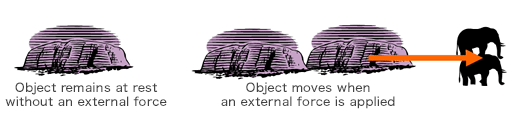
- Objects will remain in their state of motion unless an outside force acts to change the motion.

- A moving object (movable body) stays in motion at a constant velocity and an object at rest remains in the resting state, unless acted upon by an external force.

- This type of motion is called inertia and this law is often referred to as the law of inertia.

fig

- For linear motion mechanism, it is necessary to design a control unit that applies a force to the opposite direction after reducing acceleration to zero at the termination point where the direction of reciprocating motion changes.

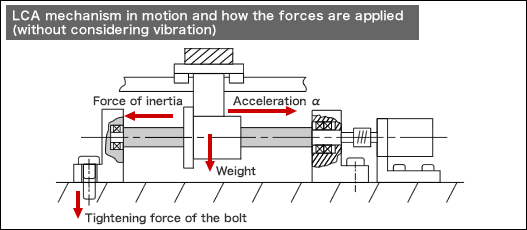
- This acceleration change requires an external force. At this time, the force of inertia acts near the termination point of reciprocating motion.

- Therefore, it is necessary to design a support structure strong enough to withstand the force of inertia.

- The following figure is an explanatory diagram of how the forces are applied to the ball screw driving mechanism.

fig

In this volume, we will learn about basic knowledge of motion in order to understand the motion state of a movable body.

(1) Fundamentals of motion

- "Motion" means that an object changes its position with respect to time.

- "Displacement" refers to positional changes of an object. (Since it quantifies the distance and direction, composition and resolution are also possible.)

- "Velocity" refers to the degree of displacement with respect to time. (Since it quantifies the distance and direction, composition and resolution are also possible.)   Unit = m/s

- "Uniform motion" means that an object travels at a constant velocity. It can be expressed as V (velocity) = S (travel distance) / t (time).

- "Acceleration" refers to a rate of velocity change with respect to time. A (acceleration) = {V - V0 (initial velocity)} / t
Unit = m/s2

- "Uniformly accelerated motion" refers to motion with constant acceleration.
The velocity after t seconds will be V = V0 + A・t
The travel distance after t seconds will be S = V0・t + (1/2) A・t2

Velocity and travel distance are used for estimating work tact (time) or life hours relative to the sliding distance when designing a linear motion mechanism. They are also utilized for assessing the moment of inertia force.

[Fig.] Example of a life test for the linear bushing (estimation of velocity, acceleration, sliding distance, and life hours)

(2) Motion expressions

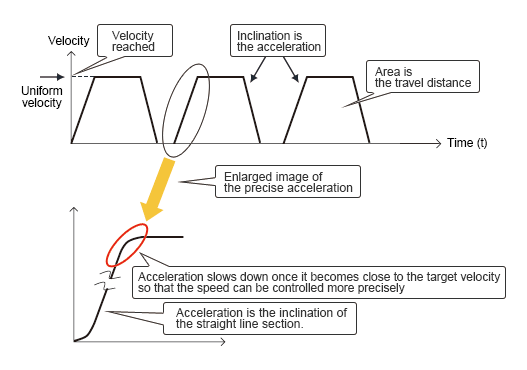
The following figure shows a relationship between the time and speed of uniform motion. It is a typical pattern of linear motion (linear reciprocating motion).

image

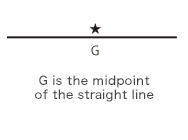
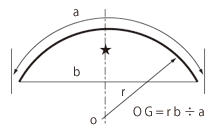
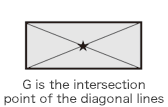
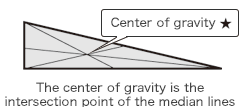
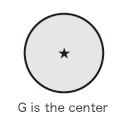
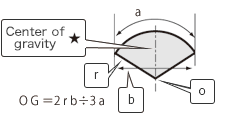
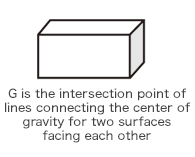
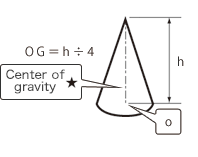
The center of gravity for basic geometric configuration can be calculated by a math formula.

(1)Line shapes

1)Straight line 2)Arc

fig

fig

(2)Planar shapes

3)Rectangle 4)Triangle

fig

fig

5)Circle 6)Sector

fig

fig

To calculate the center of gravity for planar shapes, refer to the Technical Data section containing description of 21 shapes in the MISUMI FA Mechanical Standard Components Catalog.

(3)Solid shapes

7)Cuboid 8)Circular cone and pyramid

fig

fig

月別 Archives

Pages

Powered by Movable Type 6.0.3

About this Archive

This page is an archive of entries from July 2016 listed from newest to oldest.

June 2016 is the previous archive.

August 2016 is the next archive.

Find recent content on the main index or look in the archives to find all content.