December 2017 Archives

(1)Bias error and basic countermeasures

・Positioning precision consists of two errors, namely "bias error", and "variation error".

Positioning precision = "Bias error" + "Variation error"

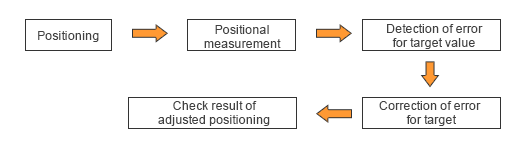
・The "bias error" can be corrected toward the target value using positional measurement and control.Generally, the error can be corrected by measuring the result of positioning precision at the initial positioning, and adjusting positioning to correct the error for the target position, etc.
image

・Suppose, for example, the required precision is +/-0.1 mm for positioning, it is preferable to select a positioning measurement sensor whose resolution (minimum read scale) is more precise than the required precision by one digit (measurement precision of 0.01 mm or higher).

(2)Bias error and countermeasure for variation

・Median values of positioning for "bias errors" vary due to various factors.It is also an important requirement to minimize these variations of median values for positioning.

・Typical factors causing variations are errors caused by temperature changes (temperature drift), such as positioning errors due to temperature drift in measurement equipment, or thermal deformation in the mechanical components for automation devices.

・Thus, in order to minimize variations in "bias error" due to temperature drift, it is necessary to (a) stabilize temperature in measurement equipment, and to (b) have countermeasures to avoid effects from thermal deformations in the mechanical components for automation devices.
a)Stabilizing temperature in measurement equipment ⇒ Setting warm-up time
b)Avoiding effects of thermal deformation in automation devices ⇒
(1)Keep heat source away from positioning mechanism
(2)Countermeasure for blocking thermal conduction to positioning section
(3)Using materials with low thermal expansion rate
(4)Stabilizing ambient room temperature

・In the precision machine tools, techniques for minimizing effects on machining precision from thermal deformation are introduced to avoid skewed thermal deformations by adopting a symmetrical mechanical structure.Fig.1 is an example of a symmetrical structured drive mechanism for injection molding equipment.

[Fig. 1] Example of symmetrical structuring for minimizing thermal deformation: plasticizing equipment (left) and injection drive unit (right)

・A higher degree of precision in an automation device is considered as making the positioning more precise.Degradations in the precision of the positioning, however, are caused by a variety of factors, and need to be recognized as one of the most difficult production technologies.

・The positioning precision obtained by the multiple times (n times) of positioning operations will have the number of variations equal to that of attempts (n) of positioning.Typical variations in positioning in this case are plotted in Fig.1.

[Fig. 1] Typical variations in positioning

・Fig.1 shows the positioning precision consists of two errors, namely "bias error" for target value for positioning, and "variation error" for limits of positioning precision (positioning tolerance).

Positioning precision = "Bias error" + "Variation error"

・Performance with low "bias error" is expressed as "high accuracy", whereas performance with low "variation error" is expressed as "high precision".Low "variation error" is also expressed as positioning with high reproducibility.

・While "bias error" can be corrected toward the target value using positional measurement and control, "variation error" requires some countermeasures for the main cause of the variation error, when a strict tolerance is applied to positioning, due to positioning errors because of various factors.

・Typical factors for errors for "variation error" are as follows:
(1)Factor specific to positioning system: Coordinates precisions of position sensor and mechanical components, backlash in drive mechanism, etc.
(2)Factor specific to workpiece for positioning: Error of shape, error in reference plane, etc.
(3)Accidental variations caused by dirt, foreign particles, etc.

This section introduces examples of the third requirement in designing high efficiency equipment,(3) waste elimination.Auto-assembling or machining is generally performed by controlling positions of the drive mechanism of three-axis (X-Y-Z axes).This section explains how to eliminate time waste in controlling the drive mechanism of three-axis.

(1)Time waste in controlling multi-axis drive table operation

・For a two-axis (X and Y axes) drive table, automated task is performed by planar two-dimensional motion control, which is realized by mutual drive control for the two axes.

・Fig. 1 shows machining lines along X-axis and Y-axis for the workpiece.Fig. 2 shows how the table is driven taking speed of motion as the Y-axis, and time as the X-axis based on this figure of machining lines.In this example (motions in the Y-axis and X-axis), positioning is programmed for driving one-cycle machining.

・During this one-cycle machining, the main task is a machining process that is performed while the speed of motion in the X-axis remains stable (indicated by red arrows).Time period other than the above (indicated by gray arrows) is considered to be time waste spent for incidental tasks.

・This control program performs drive control of the two independent axes in a concatenated manner by dividing the X-axis drive time and the Y-axis drive time in order to avoid effects such as vibrations from the Y-axis drive during the X-axis drive time.

(2)Reducing time waste in controlling multi-axis drive table operation

・Assuming that this acceleration and deceleration control is optimal for both X and Y axes in Fig. 2, controlling the drive along the Y-axis excluding the machining time outside the area of the workpiece can reduce time waste equal to the Y-axis drive time. Effects such as vibrations from the Y-axis during the X-axis drive can also be avoided (Fig. 3).

・This control of simultaneous drive for the two axes is called a coordinated operation control (Fig. 4).

[Fig. 1] Main tasks and incidental tasks

[Fig. 2] Drive control and time waste in XY table[Fig. 3] Illustration of reducing time waste by coordinated control of operation in XY table

[Fig. 4] Coordinated control of operation

This section describes solutions to address the issues for high-efficiency automation given in "2. Improvement of machine operating rate within a prescribed period" using the laser machining as an example.

(1)Improvement of machine operating rate within a prescribed period

・Whether auto-assembling machines or machining devices, an operational rate in production equipment involves idle time typical of individual device.It is thus necessary to determine causes for idle times which occurred on the individual devices and address the issues in order to improve machine operating rate within a prescribed period.Such solutions ensure stable and continuous operation.

・Fine adjustments for adjustable parameters for the device are made frequently in order to keep machine operating rate. It should be noted, however, that the fine adjustment itself may be causing unstable operations to increase.Causes for decreases in machine operating rate must be determined to implement countermeasures in the order of importance of factors affecting the declines.

・In the case of laser machining, idle time for device adjustment accrued for the following reasons:

  1. Warm-up of the machine for stabilizing temperature distribution
    Explanation and solution:
    ・Solutions for the following issues are required:
    a) Stabilizing laser oscillator temperature,
    b) Stabilizing optical system for splitting the laser beam and shaping energy shape
    c) Stabilizing temperature around the linear motor
    ・While a solution for a) is relatively dependent on the performance of the cooling system, additional cooling units were installed as countermeasures for b) and c).
  2. Adjustments of the optical axis misalignment in the optical bench section caused by thermal deformation after long hour operations
    Previously explained in Vol. 535.
  3. Countermeasure for laser energy decrease due to object lens tarnish caused by sublimation gas from the workpiece
    Explanation and solution:
    ・Although the YAG Laser is used and this laser sublimes and thermally eliminates the organic thin film, tarnish formed on the object lens surface due to accumulation of sublimation gas causes the laser intensity to attenuate.
    ・An air suction mechanism was placed in front of the object lens as a countermeasure. (See Fig.1.)

[Fig. 1] Example of fixture for laser sublimation gas suction

・This section explains optimization of the shape of the laser beam energy distribution generated by splitting a laser beam into several beams in order to improve operational stability during continuous processing for long hours.

・While splitting a single laser beam into four beams for processing requires boosting up the power of the laser oscillator, important concerns for the engineer in charge are controlling investments and avoiding over-engineered designs as much as possible.

・And it is preferable to optimize the energy shape of the laser beam because an unexpected problem (such as damage to the laser beam shaping slitter, or damage to the table caused by the transmitted light) may occur caused by the transmitted light or the reflected light if the energy of the laser beam is too intense.

・Fig.1 illustrates the relationship between the shape of the laser beam and the allowable width for positional deviation of the laser beam required for maintaining machining quality.Fig 1 leads to the following formula for an allowable width for positional deviation of the laser beam:

Allowable width for positional deviation of the laser beam (W) =< (Available laser beam width) - (Laser slit width) >/2 --- (A)

・Positions of components on the light path needed to be re-adjusted for correct alignment because the beam position may shift over time due to ambient temperature changes, etc. in the light path system for laser beam.Optimization of the shape of the laser beam which allows an increase in the allowable width (W) for deviation in Formula (A) reduces positional correction for the beam and ensures continuous and stable processing for long hours.

・This requires techniques for optimizing distribution of energy density of the split laser beam (such as techniques for optimizing from Gaussian distribution-shaped beam for tophat-shaped beam, as shown in Fig.2).

[Fig. 1] The relationship between the shape of the laser beam and the allowable width for positional deviation of the laser beam

[Fig. 2]Shape of laser energy density distribution and machining area

月別 Archives

Pages

Powered by Movable Type 6.0.3

About this Archive

This page is an archive of entries from December 2017 listed from newest to oldest.

November 2017 is the previous archive.

January 2018 is the next archive.

Find recent content on the main index or look in the archives to find all content.