December 2010 Archives

#062 Clean Air System for Pneumatic Actuators

Compressed air as the energy source for factory pneumatic actuators are produced by oil lubricated air compressors. The air as produced contains oil, water, and machine dusts, thus is not suitable to be used as is for the energy source for the equipment.
Additionally, there is a significant distance of various plumbing connecting the air compressor and the LCA actuators. Various other machines also share this compressed air over this distance and they mutually affect the air quality.
The drive components for LCA and pneumatic components are becoming more complex and elaborate due to demands for miniaturization and cost reduction, often resulting in troubles caused by inadequate maintenance activities.

The Clean Air System basics that generate appropriate quality air to avoid pneumatic system troubles will be explained.

(1)Classification of Factory Air Plumbing

The plumbing from the air compressor to the actuator end is classified into the following four sections.
 1. Air Source Line
 2. Main Line
 3. Sub Line
 4. Terminal Line

(2) Classification of Air Quality

The air quality is classified based on the production line and products which the sir is used for.
 a)General Industrial Air d)Precision Clean Air
 b)Precision Industrial Air e)Ultra Precision Clean Air
 c)Clean Air f)Medical Clean Air

(3)About Air Quality

Air quality is classified by the following parameters.
 1. Quality of air (Foreign material types in compressed air)
 2. Water and oil contents
 3. Size of solid particles and removal rate
 4. Odor

(4)Air Quality Classifications and Clean Air System

For types of air quality strongly related to LCA are explained here.

ClassificationAir QualityWaterOilSolids
General Industrial AirContains some dust, water, and oilHumidity100%
Water separation 80%
10mg/m35μm
100%
Precision Industrial Air: Industrial Equipment, Fixtures, etc.Contains some water but dust and oil are removedHumidity 100%1mg/m30.3μm
99.9%
Clean Air: Precision Automation Equipment, etc.Contains some dust and oil but water is removedCondensation point at atmospheric pressure -17°C or less6mg/m35μm
100%
Dried and chilled. Dust, water, and oil removedDried and chilled. Dust, water, and oil removedCondensation point at atmospheric pressure -17°C or less0.1mg/m30.3μm
99.9%

Glossary

Condensation Point ---Temperature point where water vapor containing air at a certain pressure becomes saturated and dew forms when cooled. Air dryness is evaluated with this index.

(5) Example of a Clean Air System

Various filters shown below are placed at the four classified air supply line, and air quality corresponding to each LCA are generated.
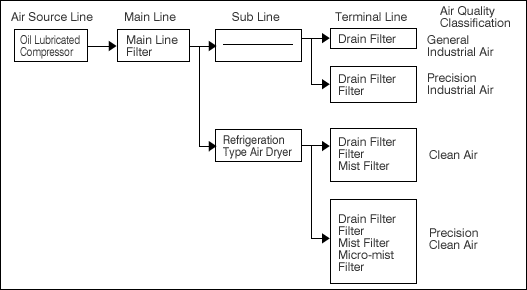
Fig.1

#061 Countermeasures for Pneumatic Actuator Air Supplies

In this volume, troubles and countermeasures on pneumatic actuator air supply will be discussed.

Action timing and velocity of air cylinders contained in pneumatic actuators are controlled with pneumatic control system components such as electrical solenoid valves and velocity control valves. Although the pneumatic actuators are fairly easily applicable, poor design planning and inadequate maintenance practices often result in troubles of peripheral air components. Increasingly progressing miniaturization and energy efficient design of the pneumatic components are making the internal structures of the components more complex and precise, requiring more attention to such details. The trouble examples and countermeasures are explained below.

(1) Improper mounting positions and direction of pneumatic components

Trouble DetailExplanationCountermeasure
Electromagnetic Valve Troubles
(See [Fig.1])

Air cylinder response errors
(latencies and malfunctions)
-Response latency caused by viscosity increase of internal slide components (prominent in reduced power operations)
-Slide components seizure due to repeated operational cycles causing malfunctions
-Valve air passages clogged by drain and oil causing malfunctions
1.Mounting orientation to avoid lateral shocks and vibrations
2.Avoid direct contact of water and oil drips, condensation, and cutting chips
3.Provide an air
4.Heat dissipating countermeasures for extended duration use
Velocity Control Valve Troubles
1)Loss of air cylinder velocity control
Valve movements are hindered by entrapped foreign objects (seal fragments, rust). (See [Fig.2] Seal Tape Usages)
1.Flush the plumbing before connecting (blow clean by compressed air)
2.Remove foreign objects from post filter plumbing (seal fragments, thread cutting chips)
2)Air cylinder slows down intermittently
-Temporary blockage of control valve needle by drain and oil causing increased air passage resistance
1.Periodical removal of drain and oil
2.Mount the control valve in high position
3.Position the control valve close to the air cylinder
Air Filter Troubles
(See [Fig.3])

Clogged air filter causing pressure and
flow volume loss
-Air filters can remove solid particles such as water/oil drops and rust but water vapor and oil mist will pass and become oxidized into carbon and tar
-Excessive impurities will clog the filter and cause reduction of air supply
1. Mount the filter close to the air cylinder and avoid exposing the post filter plumbing to temperature changes (low temp. causes condensation and water induction)
2.Periodical maintenance such as drain removal
3. Mount the filter in a visible location
4. Manage flow volume using a differential pressure gage (when precision is required)

Glossary

Drain ------ Water and mixture of water and oil within pneumatic actuators, control circuits, and plumbing
Oil Mist ------ Fine oil particles in factory air environment

[Fig.1] Electromagnetic Valve (Solenoid Type) Trouble Examples

[Fig.2] Seal Tape Termination

[Fig.3] Air Filter Trouble Examples

#060 Points on Single Axis Slide Mechanism Design

For single axis slide based LCAs, pneumatic cylinders are often used for its ease of maintenance as shown in [Table 1] from the previous discussion. On the other hand, the easy to maintain characteristic seems to cause lack of completeness in preventative maintenance design concepts that should be considered in the first place.
Here, trouble examples of pneumatic actuator applications and countermeasure designs are explained.

(1) Pneumatic Actuator Troubles and Causes

Pneumatic actuator trouble causes and origins (where countermeasures should be addressed) are shown below.

Cause of TroubleOrigin
1. Mounting errorsMechanism design
2. Inappropriate mounting position/directionMechanism design
3. Inappropriate actuator selectionMechanism design
4. Inappropriate air supply qualityMaintenance activities
5. Inappropriate maintenanceMaintenance activities

(2) Trouble Examples and Countermeasures

The trouble details of 1.~3. above and countermeasures are explained below.

(1) Inappropriate Mounting to Mechanisms
Trouble DetailsExplanationsCountermeasures
Connection MisalignmentsNon-concentric relationship between the load center and cylinder piston drive center, causing misalignment strain on air cylinders. Reduced drive force, unstable velocity, and air leakages occur.
1. Use of misalignment absorbing components (MISUMI Catalog: Floating Joints, etc.)
2. Reevaluation of cylinder mounting methods (see [Table 1])
3. Use larger diameter air cylinders
Excessive lateral loads on piston rodsExcessive lateral loads on piston rods causing air leaks from piston gaskets, rendering the cylinder unusable. (see [Fig.1])
1. Design with no lateral loading
2. Reevaluation of cylinder mounting methods
3. Use of Long Rod/Long Bushing type to give lateral load immunity
Insufficient rigidity of mounting baseInsufficient rigid mounting base may suffer damages from shocks caused by load velocity dynamics
1. Reinforced mounting base design (see [Fig.2])
Insufficient reliability and durability of air plumbingIndiscriminate use of nylon tubes and quick couplings may cause problems over time. moving unit, heat effects, temperature variations, and chemical environments will require proper countermeasure
1. Use screw-on couplings instead of quick couplings
2.Use of Teflon tubes
3. Proper tube lengths
4. Securing the tubes and couplings

[Table 1] Mounting Methods of Pneumatic Cylinders (partly excerpted)

Travel Direction of LoadCylinder Mount MethodNotes
Linear Motion OnlyFoot Type
Flange Type
Use when the load travel direction coincides with the cylinder axis center.
Trunnion Type
Clevis Type
Eye Type
Other
Use when the travel stroke is long or difficult to align load/cylinder axis centers.
When the load oscillates within one planeTrunnion Type
Clevis Type
Eye Type
When the load oscillates within one plane, use clevises and trunnions movable directions in alignment with the oscillating direction. Also align the cylinder rod tip mounting joint oscillating direction.

[Fig.1] Internal Damages of Pneumatic Cylinder

[Fig.2] Pneumatic Cylinder Mount Reinforcement

月別 Archives

Pages

Powered by Movable Type 6.0.3

About this Archive

This page is an archive of entries from December 2010 listed from newest to oldest.

November 2010 is the previous archive.

January 2011 is the next archive.

Find recent content on the main index or look in the archives to find all content.