In our tutorial #1, we've explained the mechanical LCA that corresponded to Ford-ism as "the age of fixtures". Since the technology advancement occurs on a continuous curve, it would not be appropriate to digitally divide and categorize, but for the sake of making the explanations simpler we've called the third generation manufacturing system as The Mechatronics Age, the age of Toyota style manufacturing system.
Subsequent to the advent of the Toyota manufacturing system age, the most significant difference between today and before is proliferation and utilization of computers.
Third generation LCA
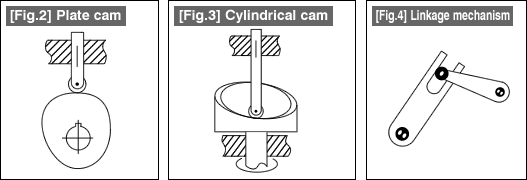
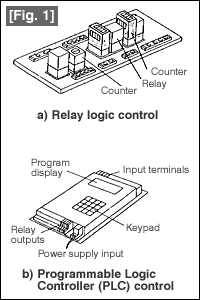
| In this third generation, the physically fixed motion control functions of cams/linkages are split apart into "Information" (time and position data) and "Motive power" control. With this, the "hard information" of the cams/linkages are replaced with "soft information" on computer software, and the motive power with servo motor controls, giving the new "Information Cam" scheme greater flexibility needed for a new trend in manufacturing of "Small lot/wide variety". In this period, the control scheme and equipment have rapidly advanced from [see Fig.1] relay logic sequence control >> PLC control >> PC control, requiring drastically increased participation of electric/electronic engineers. |  |
 |
Fourth generation LCA
Most of the fundamental componentry of LCA have emerged during the era of the third generation. Fine degree of high speed motion control was possible as long as the work piece and related tools remained unchanged. However, the era of post third generation would require the manufacturing system to adopt to decreased product life cycles and globalization. When the product life cycle becomes shorter, the used component quality tend to become more variable, and the manufacturers are required to perform the assembly work with components of varying quality. The countermeasures invented for this was to adopt experts' thought processes into computer algorithms (advancement currently continuing).
In this "Computer algorithm" generation, sensing technology and detected data processing would become important.
Furthermore, manufacturing systems with more flexibility, speediness, and lower cost of depreciation, the cell-manufacturing and one-person-manufacturing schemes where simple hardware is optimally combined with a human operator (human ingenuity) were devised and continuing to be evaluated.
![[Fig.1] Sketch of Leonardo da Vinci's cam mechanism](http://www.misumi-techcentral.com/tt/en/lca/images/026_1.gif)