February 2017 Archives

#277 Spring Design -5: Energy Absorbed and Accumulated in Springs

| No Comments | No TrackBacks

This volume explains the energy absorbed and accumulated in springs.

(a)Absorbed and accumulated energy in a spring with linear characteristics

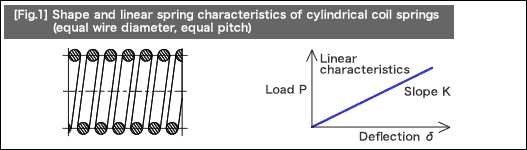
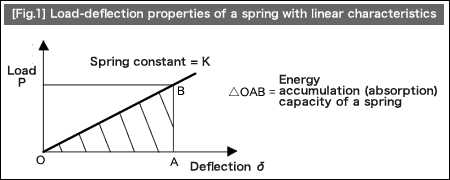
-When you apply a load on the spring, deflection (deformation) occurs in accordance with Hooke's law. (See [Fig.1].) When you quickly release a load from this condition, the spring will be restored to its original condition by the oscillating motion. This means that energy by deflection is accumulated in the spring while the load is being applied.

fig1

-The amount of energy accumulated in this spring can be expressed in the following formula:
Energy accumulated in the spring U = k · δ2 / 2    k:Spring constant  δ:Deflection
This formula is equivalent to the area of the triangle OAB shown in [Fig.1].
-If the area of this triangle OAB in [Fig.1] is the energy storage capacity of a spring, the following is true:
* When the deflection increases, the energy accumulation increases for the same springs.
*For different springs, if you increase the amount of deflection, it results in a substantial amount of energy storage capacity even when the spring constant is small.
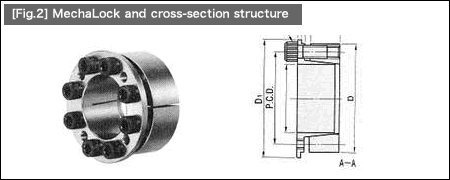
This principle is applied to shock-absorbing dampers for precision equipment and MechaLock ([Fig.2]).

fig2

(b)Absorbed and accumulated energy in a spring with non-linear characteristics

-Some of the spring structures absorb and accumulate the energy generated during spring deflection.
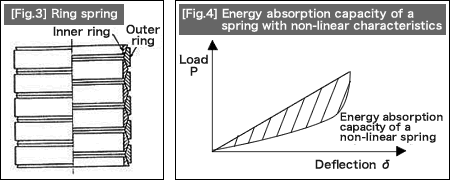
-A ring spring ([Fig.3]) has a structure consisting of inner rings and outer rings with a conical surface alternately stacked. When a pressure load is applied in the axial direction, the outer rings expand and the inner rings contract. At that time, friction occurs on the conical surface of inner and outer rings. Since this friction causes a part of the deflection energy to be absorbed, ring springs are utilized for shock absorber and buffer equipment. (See [Fig.4].)
-In the case of [Fig.4], the absorbed energy at a release of the deflection is equal to the area enclosed within the load-deflection curve shown in [Fig.4].

fig3,fig4

Unlike helical compression springs, non-linear characteristics cannot be added to helical extension springs. However, the initial tension can be put into the springs.

(1) Helical extension springs with initial tension

  • Initial tension, which is a force holding the coils against each other, can be put into helical extension springs even under a no-load condition.
  • The initial tension is created by twisting the wire in the direction of the coils in contact with one another during the spring winding process.
  • Cold-formed and solid-coiled springs are wound with some tension. In general, springs that are purposely designed to have initial tension are referred to as springs with initial tension.
  • The load and deflection characteristics of springs with and without the initial tension are shown in [Fig.1].
  • [Formula A] represents the relationship between loads and deflection of an extension spring shown in [Fig.1]. [Formula B] is a relational expression between loads and deflection of an extension spring with the initial tension.

    [Formula A]
    Load P (N) = Spring constant k (N/mm) × Deflection δ (mm)

    [Formula B]
    Load P (N) = Initial tension Pi (N) + Spring constant k (N/mm) × Deflection δ (mm)

  • Initial tension Pi will be calculated in the following formula: Formula

[Formula A]

(2) Advantages and disadvantages of springs with initial tension

This table summarizes advantages and disadvantages of springs with the initial tension added.

AdvantagesDisadvantages
  • Instability of springs under a no-load condition can be minimized.
  • Designing a smaller spring (larger load with smaller spring constant) is possible.
  • Load variation tends to be large at a specified length.
  • Even if it is necessary to perform low-temperature annealing to remove distortion occurred by coiling, the annealing result will not be sufficient.

(3) Various shapes of helical extension springs

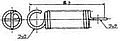
Most of the helical extension springs are without non-linear characteristics on the spring plane and classified into the cylinder type and the spindle ends type. In addition to this classification by the outer shape, the springs can be also categorized by the hook shape on both ends.

Integrated double hooks

Semicircular hook, circular hook, reverse circular hook, side circular hook, square hook, U-hook, V-hook and more.

Separate hooks

Tapered end with circular hook, plug type, plate type
(1)Load-deformation relationship

When the load on the spring: P and the deformation: δ are proportional to each other (in a linear relation), they are said to behave under "Hooke's law". The constant of proportion: k at this time is called the "spring constant". [Fig.1] shows a relationship between the load and deformation. The slope in this figure represents spring constant: k.

P = k x δ k: Spring constant

Examples of products designed and manufactured by taking advantage of this property include spring balances (scales for load weight measurement) and springs for safety valves operating at a certain required force.

(2)Springs with various loading characteristics

Contrary to the linear characteristics shown in (1), some of the springs' load and deformation are in a non-linear relationship.
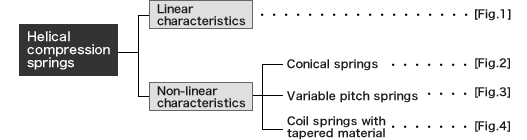
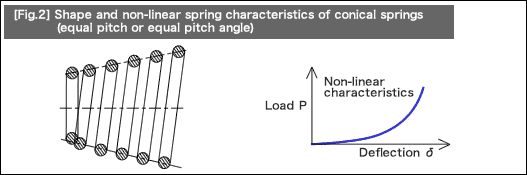
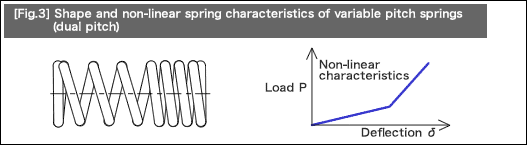
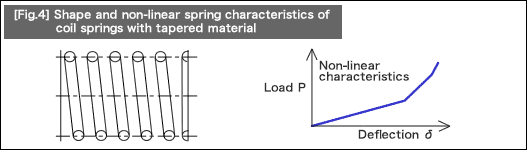
Helical compression springs having non-linear characteristics of load and deflection are available in the following three types:

fig

The functions of helical compression springs with non-linear characteristics are achieved when the line or lines and the seating surface contact each other as the load increases. This occurs because the coil spring position causes a change in at least one of the following design parameters: [1] coil diameter, [2] pitch, or [3] wire diameter.

図1

図2

図3

図4

The following table summarizes advantages and disadvantages of typical springs having the non-linear characteristics introduced earlier.

= Advantages and disadvantages of typical springs with non-linear characteristics
Type of spring with non-linear characteristicsAdvantagesDisadvantages
Conical springs
-Contact with surrounding objects can be avoided when the spring deforms.
-The seating surface contact type has the lower solid height.
-For the equal wire diameter type, the energy absorption rate becomes smaller as the coil diameter decreases.
-The line contact type has the higher solid height.
Variable pitch springs
-Inexpensive
-Higher solid height.
-Large in mass.
Coil springs with tapered material
-Lower solid height.
-Smaller in mass compared to variable pitch springs.
-Expensive

#274 Spring Design -2: Types and Characteristics of Springs

| No Comments | No TrackBacks

This table summarizes the spring types classified by the shape.

[Table 1] Spring types classified by shape
Types of springs
(Classified by shape)
Overview Drawing No.
a) Coil springs
  • Most popular and common springs.
  • Easy to produce, effective, inexpensive.
  • Provide various functions, including compression, tensile strength, and torsion.
image
b) Spiral springs
  • Spiral shaped springs designed to add torque from the spring's elastic deformation.
image
c) Disc springs
  • A disk containing a hole in the middle is processed into a conical shape, which is used for areas requiring constant load reaction at low volume.
image
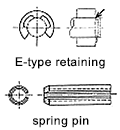
d) Fastener springs
  • Springs in various shapes used for fastening.
  • The examples include spring washers, E-type retaining rings, and spring pins.
image
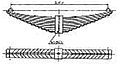
e) Laminated leaf springs
  • Frequently used for suspension of heavy objects (such as vehicles).
image
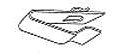
f) Flat springs
  • A flat plate is processed into a shape that will deliver the intended spring functions.
  • The examples include points of contact, clamps, and tightening parts of piping joint.
image
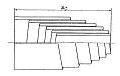
g) Torsion bars
  • A twist of the bar is applied for spring action.
  • Used as a stabilizer for automobiles.
  • It is also called torsion bar suspension.
  • Shaped like a bamboo shoot and used for shock mitigation.
image
Types of springs
(Classified by shape)
Overview Drawing No.

Besides shape, springs can be classified by the following categories:

  • Classification by materials (e.g. metal/non-metal)
  • Classification by the direction of forces applied to the spring (e.g. tensile, compression, torsion)
  • Classification by purpose (e.g. load substitution, shock mitigation, vibrational relaxation, force accumulation)
  • Classification by operating environment

月別 Archives

Pages

Powered by Movable Type 6.0.3

About this Archive

This page is an archive of entries from February 2017 listed from newest to oldest.

January 2017 is the previous archive.

March 2017 is the next archive.

Find recent content on the main index or look in the archives to find all content.