August 2017 Archives

#303 Know-how on automation: Cleaning-1 Principles of cleaning

| No Comments | No TrackBacks
General description

This volume explains how to achieve the desired cleaning quality effectively by utilizing the production technology, based on the understanding of the principles and general rules of cleaning procedures in each production process.

Explanation
(1) Principle of cleaning

The following three rules apply to work performed in a clean room:

1. Do not bring in contamination
2. Do not generate contamination
3. Do not allow contamination to accumulate

In the same idea, the cleaning principles can be described as follows:

1. Do not add contaminants that cannot be removed
2. Be sure to remove the contaminants
3. Do not allow removed contaminants to be reattached
(2) Production technology and cleaning

Each process of a production line is designed to deliver conforming items to the next production process. As for the cleaning quality, the specified quality on the product appearance must be guaranteed.

1) Do not add contaminants that cannot be removed
- The cleaning is performed in each process to remove the expected contaminants that may be generated during the process.
- Therefore, they must not generate excess contaminants that cannot be removed by the intended cleaning process.
- If heat, pressure, or chemical reactions are applied to the products in addition to these contaminants, the contaminants are difficult to remove.

2) Be sure to remove the contaminants
- The person in charge of production technology must consider measures to remove expected contaminants that could occur in each production process.
- For example, stubborn stains should be removed by a brush, or if it just contains floating contaminants, only the ultrasonic cleaning is used, and so on.

3) Do not allow removed contaminants to be reattached
- Since the reattachment of removed contaminants will likely to cause stains or burns, it must be avoided.
- Hardware and cleaning solution for the device must be appropriately selected. In addition, it is necessary to perform appropriate maintenance including the device software, and to replace cleaning solution and filters regularly.

In order for these principles to be steadily adopted in the LCA mechanism, the following agenda (1) and (2) must be resolved:

1) The purpose of the cleaning is to remove dirt and foreign particles that are mixed in during the process. However, depending on the cleaning process used, it may leave stains on the products.

2) If you dry this cleaning stain, a chemical reaction that occurs in the stained area could make this stain permanent.

3) Residual stains appear mostly because of the following two reasons: (1) Existence of residual contaminants that were not removed in the specified cleaning conditions, (2) Insufficient rinsing in the final cleaning process.

(3) Automation and insufficient cleaning

1) Cleaning stains - (2) occur mostly because the solution in the auto-cleaner's ultrasonic cleaning tank and rinsing solution in the rinse tank become more contaminated than the specified level. Therefore, it leaves small point-like stains on the product after rinsing (the process of exchanging dirty liquid with clean liquid, followed by drying.)

2) To prevent the situation described in 1), be sure to eliminate the residual cleaning solution on the workpieces to be cleaned before bringing them into the next cleaning tank. It is important to stabilize the cleaning quality for each cleaning tank appropriately.

3) Depending on the shape or state (e.g. overlapping, facing sideway, or upward/downward) of a workpiece, the contaminated cleaning solution is likely to enter from a small gap and spread by capillary action.

4) Therefore, it is recommended to place workpieces to be cleaned in a position where no residual liquid stays in, and to use a cleaning fixture that can hold the workpieces at a certain distance apart.

#302 Know-how on automation: Workpiece holding-3

| No Comments | No TrackBacks
General description

For machine tools and precision print devices designed for organic films, a single unit of these devices is used for processing workpieces in varying substrate sizes. Since the loss of machine utilization must be minimized, how to retain workpieces is particularly important. This volume describes the vacuum suction holding method that works with varying workpiece sizes.

Explanation

Cutting machines designed for thin workpieces or organic film print devices used with glass substrates will process the workpieces while holding them by vacuum suction. In this case, if the size of the retained workpiece changes, the vacuum suction groove remains open, causing the vacuum suction to fail or impairing the adhesion capacity. If you exchange the suction table, it will increase the machine idle time since the device must be disassembled for precision adjustments.

- Although the vacuum suction grooves are designed in various ways, the basic structure for vacuum suction is almost the same; vacuum suction holes are opened at the bottom of the vacuum suction grooves. (Fig.1)
- You will be able to prevent air leakage from the vacuum suction holes by replacing these holes on the bottom of the grooves with the tapped holes, and closing the unused suction holes with screws depending on the size of the workpiece that will be retained by vacuum suction.
- If you install a stopper for attaching a rubber O-ring to the stopper screw that is designed to close the vacuum suction hole, you will be able to shut off air leakage completely. (Fig.2)
- When you manually close the vacuum suction hole using the stopper screw with a rubber O-ring prior to exchanging the workpiece size, you will be able to hold workpieces of various sizes using vacuum suction.

[Fig.1] Structure example of vacuum suction holding table

[Fig.2] Stopper screw and vacuum suction screw hole

#301 Know-how on automation: Workpiece holding-2

| No Comments | No TrackBacks
General description

When you let the glass substrate loose by releasing vacuum suction that was holding the substrate onto the work table, the glass substrate may fracture.Since this is mainly caused by a shock of the rapid release of vacuum suction, it can be avoided by controlling the vacuum release gradually.

Explanation

・To make the glass substrate lightweight and cheaper to produce, the substrates are becoming thinner and larger.This trend is also making the glass substrates more susceptible to fractures during vacuum suction and release.In order to shorten the production cycle time, the vacuum suction and release may be performed in a shorter period, which causes more fracture accidents of the glass substrates.This section introduces the countermeasures for preventing glass substrate fractures by controlling the vacuum suction release.

(1)Causes of glass substrate fractures during vacuum suction release

・If the rate of vacuum release changes rapidly from the state it was suctioning the glass substrate, air may gush out from a small suction hole of the vacuum suction mechanism.
・This localized air pressure and rapid vacuum release will impact on the glass substrate, causing the substrate to fracture.

(2)Countermeasures for preventing glass substrate fractures during vacuum suction release

・To avoid the glass substrate fractures by the shock of vacuum release, it is effective to adopt the vacuum suction control design where the initial vacuum release occurs gradually in order to alleviate the shock from the release, followed by the time and speed control method until the release holes are fully open. (Fig.1)

[Fig.1] Example of controlling vacuum release time and speed

#300 Know-how on automation: Workpiece holding-1

| No Comments | No TrackBacks
General description

If you print patterns or perform various processing while holding the glass substrate onto a work table using vacuum suction, print failures or processing defects are likely to occur at the vacuum suction area.This volume explains the causes and countermeasures.

Explanation

・When printing patterns on a thin glass substrate using various solvents or when processing the substrate mechanically, the vacuum suction method is frequently adopted for holding the glass substrate onto the work table.However, some designs of the vacuum suction groove (such as groove shapes, sizes, and others) may cause processing defects.The following sections describe the relationship between the vacuum suction groove design and the processing defects, and introduce the mechanistic solutions.

(1)Production line

・To work with a thin glass substrate, various processing will be performed on this substrate by attaching the substrate onto a work table using vacuum suction.In this case, the glass substrate should be positioned against the table by aligning its outer periphery with the reference plane of the table. While keeping this alignment, you will place the glass substrate onto the tabletop and keep the substrate in place using vacuum suction.
・In order for this vacuum suction to work with glass substrates of various sizes, the tabletop has various shapes of vacuum suction grooves. (Fig.1)

(2)Causes of processing defects on work table

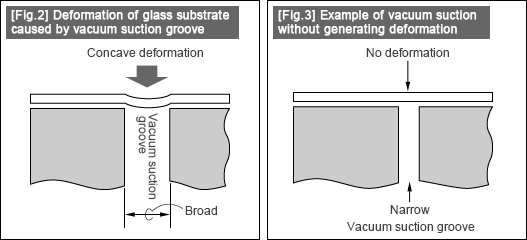
・Vacuum suction is used to attract the glass substrate placed on the work table and attach it with the tabletop.Since this vacuum suction force is locally absorbed in the vacuum suction groove, when you use a thin glass substrate, the substrate slightly deforms in a concave shape if the vacuum suction groove is too broad.
・This slight concave deformation leads to a localized variation of the print film amount during print processing or causes a curvature in the linear processing work during machining. (Fig.2)

(3)Countermeasures for processing defects caused by vacuum suction holding

・If the vacuum suction groove (width) is too broad compared to the thickness of the glass substrate that is affecting the rigidity, the groove deforms locally due to the vacuum suction force.
・To prevent these failures, the width of this vacuum suction groove should be minimized so that the glass substrate will not deform by the vacuum suction force. (Fig.3)
・The problems can be eradicated by replacing the tabletop materials with ceramics having the porous structure, rather than making changes to the vacuum groove mechanism.

[Fig.1] Example of substrate suction groove on tabletop

Fig.2,3

月別 Archives

Pages

Powered by Movable Type 6.0.3

About this Archive

This page is an archive of entries from August 2017 listed from newest to oldest.

July 2017 is the previous archive.

September 2017 is the next archive.

Find recent content on the main index or look in the archives to find all content.