April 2016 Archives

#234 Safety Design - 6: Safety Design Knowledge on Machinery -2

| No Comments | No TrackBacks

In order to fully prevent accidents causing injuries for the machine operators, it is necessary to design their gaps so that no part of the human body can enter between the equipment. ISO 13854/JIS B9711 defines the standards.

(1) Minimum gaps to avoid crushing of parts of the human body

Crushing accidents of the human body by operating mechanical devices are known to occur in the following two mechanisms:

a) Two moving parts travel toward each other
b) One moving part travels toward the fixed unit

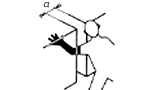
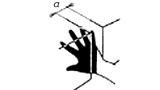
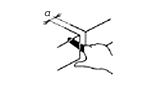
The figure shown here defines the "minimum gaps" of the equipment to avoid crushing accidents. It is recommended to adopt these measurements into the mechanical design.

Remarks

1) These "minimum gaps" defined are effective for avoiding crushing only and not effective for preventing other hazards (including shocks, drawing-in, shearing hazards).
2) In some cases, characteristics of persons involved must be considered.

Examples:
Body size differences based on the ethnicity under the global environment,
Possibilities of endangering children, etc.

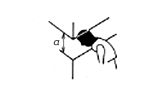
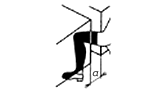
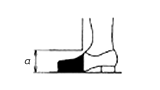
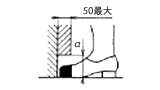
[Fig.] Minimum gaps to avoid crushing accidents of human body (unit: mm) (Source: ISO 13854/JIS B9711)
Body partsMinimum gap aIllustration
Body 500Body
Head (the worst position) 300 Head (the worst position)
Leg 180 Leg
Foot 120 Foot
Toe 50 Toe
Arm 120 Arm
Hand, wrist, fist 100 Hand, wrist, fist
Finger 25 Finger

#233 Safety Design - 5: Safety Design Knowledge on Machinery

| No Comments | No TrackBacks

JIS B 9700:2013 (Basic concepts for design) defines technical principles for incorporating safety features during the machinery design phase. This section is useful for checking safety design items.

(1) General technical knowledge on mechanical design (Reference: Safety of Machinery in JIS Handbook (72))

The following items are general requirements:

a) Mechanical stress

- Stress limitation by implementation of correct calculation, construction and fastening methods e.g. bolted assemblies, welded assemblies
- Stress limitation by overload prevention (e.g. "fusible" plugs, pressure-limiting valves)
- Avoiding fatigue in elements under variable stresses (notably cyclic stresses)
- Static and dynamic balancing of rotating elements

b) Materials and their properties

- Resistance to corrosion, aging, abrasion and wear
- Hardness, ductility, brittleness
- Homogeneity
- Toxicity
- Flammability

c) Emission values on the followings:

- Noise
- Vibration

(2) Provisions for stability

- Geometry of the base
- Weight distribution including loading
- Dynamic forces due to movements
- Vibration
- Oscillation of the center of gravity
- Characteristics of the supporting surface in case of traveling or installation on different sites (e.g. ground conditions, slope)
- External forces (e.g. wind pressure, manual forces)

(3) Other regulations and codes

d) Provisions for maintainability
e) Observing ergonomic principles --- To reduce mental or physical stress and strain of the operator
f) Preventing electrical hazard
g) Preventing hazards from pneumatic and hydraulic equipment
h) Applying intrinsic safety design measures to control systems

#232 Safety Design - 4: Risk Assessment

| No Comments | No TrackBacks

Designers for automation devices and machine tools need to have the abilities of self-assessing the degree of hazard for machinery during the designing stage. "Safety of machinery ‒ Principles of risk assessment" by ISO12100(JIS B9702) is a useful process tool designed to foster and improve designers' self-assessment abilities.

(1) Risk assessment

- Risk assessment refers to a series of logical approaches for evaluating the source of hazard associated with machinery using a statistical method.

- The risk assessment consists of the following two examinations:
  1) Risk analysis
  2) Risk evaluation

- Based on the result of risk assessment, measures for risk reduction will be implemented. Therefore, the risk assessment does not include "actions for risk reduction".

(2) Repetitive process for securing safety

A series of processes including risk analysis and assessment as well as risk reduction activities are repeated in the action process shown in the following figure. The knowledge on safety during the machinery design/production stage can be accumulated as a result.

[Fig] Repetitive process for securing safety (Source: JIS B9702)

*Note 1 --- Consider the operator's characteristics such as age, dominant hand, limit on physical performance, knowledge level (beginner or expert), etc.

#231 Safety Design - 3: Built-in Safety Devices

| No Comments | No TrackBacks

Building a safety device into mechanical equipment increases the intrinsic safety of the equipment. It is best to incorporate the intrinsic safety feature during the designing stage of equipment when you install a safety device inside the equipment.

(1) Built-in design of safety devices
-1Types of safety devices

The following types of safety devices are available:

1)Movable barrier safety device
2)Two-hand control safety device
3)Photoelectric safety device
4)Sweep safety device
5)Pull-out safety device

-2Built-in design of safety devices

Case example of movable barrier safety device:

The mechanical equipment with this safety feature implemented will not run if any part of the body is placed within the guard zone. If you install a built-in interlocking control as part of the equipment during the initial design stage, it can prevent disasters resulting from deliberate alteration such as removal of the guard.

(2) Safety measures for non-intrinsically safe device

You may need to implement additional safety measures for purchased equipment or when it is difficult to install a built-in safety device into the equipment during the initial design stage. The best way for such cases would be to implement safety measures in a step-by-step manner as shown in the below figure.

[Fig.] Safety measures implemented by machine designers and their steps

#230 Safety Design - 2: Case Examples of Intrinsic Safety

| No Comments | No TrackBacks

In the previous volume, we learned the concept of intrinsic safety for machinery. In this lecture, we will learn what the intrinsic safety is all about from the examples of the press machine and swaging equipment structures.

(1) What is the intrinsic safety of machinery

The codes on the intrinsic safety of machinery include the following three measures:

1) The safety design has been built into or embedded in the machinery.

2) The machinery has a foolproof feature that prevents accidents or disasters even in case of an incorrect operation of the machine equipment.

3) The machinery has a fail-safe feature that the equipment responds in a safe manner even in case of malfunctions or damages of the machine equipment and parts.

(2) Intrinsic safety for press machines and swaging equipment

- Most of the accidents associated with press machines or swaging equipment occur during the following processes: 1) Material supply tasks, 2) Tasks involving touching processing points, in order to adjust or correct the material position, for example.

- The intrinsic safety must be considered in designing these machines since many people injured in such situations are likely to suffer from the aftereffects.

- If it is not possible to incorporate the intrinsic safety design, the safety device must be installed.

- Examples of intrinsic safety design

a) Installation of a safety enclosure for the press die --- Install an enclosure around the die so that the operator's hands or fingers will not contact the processing points.

b) Adopting a structurally safe design --- Keep the clearance between the upper and lower dies or between strippers for the upper and lower dies to be 8 mm or less to prevent the operator's hands or fingers from being placed in the gap. (See [Fig.1])

c) Automatic press design --- Eliminate tasks requiring hand insertion by adopting an automatic system of supplying materials and/or discharging processed goods.

d) Safety press design --- Install a safety device with optical sensor or embed the safety design into the equipment by installing a two-hand control button.

[Fig.1] Case examples of intrinsic safety for press machines (Source: "Korekara No Anzenkanri (The Future of Safety Management)" published by Japan Industrial Safety & Health Association)

月別 Archives

Pages

Powered by Movable Type 6.0.3

About this Archive

This page is an archive of entries from April 2016 listed from newest to oldest.

March 2016 is the previous archive.

May 2016 is the next archive.

Find recent content on the main index or look in the archives to find all content.