May 2017 Archives

#290 Know-how on automation: Positioning -8

| No Comments | No TrackBacks
General description

・For components that are bonded at a high-temperature and high-pressure state after being precisely aligned, their bonding quality is assured by the positioning mechanism that absorbs the plate thickness variations of the bonded components.This positional adjustment requires a simple mechanism allowing height adjustment without having to modify the parallelism of the bonded components.This lecture introduces the simple height adjusting mechanism that is designed based on the concept of parallel springs.

Explanation

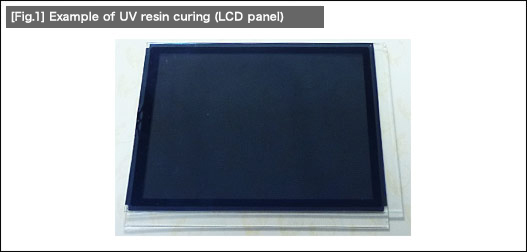
・LCD driver devices are precisely bonded using technologies such as the COG (Chip on Glass) bonding method. (Fig.1)
・Products assembled in the COG bonding method cannot be reprocessed because two components are bonded at a high-temperature and high-pressure state after their X-Y coordinates have been aligned.Therefore, both the positioning and compression bonding processes must be as accurate as possible.
・Because both of the two components bonded are usually made of hard and brittle materials like glass, the pressure variation caused by a difference in plate thickness must be minimized. For this reason, a height adjustment technique is frequently adopted for absorbing the plate thickness variations.
・To absorb the plate thickness variations, the positioning mechanism must have the following characteristics:
1.The mechanism should be compact and simple.
2.The adjustment range can be narrow, but the variations in parallelism should be small.
3.The mechanism should be free from backlashes and can be fine repeatability on accuracy.
・The plate thickness adjusting mechanism (Fig.2) uses the parallel springs shown in Fig.3. The characteristics are as follows:
a) The mechanism should be simple and built with fewer parts.
b) The height can be adjusted while maintaining the parallelism.
c) Gaps or backlashes should not occur.
・The parallel springs should be made of stainless steel (e.g. SUS304). The tensile strength is enhanced by heat treatment.
・One of the precautions for producing parallel springs is the cracks at groove corners resulting from stress concentration.This can be prevented by adopting a round shape to the groove corners of the thin plate with spring properties.

[Fig.1] Example of a product made by COG bonding

[Fig.2] Example of fine-tuning mechanism utilizing parallel springs

[Fig.3] Parallel spring

#289 Know-how on automation: Positioning -7

| No Comments | No TrackBacks
General description

-The previous lecture introduced the precision positioning fixture installed on the microscope table, making the setup changes easier during precision positioning on the microscope. This lecture introduces the simple method of adjusting the perpendicularity against this microscope as well as the perpendicular gauge used for positioning.

Explanation

-#288 introduced the precision positioning fixture installed on a microscope for fine-tuning the positions of two components. (Fig.1) In case of multi-model production, setup changes can be done in a short time once a positioning plate designed for each model has been produced.
-In this case, the positioning precision cannot be guaranteed without accurately adjusting the perpendicularity between the microscope's optical axis and the datum surface of the dedicated positioning plate for each model.
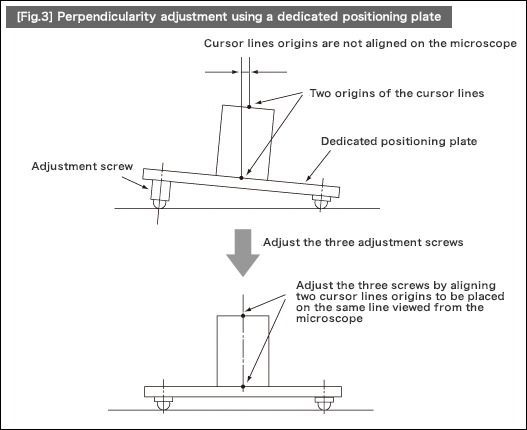
-On the dedicated positioning plate, the parallel adjustment mechanism using precision adjustment screws is assembled at three locations. These three adjustment screws allow for adjusting perpendicularity against the microscope's optical axis.
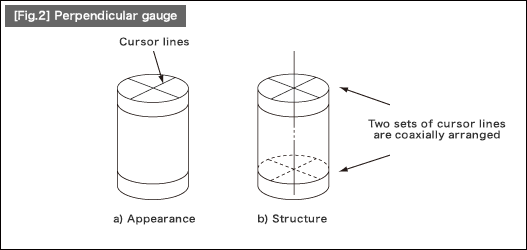
-Fig.2 illustrates a perpendicular gauge used for adjusting the perpendicularity between the microscope's optical axis and the datum surface of a dedicated positioning plate. On this gauge, two pieces of flat glass with cursor lines are placed at a certain distance apart. A virtual line connecting the two origins of the cursor lines is designed perpendicular to the bottom face of this gauge.
-To adjust the perpendicularity between the microscope's optical axis and the dedicated positioning plate, perform the following: Place this gage on the dedicated positioning plate. Move the Z-axis of the microscope to align the two origins of the cursor lines by adjusting the three screws on the positioning plate. (Fig.3)

Precautions

-A microscope usually has a heat-generating lighting unit. The microscope unit undergoes thermal deformation while the light is turned ON. After the light is turned OFF, its thermal deformation state changes. Therefore, the best timing of adjusting the perpendicularity of the dedicated positioning plate is when the microscope's thermal deformation becomes stabilized after a certain time has passed since the light was turned ON.

fig1

fig2

fig3

#288 Know-how on automation: Positioning -6

| No Comments | No TrackBacks
General description

・This lecture introduces the precision positioning fixture installed on the microscope table, making the setup changes easier during precision positioning on the microscope.
Setup changes on the microscope used for high precision positioning can be made easy by standardizing the base plate of the precision positioning fixture and designing a parallel adjustment mechanism to be installed at three locations on this base plate.

Explanation

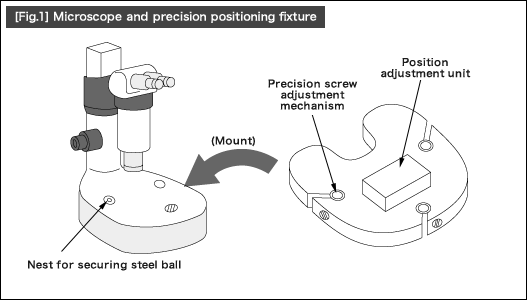
・Some devices use a microscope for precise positioning of two components. (Fig.1)
・For tasks involving setup changes, it is difficult to adjust the perpendicularity between the microscope's optical axis and the precision positioning fixture.
・One of the methods to shorten the time required for high-precision positioning is to install the precision positioning fixture on the microscope table in order to make the setup changes easier.
・The precision positioning fixture installed on the microscope table must have the following characteristics in its structure:

1. Structure allowing easy adjustment of perpendicularity between the microscope's optical axis and the precision positioning fixture
2. Superior repeatability of the fixture's installation position in relative to the microscope in every setup change
3. Simple structure enabling easy setup changes

・Fig.2 is the structural image of the item 1.
a) Prepare the precision screw adjustment mechanisms at three locations in the outer circumference of the precision positioning fixture (Fig.3)
b) Assemble (attach) the steel ball while ensuring the coaxial accuracy of the tip of the precision screw adjustment unit
c) Design the fastening structure where the precision adjustment screw is attached so as to set the screw unit in place

・In the microscope table area facing where the three precision adjustment screws are mounted, prepare a nest for securing a steel ball located on the back of the precision screw adjustment mechanism (Fig.2 and Fig.4)
・The considerate design of the three steel ball nests on the microscope table leads to excellent repeatability of the installation positions for the precision positioning fixture. (Fig.4)
・The steel ball nest comes in a set of cone, groove, and flat type models. Using these three types as one set prevents a backlash of the three steel balls during positioning.

Precautions

・The fixture's setup position can be accurately repeated by the precision screw positioning mechanism and the steel ball nests on the microscope table. However, for more precise positioning, it is recommended to adjust the cursor line of the microscope in relative to the fixture after its replacement.

[Fig.1] Example of precise positioning product (CD pickup unit)

[Fig.2] Microscope and precision positioning fixture

[Fig.3] Precision screw adjustment mechanism

[Fig.4] Shapes of three steel ball nests (lower: sectional view)

#287 Know-how on automation: Positioning -5

| No Comments | No TrackBacks

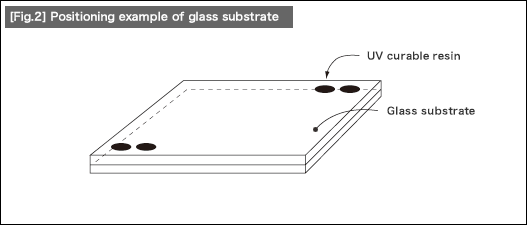
-UV curable resin is a common material used for adjusting the position of two aligned components. (Fig.1 and Fig.2)

Fig.1

Fig.2

-Adopting the UV curable resign is beneficial in terms of the following:
1) The time required for resin curing can be shortened.
2) Thermal deformation during resin curing can be avoided.
3) When using a UV permeable material (such as a glass substrate),
       the resin can be cured on the backside.

-However, Inappropriate positioning process may cause a dislocation of the components after the resin has been cured.

-The most common causes for dislocation using UV curable resin include the following:
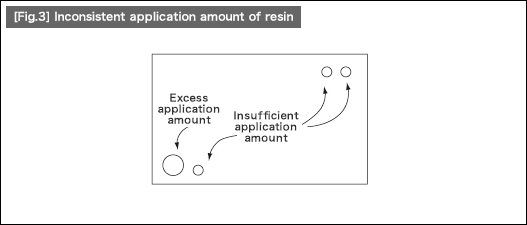
a) Inconsistent application amount of UV curable resin (Fig.3)
(Too little: Lack of strength. Too much: Dislocation caused by variations
       in cure shrinkage)

b) Varying UV curing conditions (lighting intensity X irradiation time) for
       respective application areas

c) Inconsistent adhesiveness of the adhesion sureface inconsisent
       adhesiveness of the adhesion surface

Fig.3

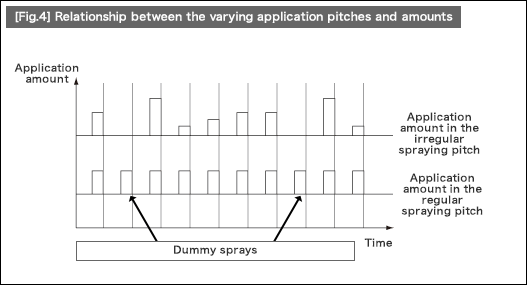
-Variations in the resin application amount are generally resulting from uneven spraying from the resin dispenser. This phenomenon occurs due to the following: i) Inconsistent viscosity of the resin; ii) Varying conditions of the resin being applied (such as viscosity, resin conditions at the dispenser head, and so on) due to changes in application pitches; iii) Changes in the properties of the resin itself.

-Variations in the UV curing conditions occur due to the reduction in illumination intensity caused by the shortened life of the UV lamp and the misaligned spray position resulting in uneven hardening.

-Variations in the adhesiveness of the bonded surface are usually caused by inconsistencies of the wet & dry cleaning quality in the previous process.

-The following table summarizes the common causes and solutions.

Causes of dislocation Common causes Solutions
a) Inconsistent application amount of resin 1) Resin application dispenser sprays uneven amount of resin 1) Stabilize the temperature surrounding the resin
Dummy spraying for stabilizing the spraying pitch of resin (Fig.4)
b) Varying UV curing conditions 1) Life of the UV lamp
2) Misalignment of resin spray position
1) Measure and control the UV light intensity
2) Stabilize the spraying position
c) Inconsistent adhesiveness of the adhesion surface 1) Dirt and smudges on the adhesion surface 1) Stabilize the wet & dry cleaning quality in the previous process
Apply primer on the adhesion surface

Fig.4

Precautions

-It is recommended to prepare a black cover to prevent the UV curable resin inside of the dispenser from being exposed to fluorescent light.

-Unstable spraying positions are generally attributable to the positioning accuracy of the workpiece being sprayed and the direction of resin released from the dispenser.

月別 Archives

Pages

Powered by Movable Type 6.0.3

About this Archive

This page is an archive of entries from May 2017 listed from newest to oldest.

April 2017 is the previous archive.

June 2017 is the next archive.

Find recent content on the main index or look in the archives to find all content.